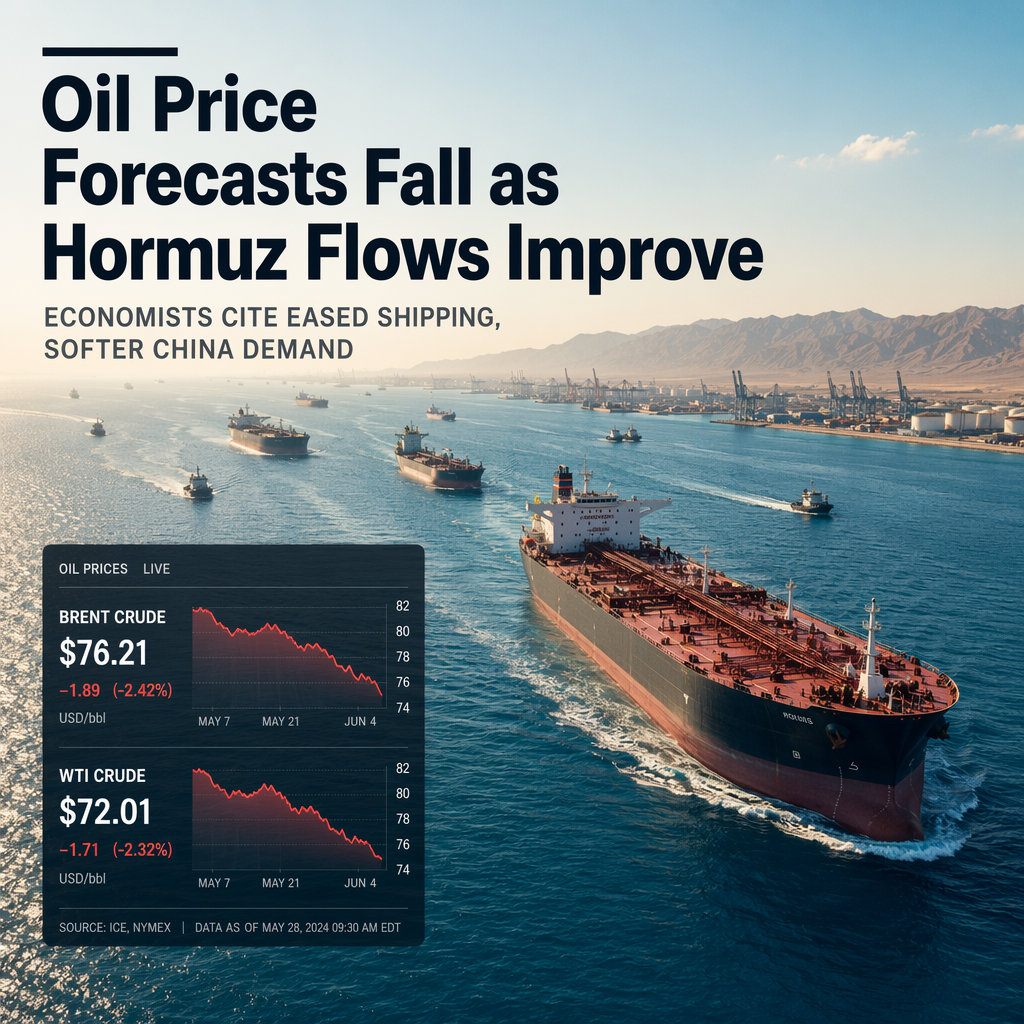
According to a Reuters poll published on Tuesday, analysts have reduced their 2026 oil price forecasts for the first time since the Iran war began, citing improvements in shipping through the Strait of Hormuz that have eased concerns over prolonged supply disruptions [1]. The poll, which surveyed 31 economists and analysts, now expects Brent crude to average $84.50 per barrel in 2026, down from the $90.44 forecast made in May. Similarly, US benchmark West Texas Intermediate (WTI) crude is projected to average $79.49 per barrel, compared with $84.63 projected last month [1].
The poll further indicates that Brent is expected to average about $84 per barrel in the third quarter of 2026, before declining to around $79 in the fourth quarter and falling to the mid-$70s by mid-2027 [1]. Global oil demand growth in 2026 is anticipated to slow to roughly 1.0 million to 2.0 million barrels per day, with analysts attributing the softer demand to weaker consumption in China, the world's largest oil importer [1].
At the time of writing, WTI trades around $70.80, returning to its March lows after fully unwinding its US-Iran war rally [1]. The article also notes that supply and demand dynamics, geopolitical events, and inventory data are key drivers of oil prices, but the current forecast revisions are primarily linked to improved shipping conditions and softer demand [1].
CONCLUSION
Economists have lowered their oil price forecasts for 2026, reflecting improved shipping through the Strait of Hormuz and weaker demand, particularly from China. The market has responded with WTI prices returning to March lows, suggesting a more bearish outlook for oil in the near to medium term.