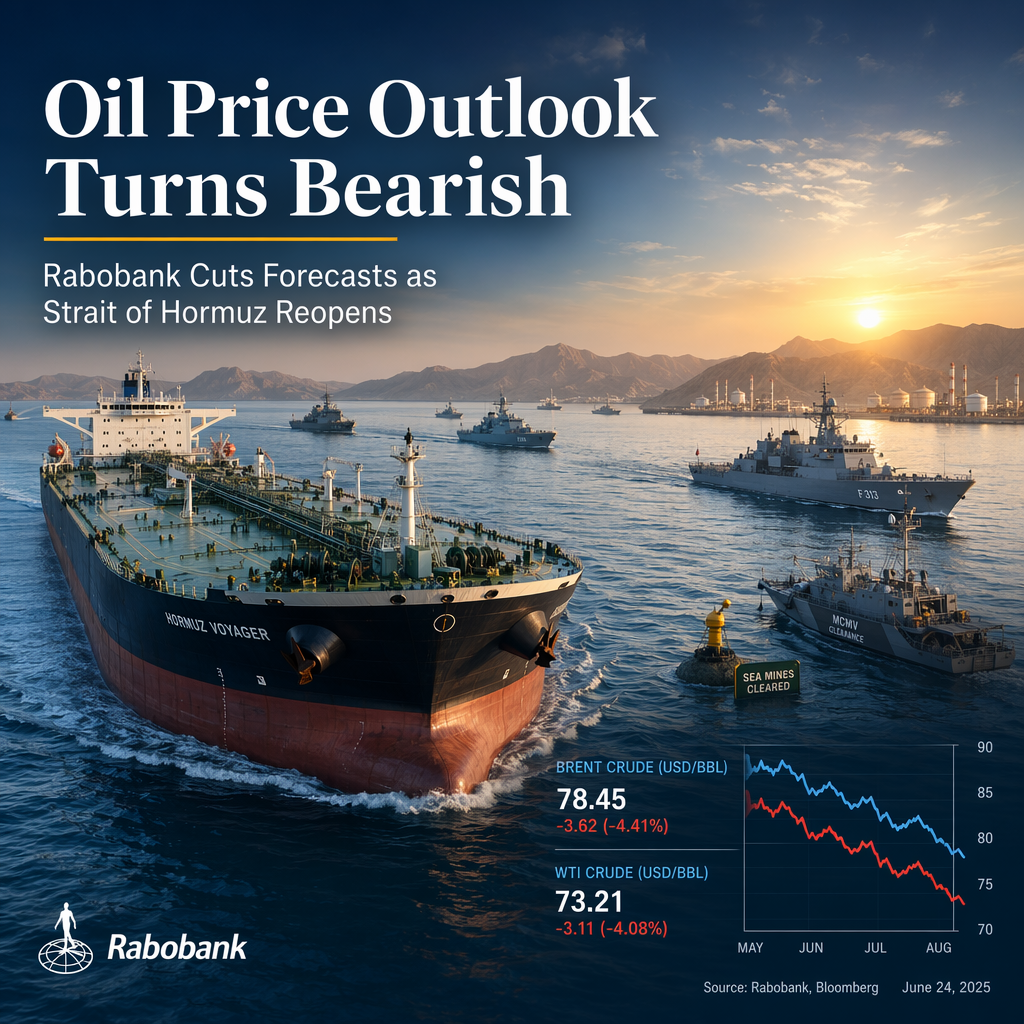
Rabobank energy strategists Joe DeLaura and Florence Schmit have revised their forecasts for Brent and WTI crude oil prices downward, following the Versailles Memorandum of Understanding (MoU) and the gradual reopening of the Strait of Hormuz [1]. The bank now projects Brent crude at $79 per barrel for Q3 2026, down from a previous forecast of $103, and $78 per barrel for Q4 2026, reduced from $93. For WTI, the new forecasts are $75.50 for Q3 2026 and $74 for Q4 2026 [1]. Rabobank anticipates a generally declining price path for both benchmarks into 2028, with Brent expected to fall to $74.50 in 2027 and $71 in 2028, and WTI to $70 in 2027 and $66.50 in 2028 [1].
The strategists attribute these downward revisions to the reopening of the Strait of Hormuz under the MoU's 60-day trial period, which is expected to clear mines and ensure the passage remains open. This development is seen as initially bearish for oil prices [1]. Additionally, the United Arab Emirates' departure from OPEC, expansion of the Fujairah pipeline, and increased oil production from South America and the United States are cited as factors contributing to the expectation of lower long-term prices, especially against a backdrop of tepid demand growth over the next three to five years [1].
Rabobank notes that, in the short term, only volatility related to the resumption of flows through the Strait of Hormuz may provide temporary support to prices. However, the overall outlook remains bearish, with prices expected to trend toward the marginal cost of U.S. production per barrel [1].
No specific market reactions or analyst opinions beyond Rabobank's own forecasts are mentioned in the article [1].
CONCLUSION
Rabobank's downward revision of Brent and WTI forecasts reflects expectations of increased supply and reduced geopolitical risk following the reopening of the Strait of Hormuz. The outlook for oil prices is bearish, with only short-term volatility expected to provide limited price support. Longer-term, prices are projected to decline toward U.S. marginal production costs.