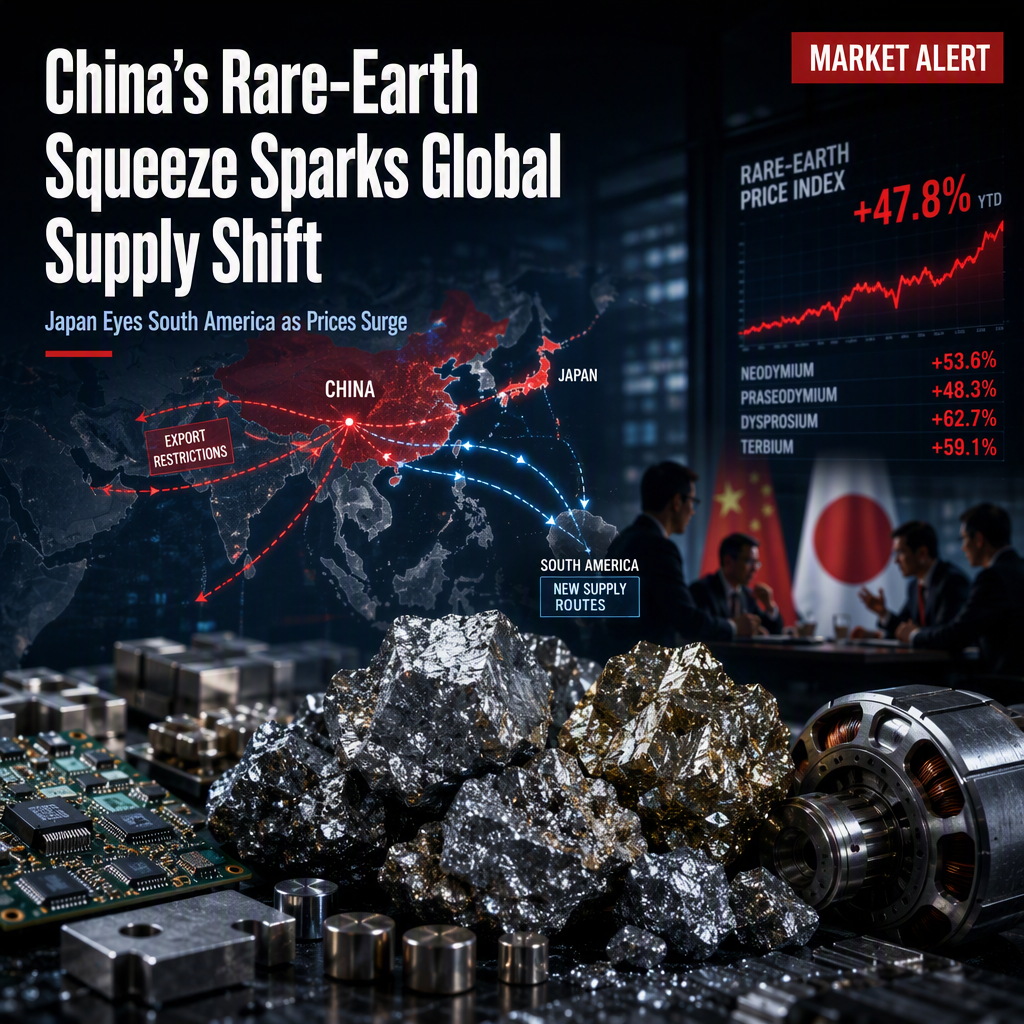
China has sharply reduced its exports of rare-earth elements to Japan and the United States in the first half of 2026, following the implementation of new export restrictions. Shipments to Japan were cut by roughly half, while exports to the U.S. dropped by nearly 30% during the January-June period, underscoring Beijing's use of its dominant position—accounting for about 70% of global rare-earth production—to exert economic and diplomatic pressure [1]. This move has had immediate market repercussions: rare-earth prices for Japanese firms surged over 20%, creating a significant price gap and exacerbating supply chain challenges for countries reliant on Chinese rare earths [1]. Technical analysis indicates heightened price volatility, with resistance levels rising and support levels threatened by ongoing diplomatic tensions [1].
Industry observers and market analysts have expressed growing concern about the reliability of China's rare-earth supply, advising buyers to seek alternative sources and closely monitor price developments. The supply squeeze is opening opportunities for other producers, and Japanese companies are responding by investing in seabed extraction and diversifying their supply chains [1]. Quotes from industry officials highlight the urgent need for Japan and the U.S. to reduce their dependence on Chinese rare earths and brace for continued price volatility. Analysts forecast that the export restrictions are likely to persist, with further upward pressure on prices and increased market bifurcation expected [1].
In response to these developments, Japan is actively pursuing new resource partnerships in South America. Japanese Foreign Minister Toshimitsu Motegi met with Ecuador's Foreign Minister Roberto Kury Pesantes on August 6 to discuss diversifying Japan's sources for crude oil and rare earths [2]. This outreach follows a preliminary agreement with the Mercosur trade bloc, signaling Japan's intent to deepen ties with resource-rich countries such as Brazil, Argentina, Paraguay, and Uruguay [2]. Negotiations with Ecuador are expected to focus on facilitating investment and reducing tariffs on exports like crude oil and copper, aligning with Japan's broader strategy to hedge against supply chain disruptions and geopolitical risks [2].
Market participants believe that increased cooperation with Ecuador and Mercosur could provide Japanese companies with access to new resource streams and help stabilize commodity prices amid ongoing volatility and competition from China and the U.S. [2]. A Japanese trade official emphasized the importance of securing diversified resource channels for Japan's economic resilience, noting South America's significant potential as a supplier [2]. Analysts expect that formal trade agreements could positively impact Japanese conglomerates involved in resource trading and downstream industries reliant on stable raw material supplies [2].
No relevant information on rare-earth exports or market reactions was provided in the third source, which focused on Chinese drone exports [3].
CONCLUSION
China's rare-earth export restrictions have triggered a sharp supply reduction and price surge for key importers like Japan and the U.S., intensifying concerns over supply chain security. In response, Japan is accelerating efforts to diversify its resource base through new trade partnerships in South America. The market is bracing for continued volatility and upward price pressure as countries seek alternatives to Chinese rare earths.