
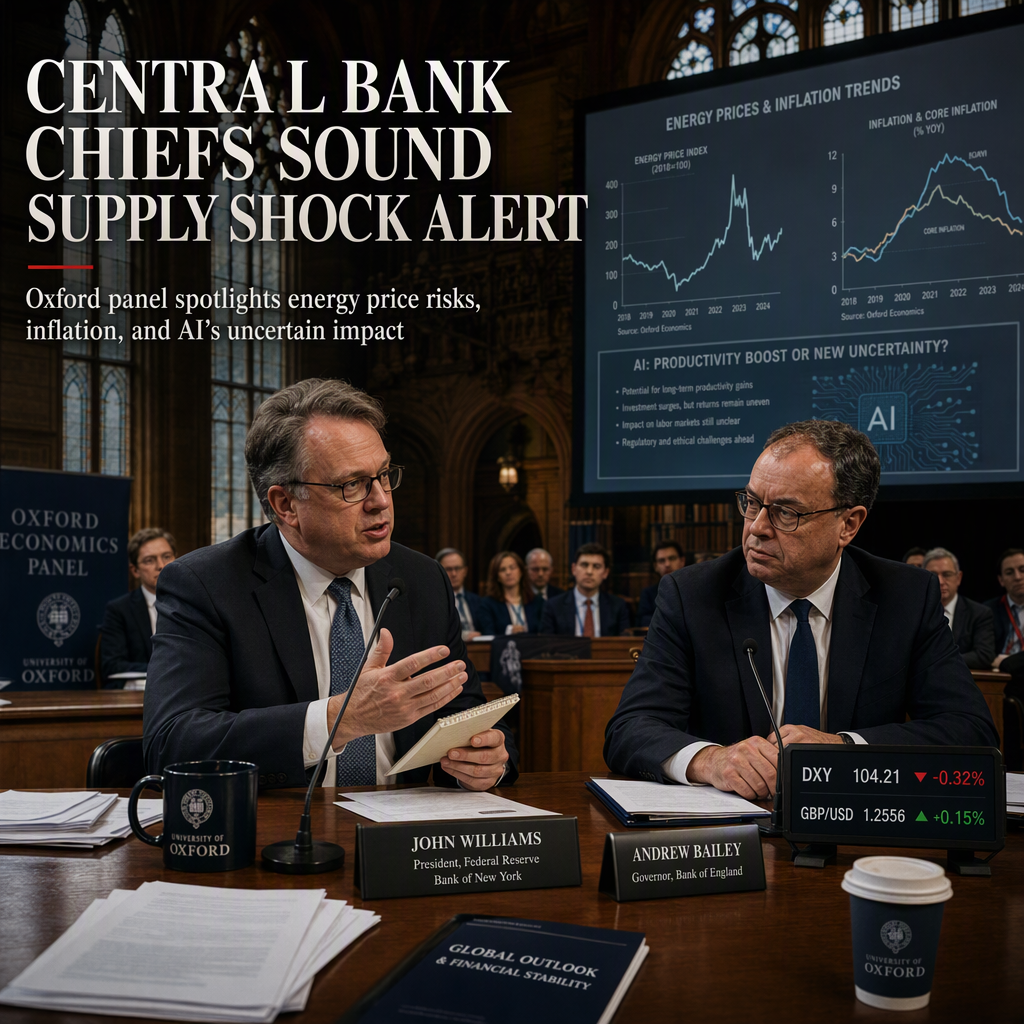
At a panel discussion held at Oxford University on Friday, central bank leaders from both the United States and the United Kingdom addressed the ongoing challenges posed by persistent supply shocks and elevated energy prices. John Williams, President of the New York Federal Reserve, emphasized that while tariffs and higher energy prices do not typically result in sustained inflation, repeated supply shocks are currently maintaining upward pressure on prices. Williams stated, 'Can't ignore persistent supply shocks,' and clarified that the labor market is not a source of inflationary pressure at this time. He also noted that the Federal Reserve should ensure that these shocks do not become entrenched in the economy. Additionally, Williams remarked that there has not yet been a noticeable productivity impact from artificial intelligence (AI) [1].
Simultaneously, Bank of England Governor Andrew Bailey highlighted that the pass-through from higher energy prices to broader inflation has so far been 'quite subdued,' but cautioned that it is still early to draw definitive conclusions. Bailey warned that if energy prices remain elevated for an extended period, it will become increasingly difficult for the Bank of England to maintain its current stance of not raising interest rates. He also mentioned that the central bank considers the rise in mortgage rates when assessing economic and monetary conditions. Looking ahead, Bailey expressed optimism about AI, suggesting it could deliver a positive supply shock at a time when economies are grappling with a series of negative supply shocks [2].
In terms of market reaction, Williams' comments were followed by a slight extension of losses in the US Dollar Index (DXY), which was down 0.2% to near 101.05 at the time of reporting [1]. In contrast, Bailey's remarks had no immediate impact on the British Pound, with GBP/USD gaining 0.15% and trading just below the 1.3240 level [2].
Both central bankers underscored the importance of monitoring supply-side developments and the potential implications for monetary policy. While Williams downplayed the role of the labor market and tariffs in driving inflation, Bailey focused on the risks posed by sustained high energy prices and the potential for AI to alter the supply landscape in the future.
CONCLUSION
Central bank leaders from the US and UK are closely monitoring persistent supply shocks and high energy prices, warning of their potential to influence inflation and monetary policy decisions. While immediate market reactions were muted, the comments highlight ongoing uncertainty and the need for vigilance as global economies navigate evolving supply-side challenges.