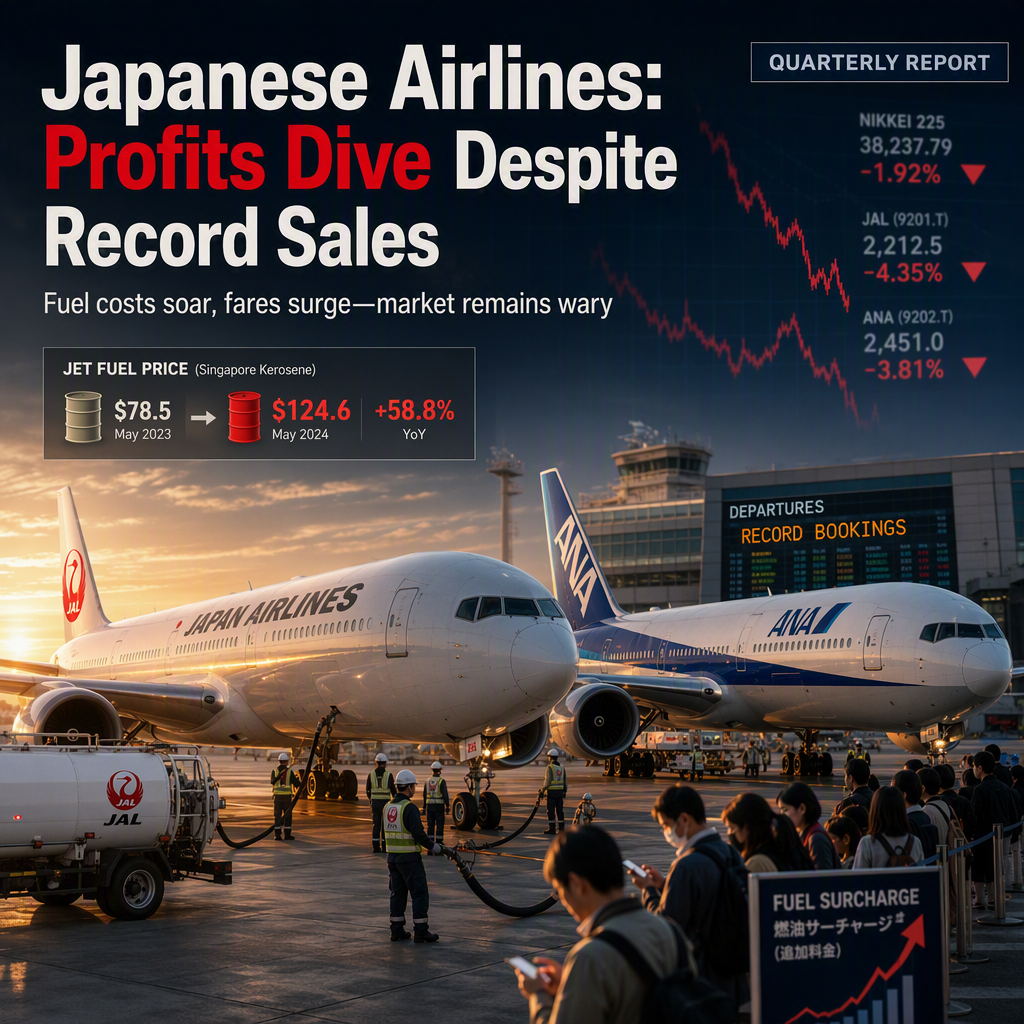
Japan Airlines (JAL) and All Nippon Airways (ANA), the two largest commercial passenger airlines in Japan, have reported record sales for the recent quarter, driven by robust demand and a surge in Golden Week bookings [1]. Despite this strong top-line performance, both airlines experienced significant declines in profitability due to elevated jet fuel prices, which have been attributed to the ongoing Iran war [1]. JAL announced an 80% fall in quarterly profit, while ANA Holdings reported a 15% drop in net profit for the first quarter, both citing soaring fuel costs as the primary factor impacting their bottom lines [1].
In response to the sustained rise in jet fuel prices, both JAL and ANA have implemented record-high fare surcharges since April and have set new surcharges for the July-August Japan travel season [1]. Additionally, the airlines have revamped their domestic fare structures, making them increasingly similar to budget carriers [1]. These measures, however, have put pressure on their frequent flyer miles programs, as higher surcharges reduce their attractiveness to travelers [1].
To counteract the challenging fuel cost environment, JAL is considering upgrades to its miles program aimed at boosting non-aviation businesses and diversifying revenue streams [1]. Despite the robust demand for air travel, the market sentiment for Japanese airline stocks remains cautious, reflecting concerns over the impact of sustained high fuel prices on profit margins [1].
CONCLUSION
Japanese airlines are facing a challenging environment where record sales are being offset by soaring fuel costs, leading to sharp declines in profits. While demand for air travel remains strong, market sentiment is cautious due to concerns about the long-term impact of high fuel prices on profitability.