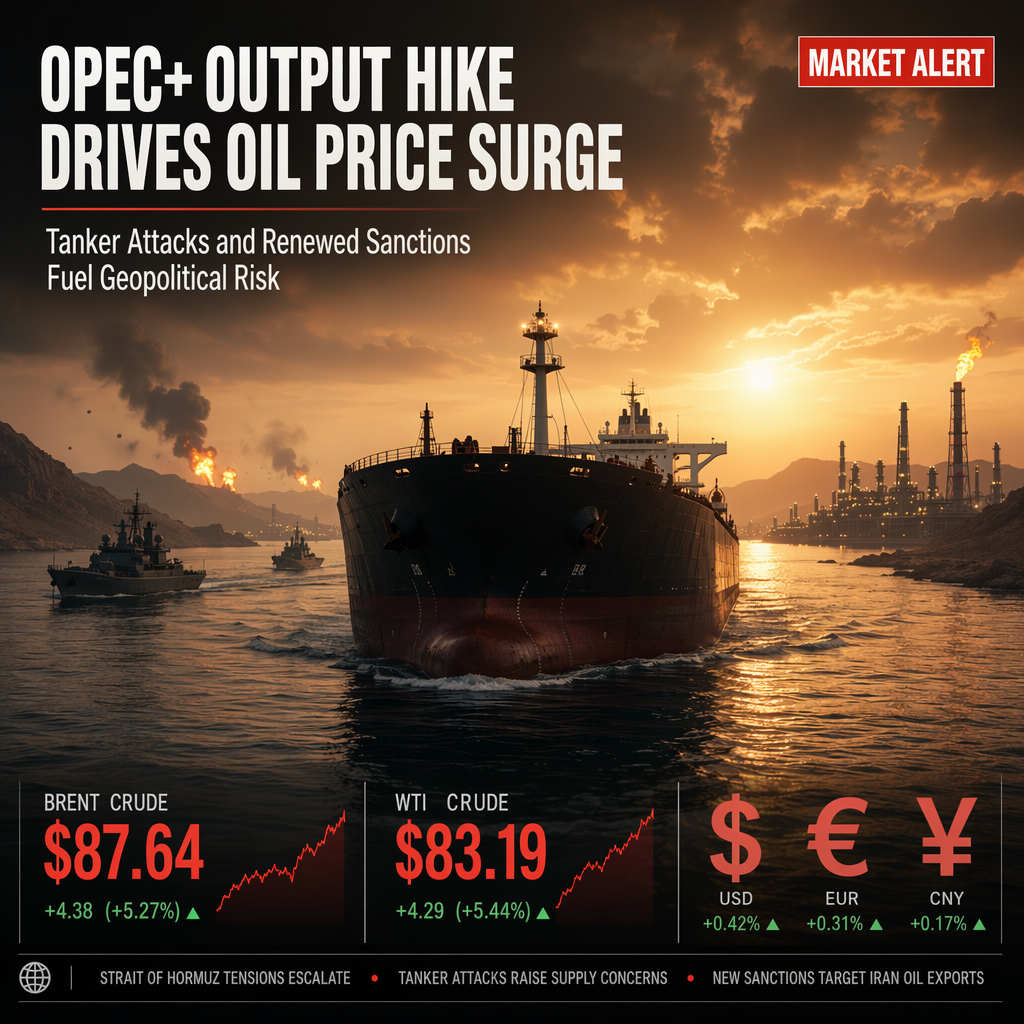
Over the weekend, OPEC+ approved a production increase of 188,000 barrels per day for August, with Saudi and UAE exports returning to near pre-conflict levels. This supply-side development was accompanied by Saudi Aramco slashing its official selling price for Asian buyers by $11 a barrel, widening the discount to the regional benchmark to $1.50. Such aggressive price cuts were last seen during the 2015 and 2020 oil price wars, signaling expectations of an oversupplied market. The fundamental case for lower oil prices is reinforced by the OPEC+ output hike and recovering Gulf exports [1].
However, the market narrative shifted dramatically following reports that Iranian forces struck a Qatari liquefied natural gas tanker and fired on other commercial vessels near the Strait of Hormuz. In response, the U.S. Treasury revoked a government waiver that had allowed Iran to legally sell oil despite sanctions. These events occurred in a region where tanker traffic had only recently begun to normalize after disruptions earlier in the year due to the Iran-Israel-U.S. conflict. The attacks and renewed sanctions injected significant geopolitical risk into the market [1].
As a result, WTI crude, which had been trading near four-month lows around $68 a barrel, surged above $71, while Brent crude climbed past $74. The market reaction reflects a sharp increase in the risk premium, as traders priced in not only the immediate impact of the attacks and sanctions but also the heightened uncertainty and potential for further escalation. The underlying supply picture remains loose, but geopolitical fears have temporarily overridden bearish fundamentals, driving prices higher [1].
The analysis suggests that both supply and demand factors are exerting opposing pressures on oil prices. While fundamentals point to a potential glut, the risk premium associated with instability in the Strait of Hormuz is currently dominating market sentiment. Traders are advised to monitor headlines for further developments, as the balance between these forces will determine future price direction [1].
CONCLUSION
The oil market is currently caught between bearish supply fundamentals and bullish geopolitical risks. While OPEC+ output increases and aggressive price cuts suggest an oversupplied market, recent tanker attacks and renewed U.S. sanctions on Iran have sharply raised the risk premium, pushing prices higher. Market participants should remain alert to further developments in the region, as ongoing uncertainty could continue to drive volatility.