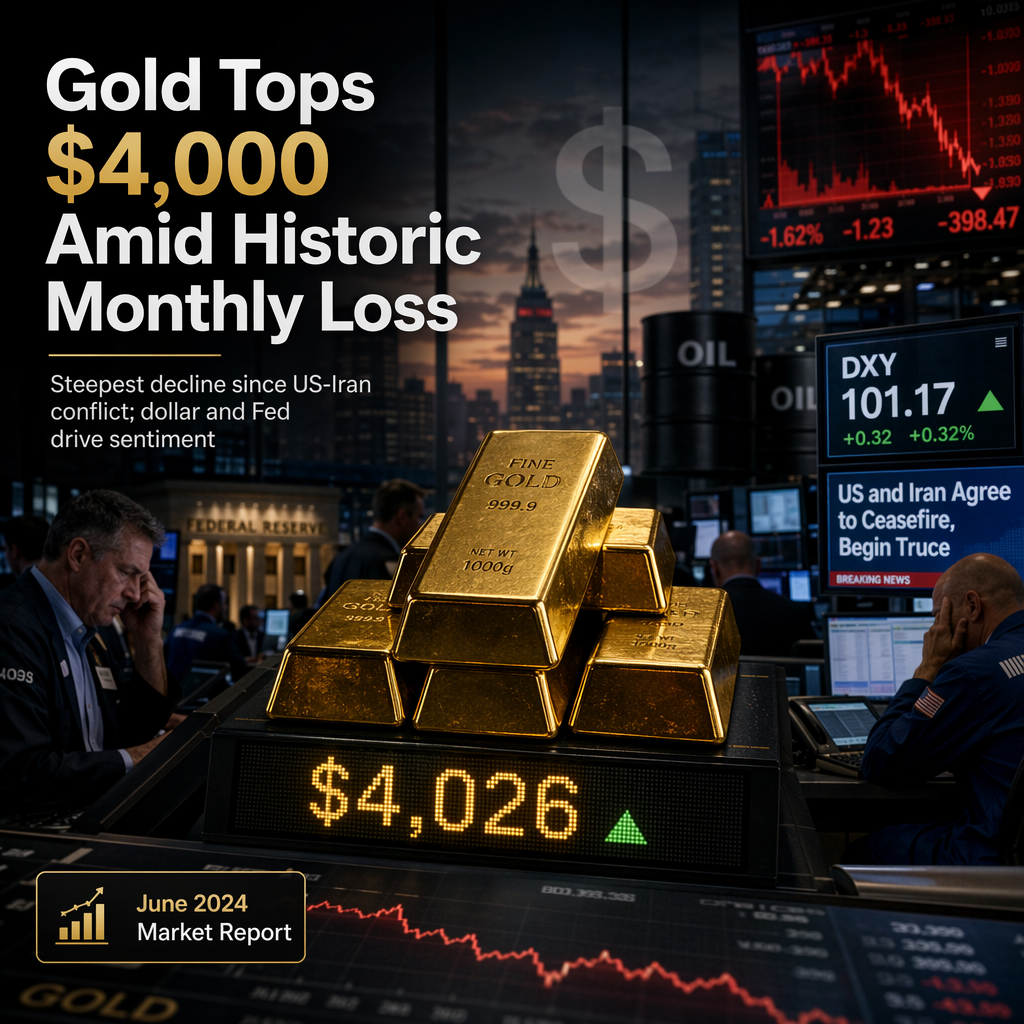
Gold (XAU/USD) posted a modest gain of 0.35% on Tuesday, trading at $4,026 after rebounding from an eight-month low of $3,942 earlier in the day. Despite this uptick, gold is set to close June with a significant monthly loss of over 11%, having retreated from highs near $4,500 to current levels, primarily due to the strengthening US Dollar and the aftermath of the US-Iran war, which initially drove oil prices higher and supported the Greenback [1].
The US-Iran conflict was identified as the main catalyst for gold's sharp decline in June. Although a Memorandum of Understanding (MOU) was signed to end hostilities and oil prices have since eased, gold failed to recover as expectations grew that major central banks, particularly the Federal Reserve, could raise interest rates. This speculation has buoyed the US Dollar Index (DXY), which rose 0.07% to 101.17, and pushed the US 10-year Treasury yield up by 3.5 basis points to 4.412% [1]. Money markets are pricing in 35 basis points of Fed tightening by December 2026, though no policy change is expected in July [1].
Cleveland Fed President Beth Hammack reinforced a hawkish stance, stating that inflation remains too high and that the Fed may need to consider further rate hikes if consumer data remains strong. Recent US data showed JOLTS job openings unexpectedly increased to 7.594 million in May, surpassing forecasts and April's revised figure, while consumer confidence improved in June as the US-Iran truce drove gasoline prices lower [1].
Technically, gold remains in a downtrend, with a series of lower highs and lows. The Relative Strength Index (RSI) is bearish, though it indicates that selling pressure has eased slightly. For a bullish reversal, gold would need to break above $4,100, with further resistance at $4,220 and $4,280 [1].
CONCLUSION
Gold's modest recovery above $4,000 has not offset its steep monthly decline, driven by a stronger US Dollar and expectations of higher interest rates. Market sentiment remains bearish, with technical indicators pointing to continued downside unless key resistance levels are breached. Investors are closely watching upcoming US employment data for further direction.