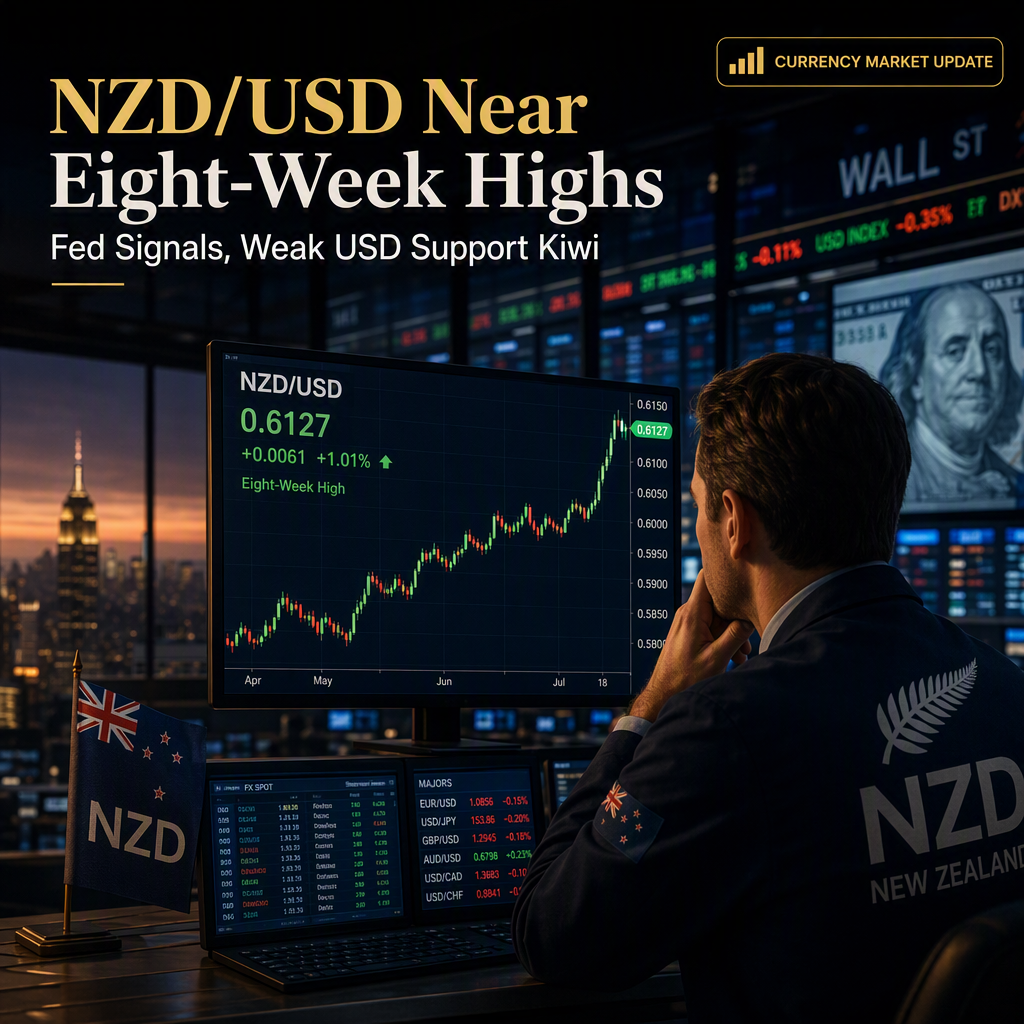
The New Zealand Dollar (NZD) traded lower against the US Dollar (USD) on Friday but remained steady near eight-week highs at 0.5885, with downside attempts contained above a previous resistance area at 0.5860 [1]. Over the week, the NZD rallied nearly 1.5%, making it the strongest major currency against the USD, a move attributed to a weaker USD following the Federal Reserve’s monetary policy meeting on Wednesday [1]. The Fed left its Federal Funds Rate unchanged at the 3.50%-3.75% range, as expected, but the lack of guidance from Chairman Warsh was interpreted by markets as a dovish signal, leading to a broad decline in the USD against its main peers [1].
On Friday, the NZD lost some momentum after Chinese NBS Manufacturing PMI figures showed an unexpected contraction in business activity for July, attributed to weak domestic demand and the disruptive impact of typhoons [1]. Given China’s status as New Zealand’s major trading partner, the NZD is closely correlated to Chinese economic growth [1].
From a technical perspective, NZD/USD trades at 0.5875, maintaining a constructive near-term bias. However, overbought Relative Strength Index (RSI) levels above 70 suggest the pair may be ripe for a deeper correction, even as the Moving Average Convergence Divergence (MACD) remains above its signal line, indicating that upside pressure is still present [1]. Key support is seen between the ascending trendline from June 25 lows at 0.5785 and the July 23, 27, and 29 lows around 0.5865, while resistance lies above Thursday's highs at 0.5885, with further resistance at the 78.6% Fibonacci retracement of the June sell-off at 0.5911 and June's peak near 0.6000 [1].
The NZD was the strongest major currency against the USD this week, appreciating by 1.22% against the USD, 0.14% against the EUR, and 0.29% against the GBP, while declining 0.77% against the JPY [1].
CONCLUSION
The NZD/USD pair remains supported near recent highs, buoyed by a weaker USD following the Fed's dovish stance, though momentum has slowed due to weak Chinese economic data. Technical indicators suggest the pair is overbought, with potential for a correction, but the overall trend remains constructive in the near term.