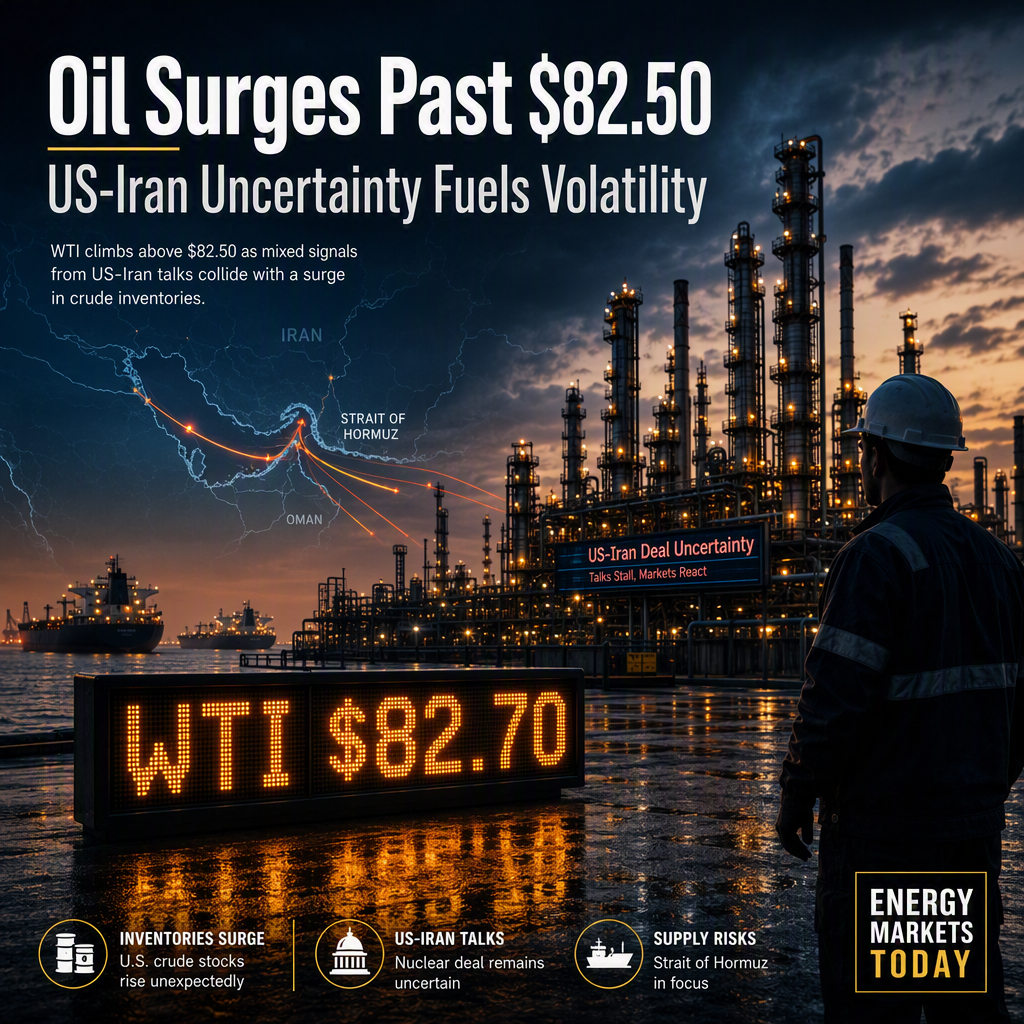
West Texas Intermediate (WTI) crude oil extended its gains for the third consecutive day, trading around $82.70 per barrel during Asian hours on Wednesday, as investors responded to mixed signals regarding a potential deal between the United States and Iran [1]. Initial market sentiment was buoyed by comments from Pakistan’s defence minister, who suggested that Washington and Tehran were 'close to some sort of arrangement' to secure the critical Strait of Hormuz, and by reports that parallel talks between Iran and Oman had reached an advanced stage [1].
However, optimism was dampened by escalating rhetoric from the White House. US President Donald Trump took a firmer stance, demanding that Tehran pay reparations for victims of attacks linked to the Islamic Republic, in response to Iran’s weekend demands for war compensation following US and Israeli military operations in the region [1]. Analysts at Commerzbank noted that hopes for a new agreement between Iran and the US and for the reopening of the Strait of Hormuz are fading, as both sides have hardened their positions. This entrenchment is contributing to a geopolitical risk premium in the energy complex, reinforcing Brent’s move toward $90 per barrel and gas oil toward nearly $1,350 per ton, and tightening the backdrop for European diesel markets [1].
Adding to the uncertainty, US inventory data from the American Petroleum Institute (API) showed a significant bearish surprise: US weekly crude oil stocks surged by 9.1 million barrels last week, compared to market expectations of a 0.5 million barrel decline. This marks the largest inventory increase since February [1]. Despite this bearish inventory data, the geopolitical risk premium has continued to support oil prices [1].
CONCLUSION
WTI oil prices have advanced above $82.50 per barrel, driven by geopolitical tensions and mixed signals over a potential US-Iran deal, despite a significant increase in US crude inventories. The market remains focused on the evolving diplomatic situation and the entrenched risk premium, which is supporting prices even in the face of bearish supply data.