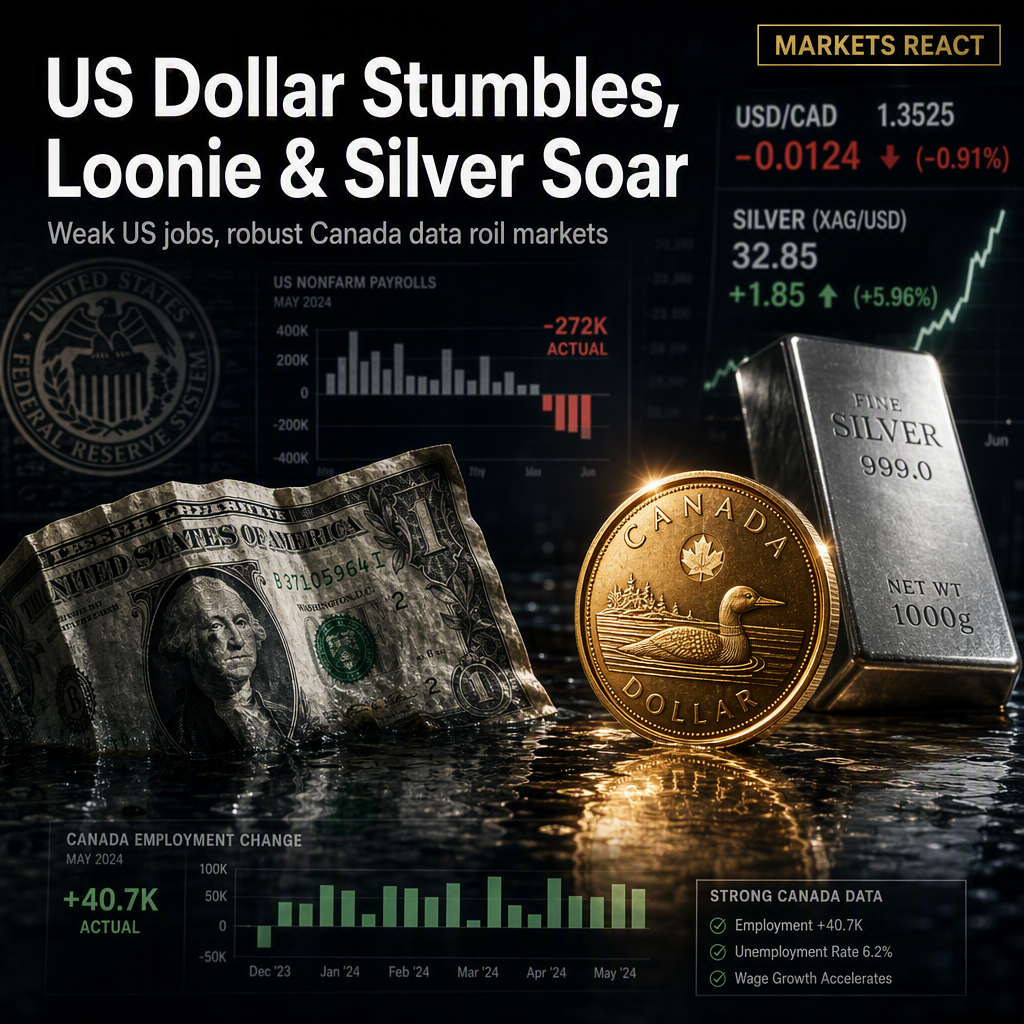
A significant divergence in North American labor market data on Friday triggered sharp moves in currency and commodity markets. The US Bureau of Labor Statistics reported that Nonfarm Payrolls (NFP) fell by 23,000 in July, far below expectations for an 80,000 increase, with downward revisions to May and June totaling 103,000 jobs. Despite this, the US unemployment rate edged down to 4.1% from 4.2%, primarily due to a drop in the participation rate, and average hourly earnings growth slowed to 3.2% year-on-year from 3.5% [1][2][3][6]. The disappointing US jobs data led to a swift decline in the US Dollar Index (DXY), which dropped 0.36% to 99.58, and US Treasury yields, with the 10-year note yield falling by 3.5 basis points to 4.637% [2][6].
In contrast, Canadian labor market data surprised to the upside. Statistics Canada reported a 75,100 increase in employment for July, well above forecasts of 15,000–20,000, and the unemployment rate fell to 6.4%, despite a rise in the labor force participation rate to 65.1% [1][5]. The private sector led job growth, with an even split between full- and part-time employment, and hours worked rose 0.6% month-on-month. Wage growth in Canada slowed to 3.0% year-on-year [5]. This robust Canadian data pushed the Canadian Dollar sharply higher, with USD/CAD dropping below the 1.40 support level to trade around 1.3940, its lowest since June, down 0.53% on the day [1][5].
Market expectations for central bank policy shifted notably. The probability of a 25-basis-point Federal Reserve rate hike in September fell to 42% from 55% a day earlier, and money markets now see nearly a 70% chance of a hold, down from 42% previously [1][2][3][6]. ING and TD Securities analysts both expect the Fed to remain on hold, with ING projecting an extended pause well into 2027, pending further jobs and inflation data, and TD Securities expecting the Bank of Canada to stay on hold through 2026 [3][5]. Richmond Fed President Thomas Barkin described the US labor market as being in 'weak balance' with 'low hiring and low firing,' and noted that corporate earnings remain strong, which he is monitoring for potential impacts on jobs [1][2][4].
The sharp divergence in US and Canadian payrolls also impacted other markets. Silver (XAG/USD) surged nearly 4% to around $63.94, breaking above its 50-day Simple Moving Average, as the weaker US Dollar and lower yields reduced the opportunity cost of holding non-yielding assets [6]. Technical analysis suggests a bullish near-term bias for silver, with resistance at $65 and support at $62 [6].
Looking ahead, traders are focused on the upcoming US Consumer Price Index (CPI) release on August 12, with economists projecting a slight drop in inflation. The outcome of this data, along with the next jobs report and the Jackson Hole Symposium, will be crucial for shaping future Fed policy decisions [2][3][5].
CONCLUSION
The stark contrast between weak US and strong Canadian employment data led to a sharp decline in the US Dollar and a rally in the Canadian Dollar and silver prices. Markets have scaled back expectations for near-term Fed rate hikes, while analysts anticipate both the Federal Reserve and Bank of Canada will remain on hold for an extended period. Attention now turns to upcoming US inflation data, which will be pivotal for future monetary policy direction.