
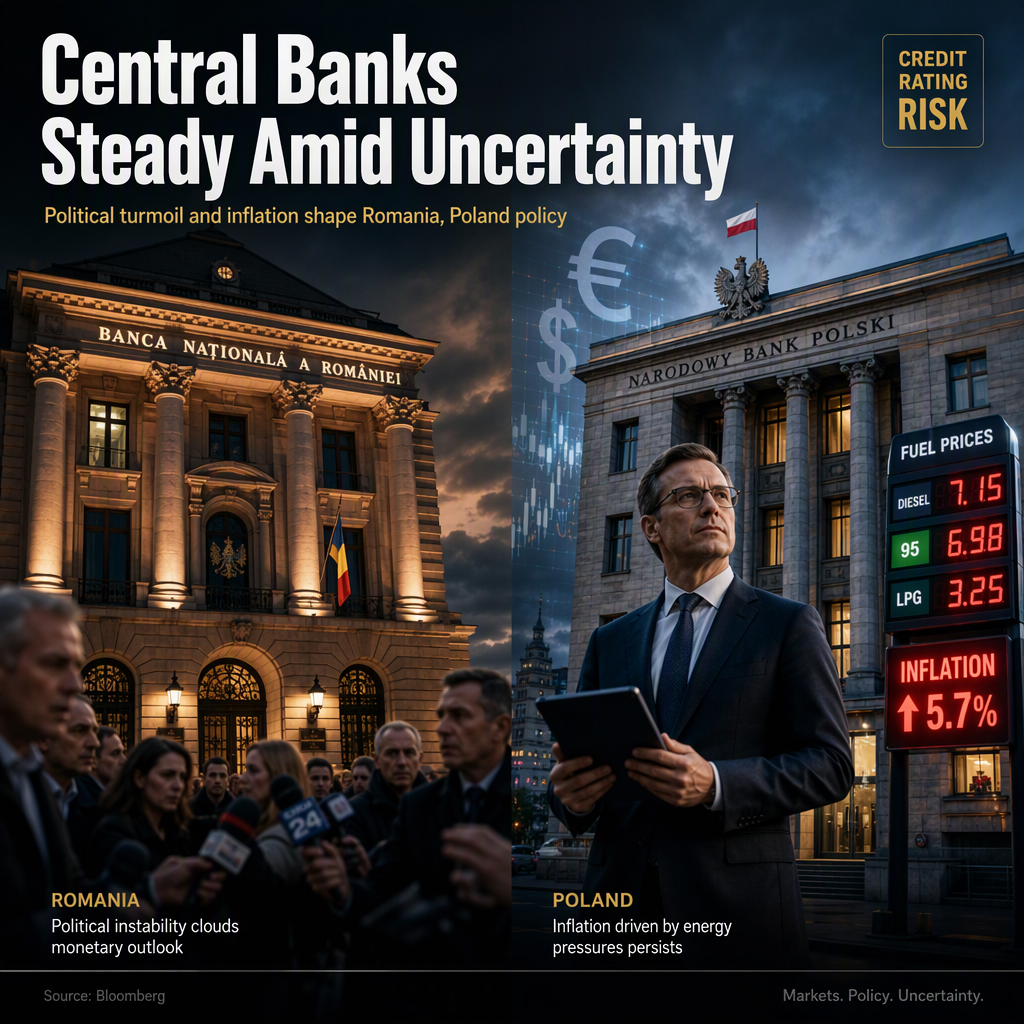
The National Bank of Romania (NBR) is expected to maintain its policy rate at 6.50%, according to Societe Generale, as ongoing political deadlock in Bucharest and weakness in the Romanian Leu (RON) counterbalance a significant decline in inflation. Headline CPI in Romania dropped from a peak of 10.85% year-on-year in May to 6.17% in August, primarily due to base effects. Despite this sharp fall in inflation, uncertainty surrounding government formation persists, with President Dan nominating diplomat Luca Niculescu as Prime Minister after a failed confidence vote for the previous nominee. Niculescu has until the 15th to form a cabinet and secure parliamentary approval, but his nomination has been met with resistance from the Social Democrats, the largest party in parliament. Prolonged political turmoil is flagged as a risk to Romania’s Investment Grade rating, with S&P affirming the country’s BBB− rating but warning of a potential downgrade if fiscal consolidation is delayed. Moody’s also indicated that the coming weeks will be crucial in determining the durability of fiscal adjustments necessary to maintain the current rating [1].
In Poland, the National Bank of Poland (NBP) kept its reference rate unchanged at 3.75% in October, as anticipated by ING economists Rafal Benecki and Adam Antoniak. The recent rise in inflation is attributed mainly to higher fuel prices, and the current environment allows the Monetary Policy Council (MPC) to keep rates on hold for several months. ING forecasts only modest, preventive tightening in early 2027, with potential rate hikes of 25–50 basis points, which is significantly less than the 100 basis points currently priced in by markets. The economists note that while second-round inflationary effects from high energy prices have not yet materialized in Poland, they are beginning to appear in the Czech Republic. The MPC is expected to review the latest macroeconomic projections in November, which could prompt discussions about the need for tighter policy. ING’s baseline scenario anticipates two 25bp rate hikes in the first quarter of 2027 to mitigate the risk of entrenched inflation, especially as core inflation is forecast to rise in the coming months. However, the overall scale of tightening is expected to be much smaller than market expectations [2].
Both countries’ central banks are opting for a cautious approach, holding rates steady despite differing underlying pressures—political instability and currency weakness in Romania, and energy-driven inflation in Poland. Forward-looking statements from analysts highlight the importance of political developments in Romania for its credit rating, and the likelihood of only limited monetary tightening in Poland over the medium term [1][2].
CONCLUSION
Central banks in both Romania and Poland are maintaining their current policy rates amid distinct domestic challenges. While Romania faces political uncertainty that could impact its credit rating, Poland is expected to see only modest rate hikes in the coming years despite inflationary pressures. Market participants should monitor political developments in Romania and inflation trends in Poland for future policy shifts.