
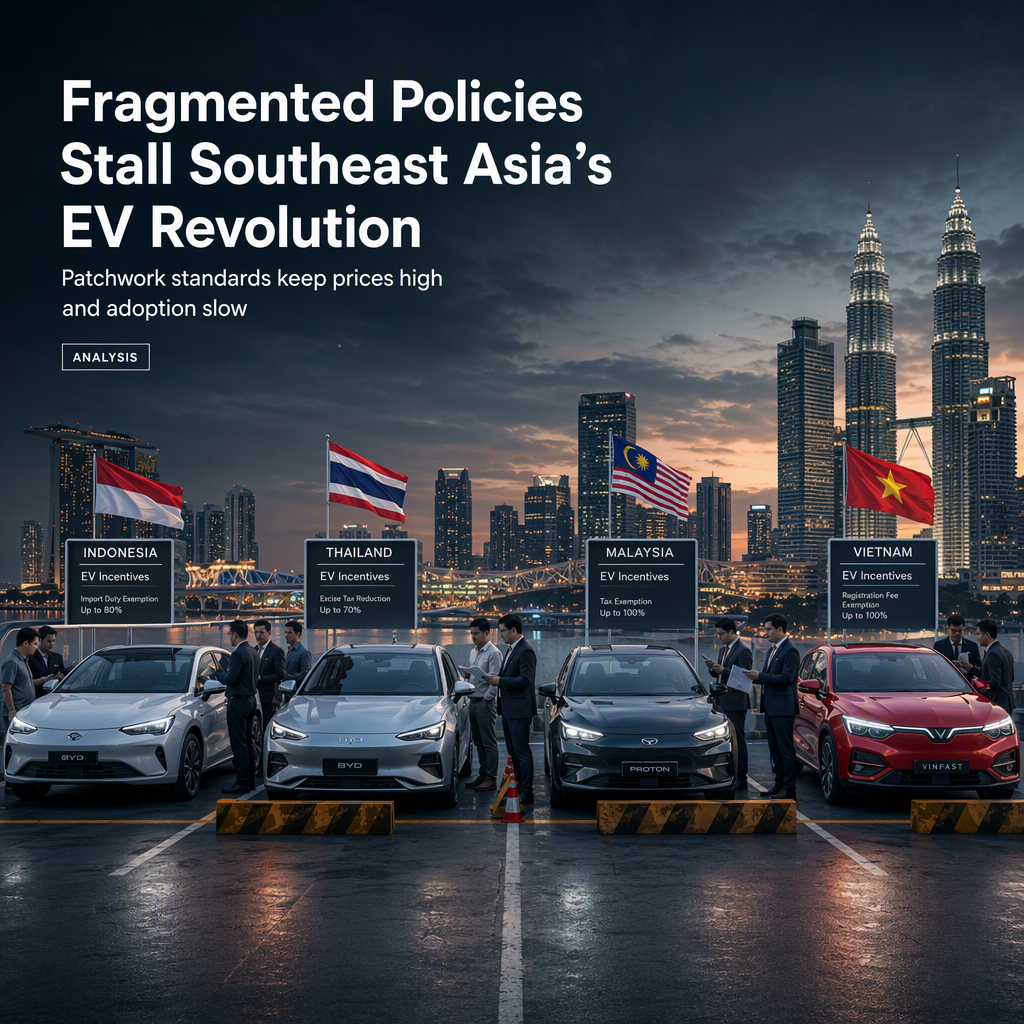
Southeast Asian governments are rapidly advancing their ambitions to build domestic electric vehicle (EV) industries, with major economies such as Indonesia, Thailand, Malaysia, and Vietnam announcing ambitious targets for EV production and adoption [1]. Thailand aims to produce 725,000 EVs annually by 2030, representing 30% of its total vehicle output, while Indonesia has set a goal of 2 million EVs on its roads by 2030 [1]. Malaysia and Vietnam are also rolling out incentives to attract investment from both Chinese and Western automakers [1].
Despite these efforts, the region faces significant challenges due to fragmented government policies and a lack of unified market standards. Each country is pursuing its own EV strategy, resulting in a patchwork of standards, production facilities, and supply chains. This fragmentation forces automakers to customize models for each market, raising production costs and slowing the introduction of affordable EVs [1]. An industry executive noted that the cost of manufacturing EVs in Southeast Asia remains higher than in China, primarily due to the lack of regional coordination [1].
Industry analysts warn that without greater regional cooperation, economies of scale will be difficult to achieve, keeping EV prices high for consumers and potentially slowing adoption rates [1]. Subsidies for EV purchases are available but are often limited and may not sufficiently offset the higher prices caused by fragmented markets [1]. This lack of affordable EV options could undermine Southeast Asia’s goals for reducing emissions and cutting reliance on imported fossil fuels [1].
Experts are urging governments in the region to harmonize standards, streamline regulations, and promote cross-border investments in EV manufacturing. Without such coordination, Southeast Asia risks lagging behind other markets and missing out on both environmental and economic benefits [1].
CONCLUSION
Southeast Asia's fragmented EV policies are raising production costs and keeping prices high for consumers, threatening the region's ambitious adoption targets. Analysts emphasize that greater regional cooperation is essential to achieve economies of scale and unlock both environmental and economic benefits. Without harmonization, Southeast Asia risks falling behind in the global EV race.