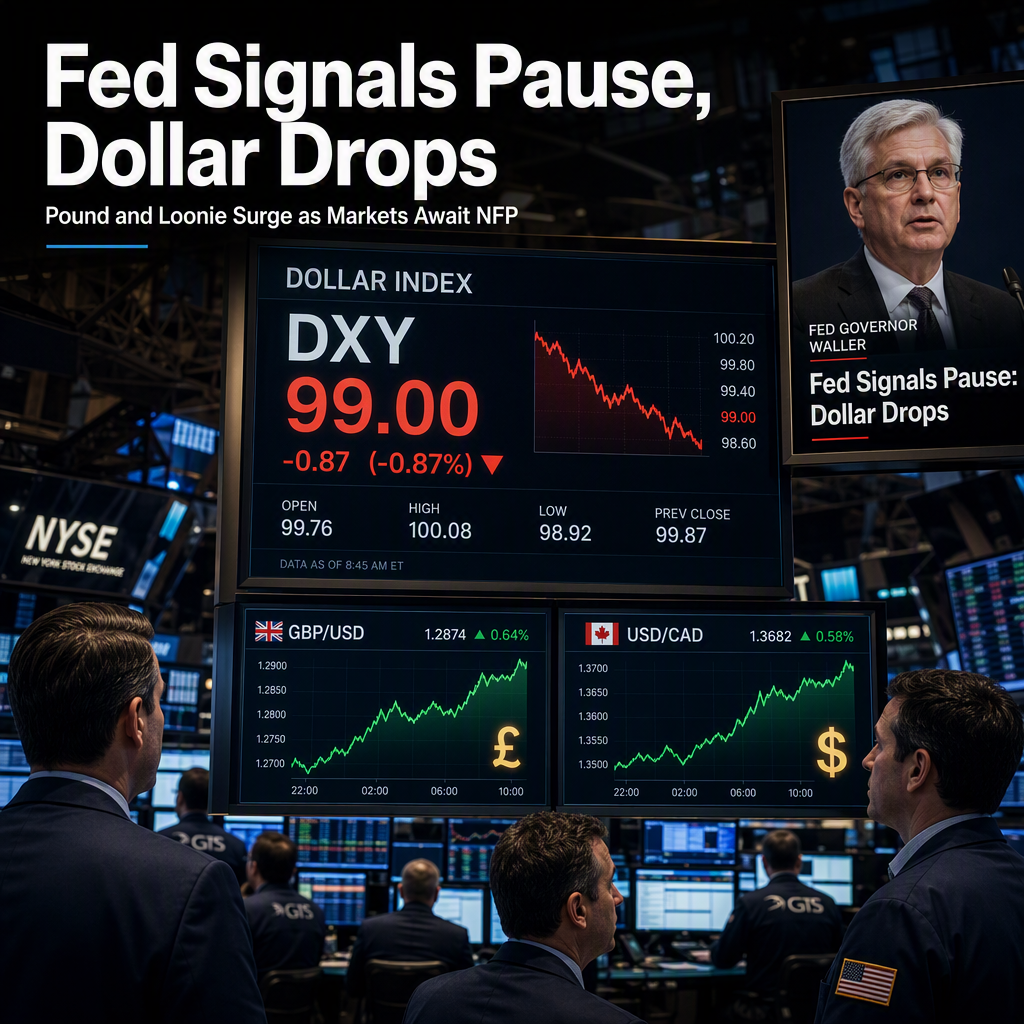
Federal Reserve Governor Christopher Waller's comments on Thursday signaled a more neutral stance on US monetary policy, stating that he favors holding the Fed funds rate unchanged if upcoming inflation data shows cooling, but remains open to a rate hike should inflation surprise to the upside [1][2]. This shift led to a repricing in money markets: the probability of a 25-basis-point rate hike at the next Fed meeting dropped from over 60% to 54% according to one source [1], and from 63% to 48% according to another [2], reflecting some discrepancy in market estimates. Waller also noted he is 'finally seeing some signs of disinflation in recent data' and that the September rate decision will depend on August inflation figures [2].
The US Dollar weakened broadly in response to Waller's dovish tone and a sharp rally in the Japanese Yen, with the US Dollar Index (DXY) falling to around 99.00, near a one-week low, after peaking at 99.86 on Wednesday [2]. The Pound Sterling (GBP/USD) rose 0.37% to 1.3535, benefiting from both the softer US Dollar and hawkish comments from Bank of England Chief Economist Huw Pill, who reiterated the need to raise the Bank Rate to 4% to counter potential inflationary dynamics [1]. The Canadian Dollar (USD/CAD) also extended gains, trading at 1.3785, its lowest level in over a week, supported by the Bank of Canada's hawkish hold and rising oil prices [2].
US economic data released Thursday showed the ISM Services PMI for August at 55.4, beating forecasts of 54.3 and July’s 54.1, with sub-components indicating higher prices and a stabilized, though still contracting, jobs market [1][2]. Initial Jobless Claims rose slightly to 206,000, just above expectations [1][2]. In Canada, the Bank of Canada kept its policy rate at 2.25% for a seventh consecutive meeting but warned that 'the upside risks to inflation have increased,' prompting markets to bring forward expectations for a rate hike from January to December and firming up odds of 75 to 100 basis points of tightening over the next twelve months, though some analysts caution this may be too aggressive given current inflation and economic indicators [2].
Looking ahead, market participants are focused on Friday’s US Non-Farm Payrolls and Canadian employment reports. The US economy is expected to add 58,000 jobs in August, while Canadian employment is forecast to rise by 15,000 [2]. Technical analysis for GBP/USD suggests a mildly bullish near-term bias, with the pair trading above key moving averages and trend lines, though momentum remains steady rather than impulsive [1].
CONCLUSION
Fed Governor Waller’s dovish comments and a shift in market rate hike expectations triggered broad US Dollar weakness, boosting both the British Pound and Canadian Dollar. With key labor market data due Friday, markets remain sensitive to incoming economic signals that could further influence central bank policy paths and currency movements.