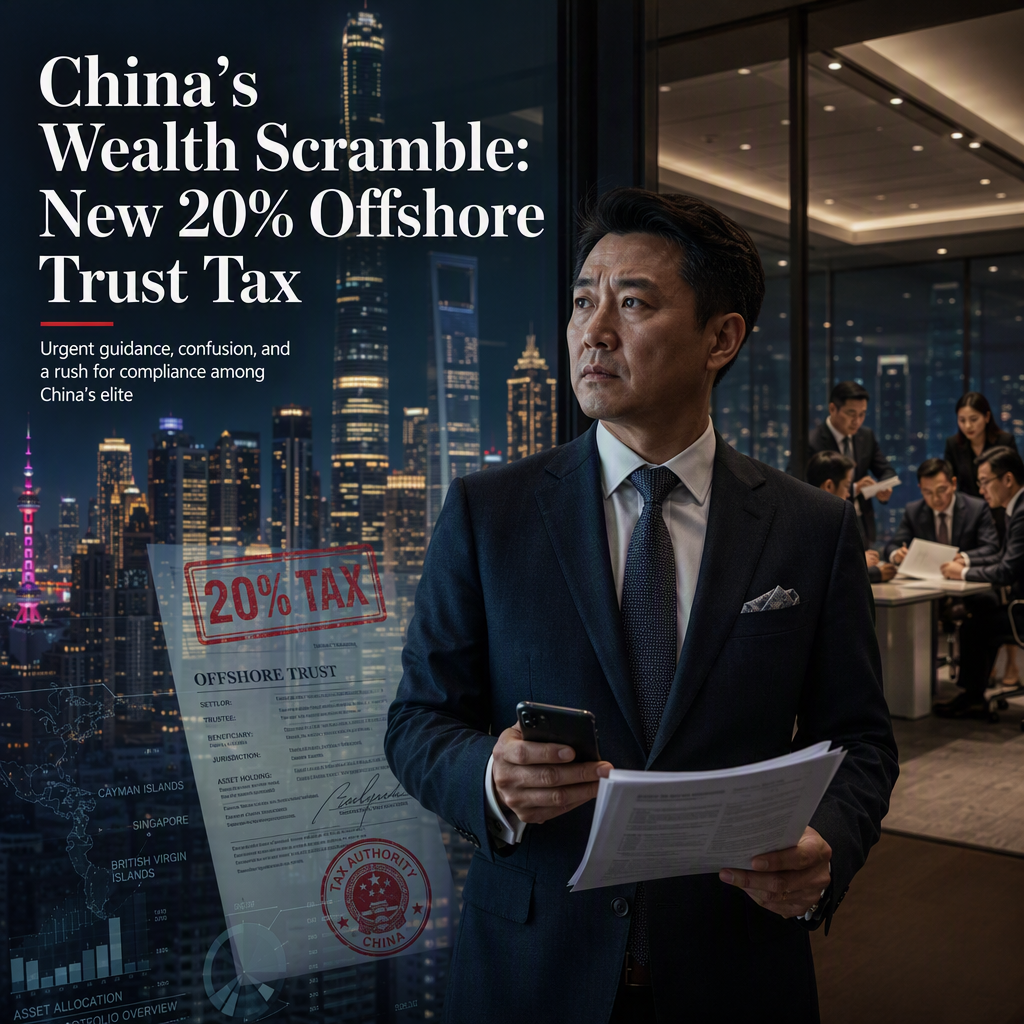
Beijing has introduced a new 20% tax on offshore trusts, a move that has caused significant confusion and concern among China's ultra-wealthy and their advisors [1]. The State Taxation Administration (STA) is currently conducting large-scale training for local tax officers at provincial, municipal, and county levels to ensure consistent application of the new levy, according to Windson Li, co-head of tax for Asia at DLA Piper [1]. The STA has also distributed draft guidelines to selected onshore law and accounting firms and plans to hold consultation sessions with lawyers in the coming weeks, with expectations that further draft guidance will be released and eventually made public [1].
The new tax, imposed last month, applies at nearly every stage of a trust's lifecycle, including establishment, profit distribution, and wind-up. Individuals are required to declare and settle outstanding taxes on assets already transferred into such structures within 90 days of the rules' release—by October 21—or face surcharges for late filing or non-payment [1]. This has triggered a rush among wealthy individuals for tax and legal advice, as well as a scramble for cash to meet the tax obligations [1].
While the rules have ended decades of regulatory ambiguity regarding offshore trusts, they have also generated new confusion over their implementation. For example, trusts established after 2023 face the 20% charge at inception, but it remains unclear how many years back owners of older structures, which are subject to an annual recurring tax, must declare, according to Yuan Cao, a Beijing-based partner at law firm Yingke [1]. Advisors also warn that many trust assets could be subject to foreign-investment reporting rules issued in July, potentially inviting scrutiny from foreign-exchange authorities regarding how the money was transferred out of China [1].
The Chinese Embassy in Singapore and tax bureaus in Beijing, Shanghai, and Guangdong did not respond to requests for comment [1].
CONCLUSION
Beijing's new 20% tax on offshore trusts has created significant uncertainty and prompted urgent action among China's wealthy to comply with the new rules. While the government is working to clarify implementation through training and draft guidelines, key questions remain unresolved, particularly for older trusts and foreign-investment reporting. The market impact is high as stakeholders await further guidance.