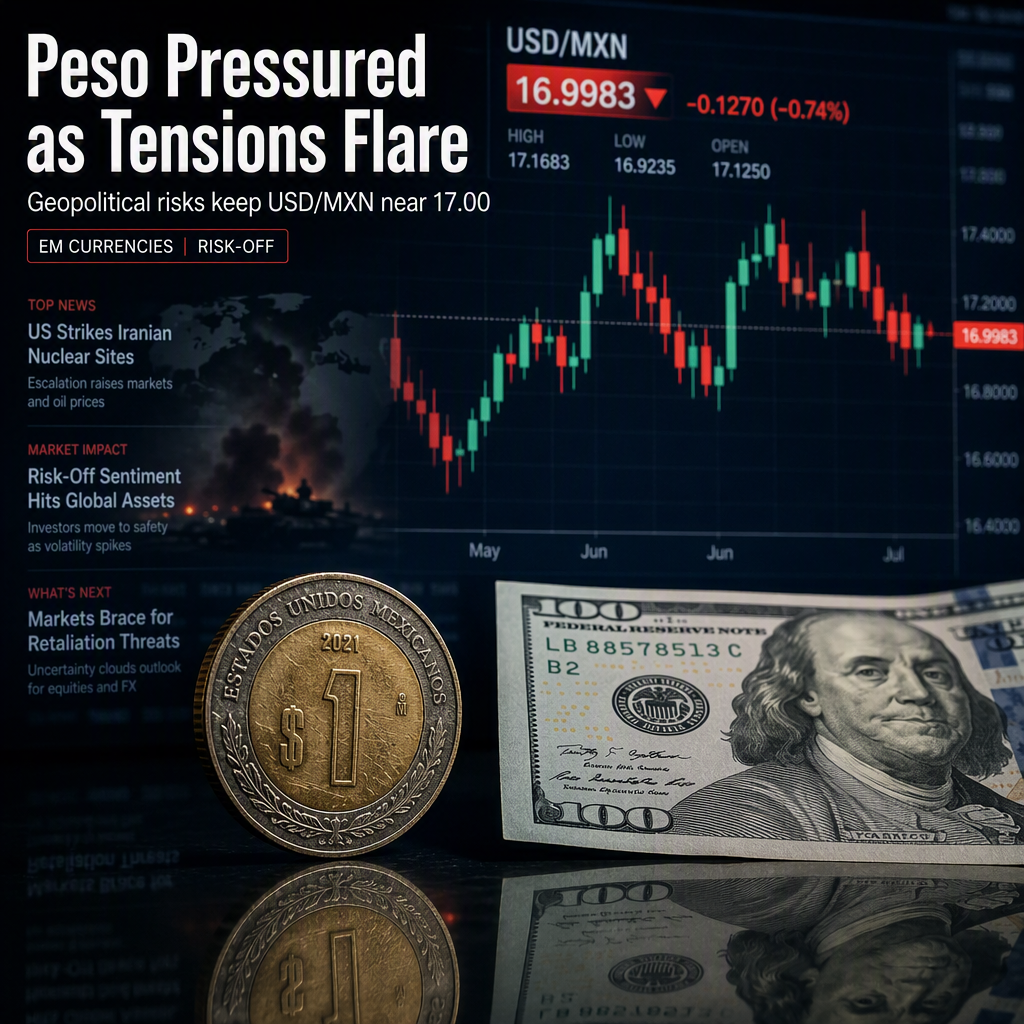
The Mexican Peso (MXN) erased some of its earlier gains against the US Dollar (USD) on Tuesday, trading at 16.99, as geopolitical tensions escalated following successive strikes between the US and Iran. The White House ordered attacks near the Strait of Hormuz to diminish Iran’s capabilities, and Iran retaliated with strikes against US bases and interests, according to Fars. This geopolitical uncertainty soured risk appetite and weighed on emerging market currencies like the Peso, pushing the US Dollar Index (DXY) up by 0.27% to 99.68 [1].
US economic data provided a mixed backdrop. The ISM Manufacturing PMI for August remained in expansion territory but fell from 55.6 to 54.6, missing forecasts of 55.2. The JOLTS job openings survey also showed weaker hiring than expected, with 7.217 million openings compared to the forecast of 7.3 million. Despite these signs of cooling, the labor market remains solid, suggesting the Federal Reserve could still consider raising rates. Key upcoming US data releases include the Fed’s Beige Book, ISM Services PMI for August, and the Nonfarm Payrolls report on Friday [1].
In Mexico, the August S&P Global Manufacturing PMI contracted to 49.8 from 51.3 in July, indicating a slowdown in the sector. The Bank of Mexico’s (Banxico) survey of private economists revealed trimmed inflation projections for 2026 (from 4% to 3.90%) and 2027 (to 3.84%), with underlying inflation expected to drop to 3.99% by year-end and 3.80% by 2027. Economic growth is forecast at 1.30% for 2026 and 1.80% for 2027. The USD/MXN exchange rate is projected to end 2023 at 17.50 and 2027 at 18.05 [1].
Technically, USD/MXN trades at 17.0000, maintaining a bearish tone as it remains below key moving averages and a descending trend-line barrier near 17.3217. The Relative Strength Index (14) at 38.9 suggests weak but not extreme downside momentum after a recent bounce from late-August lows. Resistance is seen at the downtrend line from 18.1651, now around 17.3217, with grouped 50/100/200 simple moving averages overhead [1].
CONCLUSION
Geopolitical tensions between the US and Iran have weighed on the Mexican Peso, keeping USD/MXN near 17.00 as risk appetite fades. While US economic data and upcoming releases may further influence the pair, Mexico’s weaker manufacturing data and trimmed inflation forecasts suggest a cautious outlook. Technical indicators point to limited upside for USD/MXN in the near term.