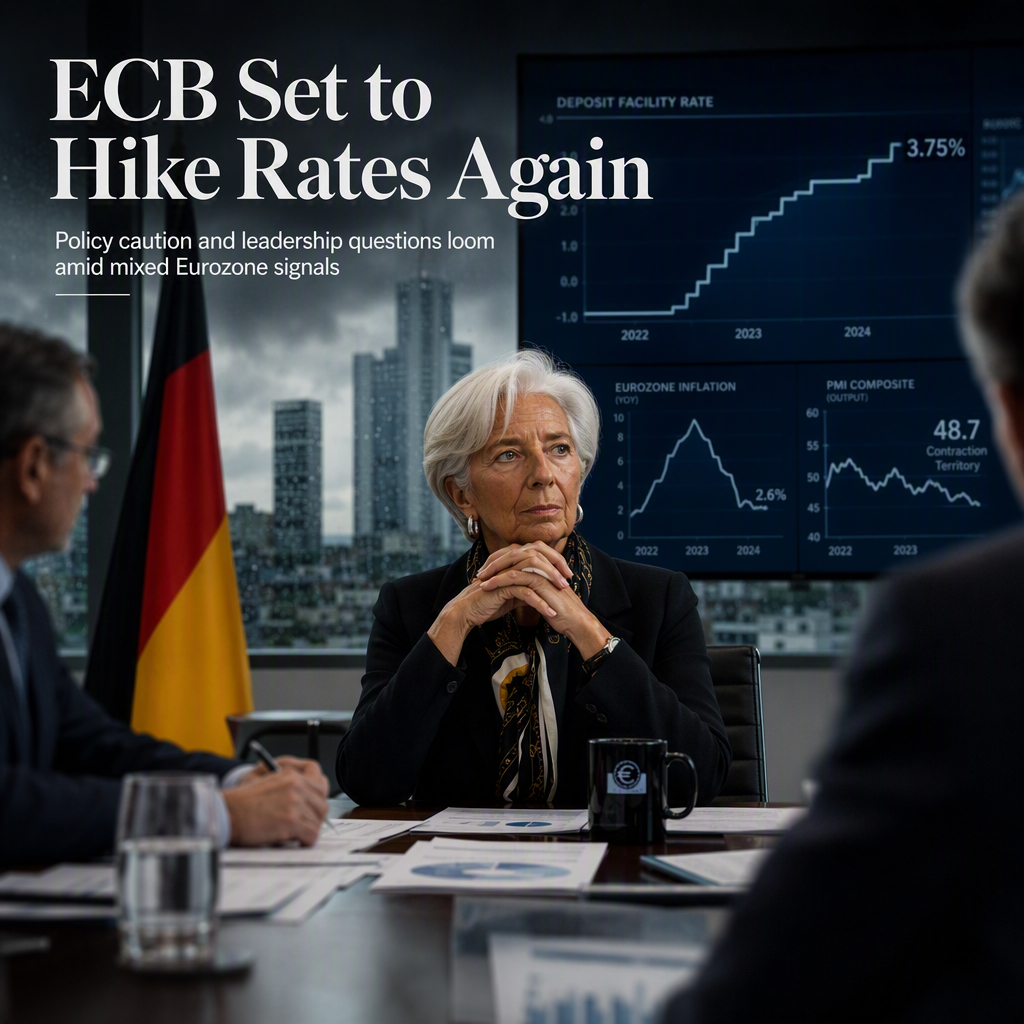
The European Central Bank (ECB) is widely anticipated to raise its deposit rate by 25 basis points to 2.50% at its upcoming September meeting, according to both TD Securities and BNY analysts [1][2]. TD Securities' macro team, including Pooja Kumra, expects the Governing Council to maintain a cautious, data-dependent, and meeting-by-meeting approach, with limited forward guidance on future policy moves [1]. The decision is supported by new staff projections, which are expected to justify the hike due to persistent inflation risks, despite some recent softening in data [1].
BNY's Geoff Yu notes that market expectations are aligned with a 25bp hike to 2.50%, and highlights that Eurozone assets remain resilient, supported by steady composite PMI readings and signs of improving German demand [2]. The Euro area composite PMI for August held at 52.0, unchanged from July’s eight-month high, indicating another solid month of private sector growth. The services PMI eased slightly to 51.6 from 51.7, while manufacturing momentum strengthened [2]. In Germany, the services PMI for August edged down to 49.7 from 49.8, signaling a marginal contraction, but underlying demand improved with new business rising for a second month and export orders increasing at the strongest pace since May 2023 [2].
TD Securities points out that the ECB's headline inflation forecasts may be nudged marginally lower for 2026, but sees small upside risks (~0.1%) in 2027/2028 due to persistent shocks and sharp moves in natural gas prices. For Q3 2026, natural gas prices are close to 30% higher than the ECB's June projections, even as oil prices are 15% lower [1]. The policy trade-off is described as "clearly higher, persistent inflation and only slightly weaker growth," which TD believes justifies a rate hike [1].
Meanwhile, BNY highlights growing speculation over ECB leadership succession, with questions surrounding President Christine Lagarde’s tenure, which is scheduled to run until October 2027, and the possibility of Bundesbank President Joachim Nagel as a German candidate for the presidency. German Chancellor Friedrich Merz is set to meet ECB officials next week ahead of the rate decision, providing an opportunity to discuss Germany’s economic outlook and the leadership question [2]. Price pressures remain broadly stable but elevated compared to pre-Iran war levels, and business confidence is steady [2].
Both sources agree that the ECB is likely to reiterate its data-dependent and meeting-by-meeting approach, with the situation in the Middle East cited as too fragile for strong forward guidance [1].
CONCLUSION
The ECB is expected to deliver a 25bp rate hike to 2.50% in September, supported by persistent inflation risks and resilient Eurozone data. Market participants are focused on the central bank’s cautious policy stance and ongoing leadership succession speculation. The overall market impact is medium, with steady economic indicators and limited forward guidance shaping expectations.