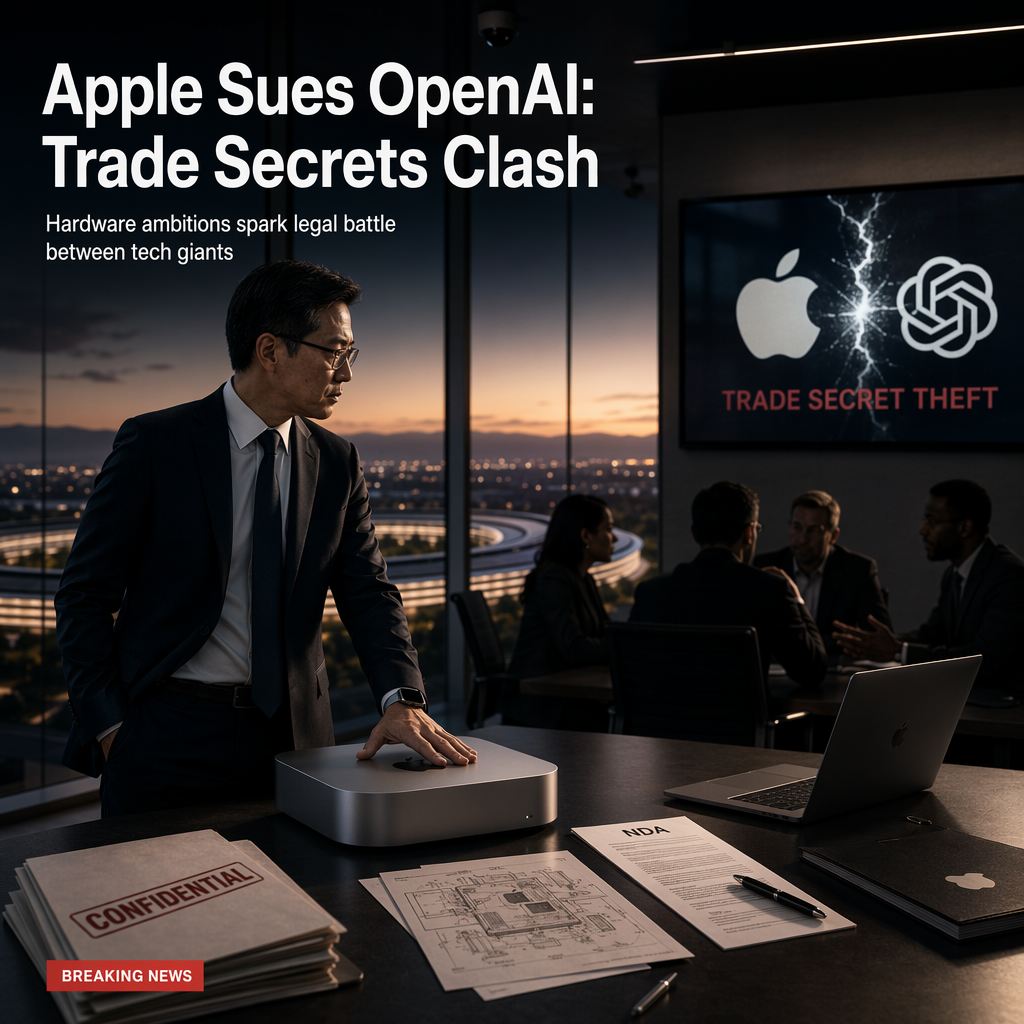
Apple has filed a lawsuit against OpenAI in federal court in Northern California, accusing the artificial intelligence company of trade secret theft and alleging that OpenAI used Apple's intellectual property to develop its own consumer hardware products [1]. According to the legal filing, Apple claims that OpenAI engaged in a coordinated effort involving staff at multiple levels, including its Chief Hardware Officer, to steal confidential information and trade secrets from Apple [1].
The lawsuit marks a significant shift in the relationship between the two companies, which previously partnered in 2024 to integrate ChatGPT into the iPhone's operating system, an announcement that included a visit from OpenAI CEO Sam Altman to Apple's headquarters [1]. Relations reportedly deteriorated after OpenAI announced plans to enter the hardware industry, including the $6.4 billion acquisition of IO Products, a startup founded by former Apple designer Jony Ive [1]. IO Products is also named as a defendant in the lawsuit [1].
Apple's allegations focus heavily on former employees, particularly Tang Tan, OpenAI's hardware chief and a former Apple vice president, who is accused of directing Apple employees interviewing at OpenAI to bring 'actual parts' from Apple for 'show and tell' sessions to elicit more confidential information [1]. Chang Liu, another former Apple employee now at OpenAI, is accused of stealing an Apple laptop [1]. Apple also alleges that OpenAI coached departing employees on how to evade Apple's security processes and that OpenAI encouraged hardware partners to use a proprietary metal finishing technique invented by Apple without proper authorization [1].
In response, an OpenAI representative stated, 'We have no interest in other companies' trade secrets. We remain focused on building innovative technology that empowers people everywhere' [1]. OpenAI has not disclosed details or timelines for its hardware products, though CEO Sam Altman previously stated that the company had completed its first prototypes as of November [1]. Apple did not comment on whether the lawsuit would impact its partnership with OpenAI [1].
CONCLUSION
Apple's lawsuit against OpenAI signals a major escalation in tensions between the two tech giants, with serious allegations of trade secret theft and employee misconduct. The case could have significant implications for both companies' hardware ambitions and their ongoing partnership. Market participants are likely to closely monitor developments for potential impacts on Apple's product pipeline and OpenAI's hardware strategy.