
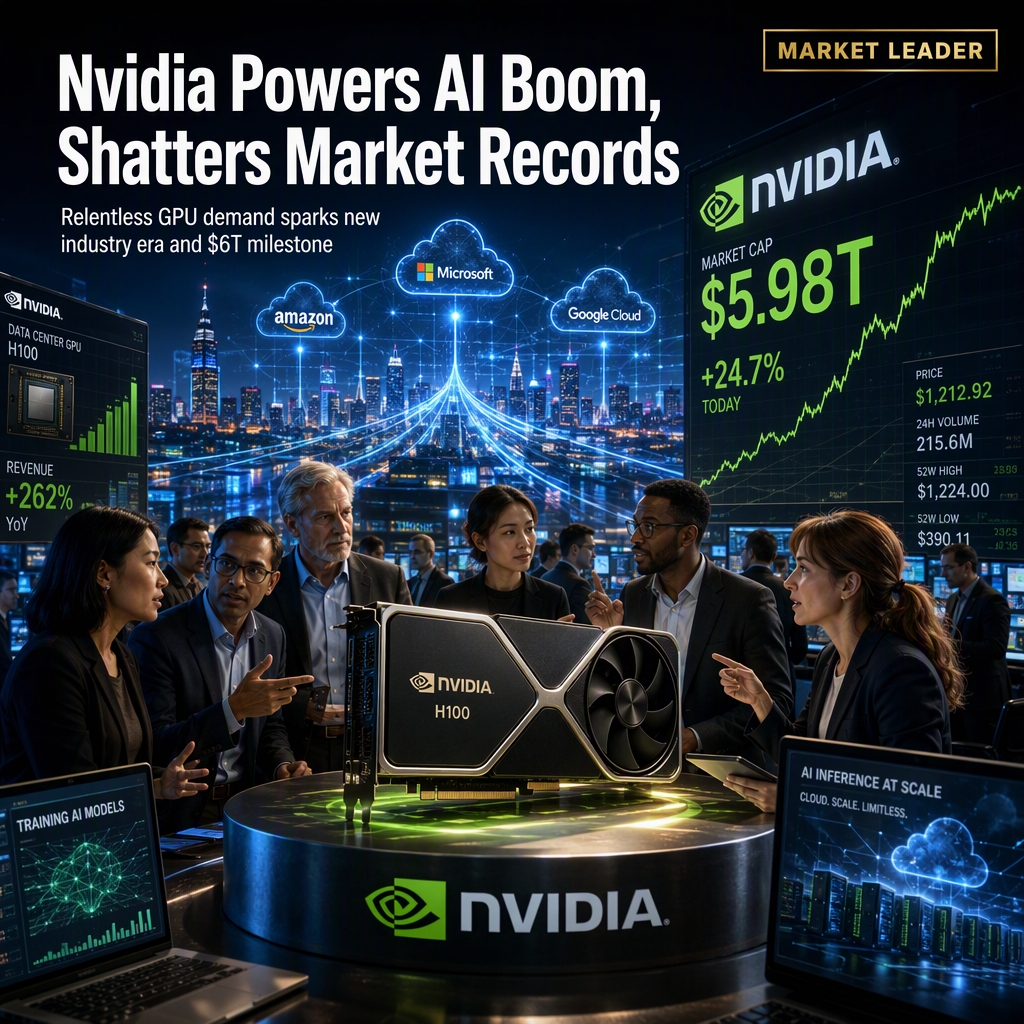
Nvidia GPUs have become the cornerstone of AI development, with AI labs spending tens of billions of dollars annually to acquire the chips needed to run their models [1]. This surging demand has led to the emergence of over 300 neoclouds renting GPUs to businesses, representing a 55% increase in less than 11 months, according to SemiAnalysis [1]. Nvidia's stock reached a new record this week, pushing its market capitalization close to $6 trillion [1]. Customers now have multiple avenues to access Nvidia GPUs, including major cloud providers such as Amazon, Microsoft, and Google, as well as neoclouds like CoreWeave, online marketplaces, or direct hardware purchases [1].
For Nvidia, this widespread demand translates into relentless growth. Management anticipates $108 billion in revenue for the October quarter, marking an 89% year-over-year increase [1]. The company's customer base is diversifying, with five clients accounting for at least 10% of Nvidia's accounts receivable in the July quarter, up from three in January [1]. Industry research indicates that the number of Nvidia GPU providers has grown to 323 as of September, up from 209 less than 11 months earlier [1]. Nvidia CEO Jensen Huang highlighted the rise of neoclouds, predicting a "whole new crop of really, really exciting neoclouds with hundreds of billions of dollars backlog together" [1].
Hyperscalers remain dominant, with companies spending tens of millions annually on cloud services from Amazon, Google, and Microsoft [1]. Since the launch of ChatGPT in 2022, enterprises have increasingly relied on these providers for generative AI workloads, benefiting from their reputation and full-stack capabilities [1]. Leading AI labs Anthropic and OpenAI have committed to spending over $500 billion between Amazon and Microsoft, which together controlled 59% of the cloud infrastructure market in 2025, according to Gartner [1]. Gartner analyst Hardeep Singh emphasized the trust enterprises place in hyperscalers due to their decade-long expertise [1].
The proliferation of GPU access options has created a paradox of choice for companies needing computing power urgently, but it also signals a robust and expanding ecosystem around Nvidia's technology [1].
CONCLUSION
Nvidia's GPUs are driving unprecedented growth in both the company's financials and the broader cloud infrastructure industry, with demand fueling new market entrants and record stock performance. The diversification of customer access and spending commitments from major AI labs underscore Nvidia's central role in the AI revolution. Market sentiment remains strongly positive, reflecting confidence in Nvidia's continued leadership and expansion.