Oil prices surged sharply on Monday, with West Texas Intermediate (WTI) crude climbing to just above $84.00 per barrel, marking a fresh one-month high, as hostilities between the US and Iran escalated and threatened to spill into a broader conflict. At the time of reporting, WTI was trading around $83.70, having regained half of the ground lost after the ceasefire agreement reached in May and standing about 23% above early July lows, though still about 25% below the $113.28 high seen in March [1]. The US military has conducted strikes on Iranian targets for nine consecutive days, following the deaths of US soldiers in Iraq and Jordan in attacks attributed to Tehran [1].
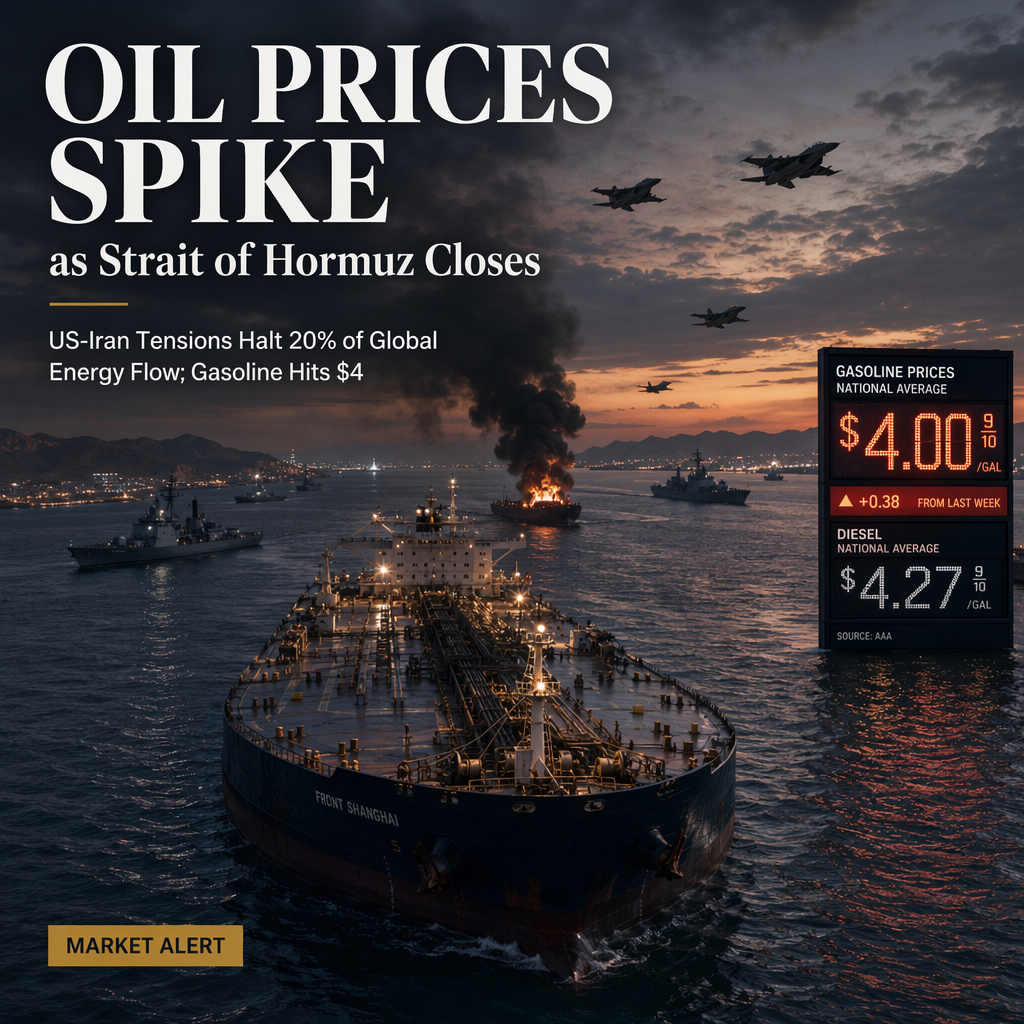
The conflict has led to the closure of the Strait of Hormuz for sea traffic, a critical chokepoint through which 20% of the world’s energy supplies typically transit. The British maritime authority reported a vessel on fire off the coast of Oman, and the Iranian Islamic Revolutionary Guard Corps (IRGC) warned the US of a 'punitive operation,' stating that 'not even a single drop' of oil would cross the strait while US aggression continues [1][2]. According to NBC News, the US revoked a sanctions waiver on Iranian oil on July 7, and President Donald Trump subsequently announced the end of the ceasefire and the reinstatement of the Iranian blockade in the Strait of Hormuz, targeting vessels transiting to or from Iranian ports [2].
The market reaction has been swift: the national average price for regular gasoline in the US hit $4 per gallon for the first time since June 17, after having fallen to as low as $3.79 on July 7 and 8. On Friday, US crude settled at $82.49 and Brent at $88.10. Both benchmarks rose more than 15% last week and over 20% in the past two weeks [2]. The uncertainty was further fueled by President Trump’s proposal to impose a 20% fee on all cargo shipped through the strait, which was quickly rejected by shipping companies and international organizations as a violation of international law. Although the fee was later dropped, oil prices continued to rise amid ongoing US-Iran military exchanges [2].
Analysts cited in the articles note that Tehran appears to be seeking authority over navigation in the Strait of Hormuz through mandatory transit protocols and fees, rather than pursuing a full closure. Ship crossings in the strait dropped to a three-week low last week, with only eight ships crossing on Thursday compared to a pre-war daily average of 130 [2]. Additionally, developments in the Russia-Ukraine war have contributed to market volatility, with Russia banning exports of key refined products until the end of July due to attacks on its energy infrastructure [2].
CONCLUSION
The escalation of US-Iran hostilities and the effective closure of the Strait of Hormuz have driven oil and gasoline prices sharply higher, with WTI reaching one-month highs and US gas prices returning to $4 per gallon. The situation remains highly volatile, with ongoing military actions and disruptions to global energy flows creating significant uncertainty in the market.