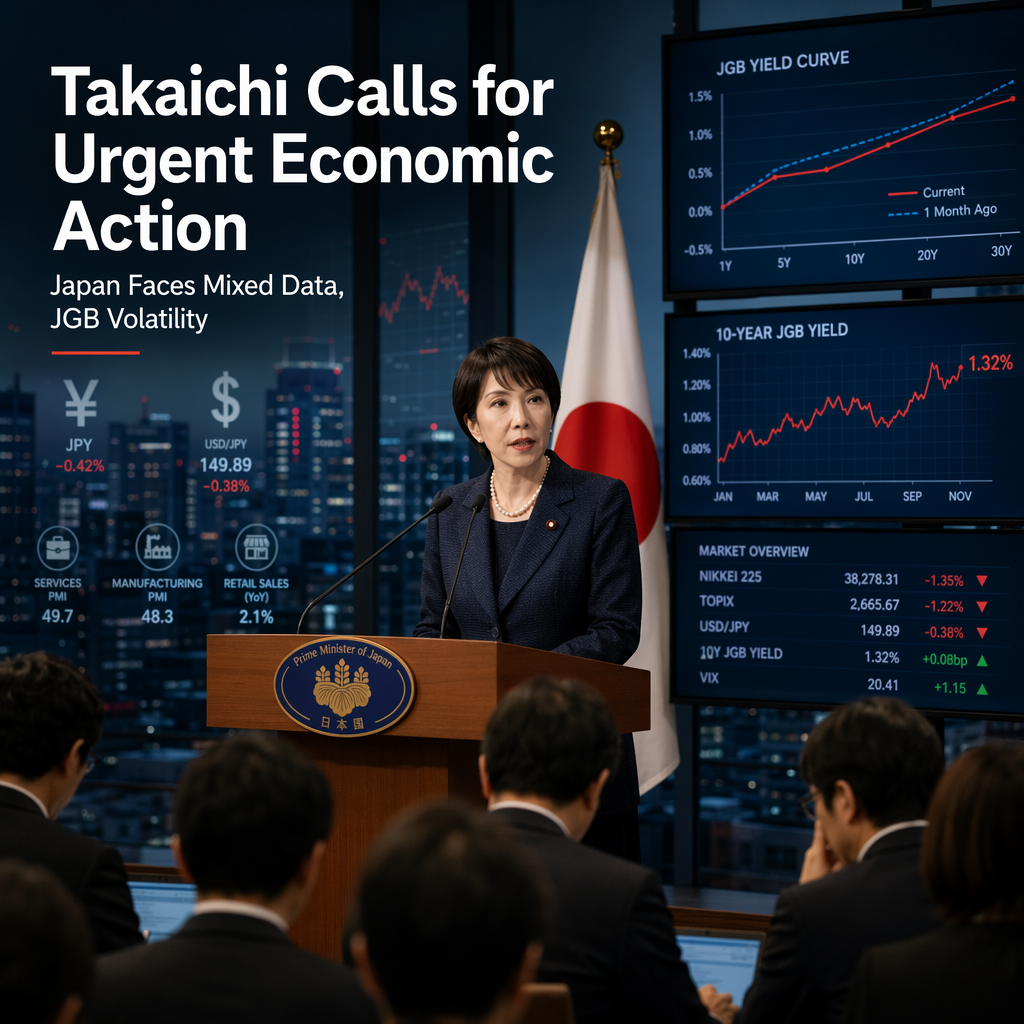
Japanese Prime Minister Sanae Takaichi has emphasized the urgent need for Japan to build a strong economy, warning that 'if we don’t build a strong economy now, it will be too late' [1]. Takaichi rejected claims that her government’s draft economic blueprint was responsible for the recent selloff in Japanese Government Bonds (JGBs), which drove bond yields to multi-decade highs. She argued that the market shock was not linked to any unapproved government document, but rather reflected multiple factors, including U.S. interest rates and employment data [1].
Recent economic data from Japan presents a mixed picture. The machinery orders report for June showed a significant month-on-month decline, with core private sector orders (excluding ships and electricity) falling 12.4% after an 8.7% increase in the previous month. This marks the first decline in two months, and the three-month moving average remained negative at -4.8% month-on-month [1].
On a more positive note, Japan’s tertiary industry activity index rose 1.1% month-on-month and 1.5% year-on-year in May, indicating a firmer service sector backdrop. Personal services improved by 0.6% month-on-month, while business services gained 2.0%. Notable contributors to the monthly increase included information and communications (3.1% m/m, 2.0% y/y), finance and insurance (3.4% m/m, 13.7% y/y), and retail trade (1.9% m/m, 4.1% y/y), alongside gains in business-related services, leisure-related services, utilities, and transport/postal activities [1].
BNY’s Geoff Yu frames domestic investment and competitiveness as key to supporting the Japanese Yen, highlighting the importance of capital spending signals and the government’s focus on boosting investment, wages, and strategic capacity [1].
CONCLUSION
Japan faces urgent calls for economic strengthening amid mixed economic data and recent JGB market volatility. While machinery orders have weakened, the service sector shows resilience, and the government is prioritizing investment and competitiveness to support the Yen. Market participants remain attentive to policy signals and ongoing economic trends.