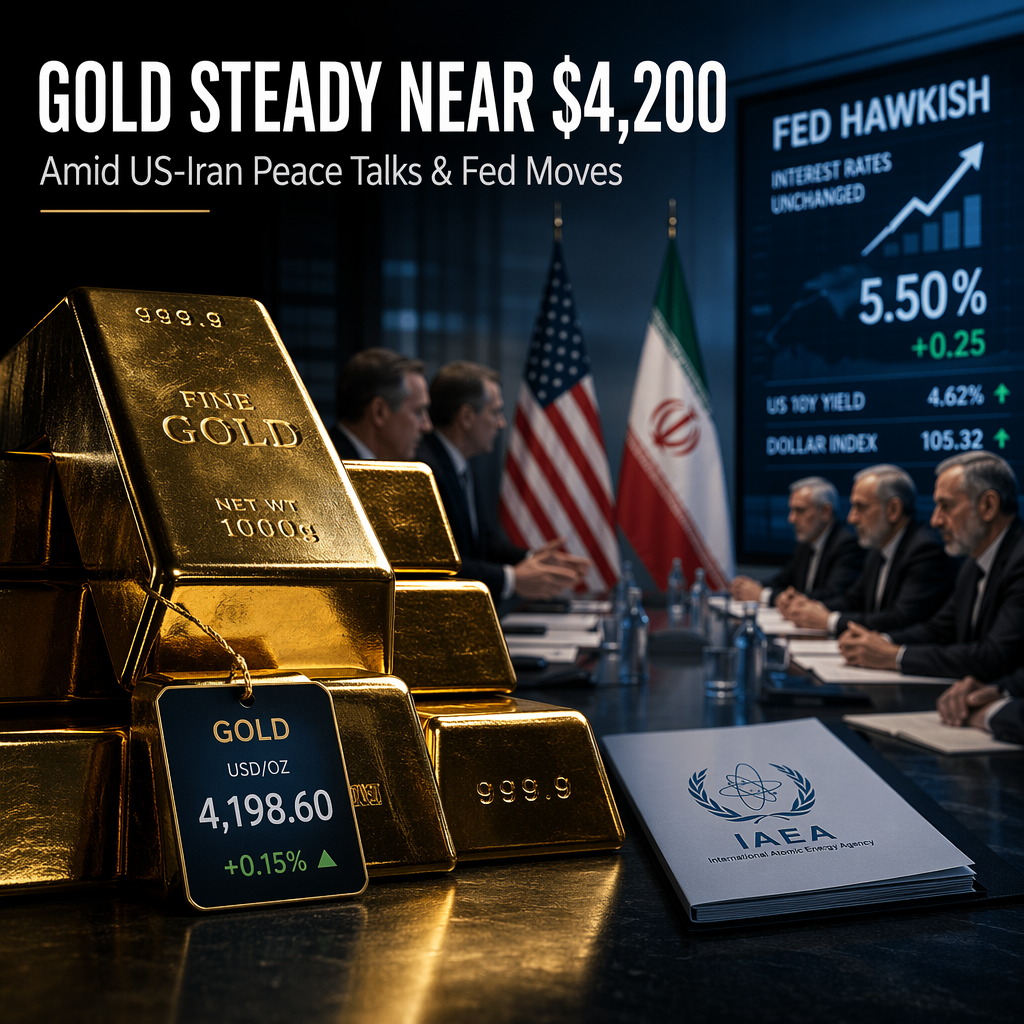
Gold prices (XAU/USD) remained stable near $4,190 during the early Asian session on Tuesday, as traders weighed the impact of ongoing US-Iran peace negotiations against a more hawkish stance from the US Federal Reserve [1]. US Vice President JD Vance stated on Monday that negotiations between the US and Iran had made 'great progress,' with Tehran agreeing to allow International Atomic Energy Agency (IAEA) inspectors back into Iran, despite recent tensions over the closure of the Strait of Hormuz following Israeli strikes on Lebanon [1].
Saxo Bank analyst Ole Hansen noted that 'energy prices will remain a key short-term driver for the precious metal space,' referencing the 'ongoing bumpy talks' between the US and Iran, which could influence oil prices and, in turn, gold prices [1]. The market's attention has also shifted to US monetary policy, as the new Federal Reserve Chair, Kevin Warsh, adopted a hawkish tone on inflation during his first policy meeting. This has led traders to price in nearly an 89% chance of a Fed rate hike in December, up from 61% before last week's FOMC meeting, according to the CME FedWatch tool [1].
Gold is often used as a hedge against inflation but does not yield interest, making it less attractive when interest rates are high [1]. The interplay between geopolitical developments and expectations of higher US interest rates has kept gold prices in a narrow range, as investors assess the balance of risks [1].
CONCLUSION
Gold prices are currently steady as markets balance optimism over US-Iran peace progress with expectations of a US rate hike. The prospect of higher interest rates is capping gains for the precious metal, while geopolitical tensions continue to provide support. Market participants are closely watching both the outcome of the negotiations and the Federal Reserve's next moves.