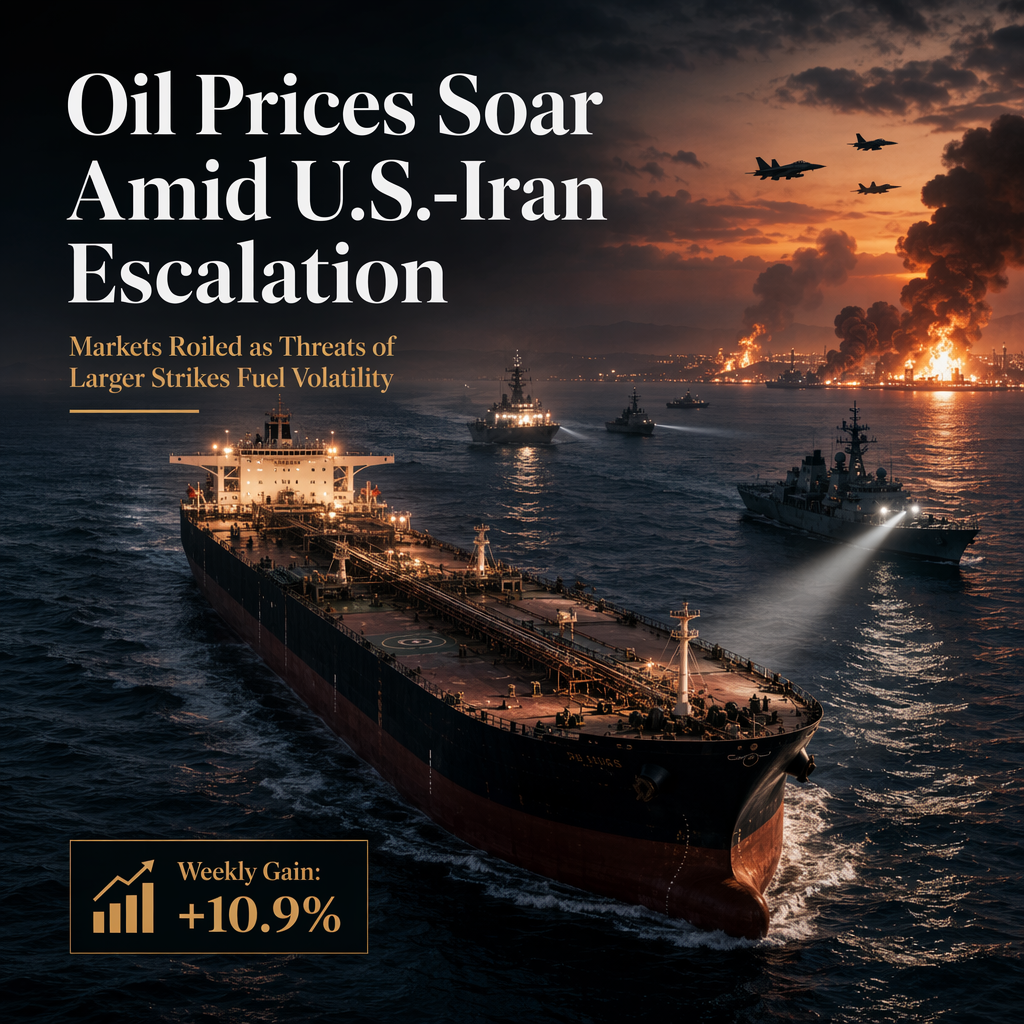
Oil prices experienced a notable decline of around 3% early on Friday, yet remained on track for a significant weekly gain of over 10% as the conflict between the U.S. and Iran intensified [1]. At 6:25 a.m. ET, Brent crude futures for July delivery were down 3% at $97.72 per barrel, but still heading for a 10.9% weekly increase. Similarly, U.S. West Texas Intermediate crude futures fell 2.8% to $89.59 per barrel, up 8.6% for the week [1].
The escalation in hostilities included the U.S. Central Command conducting its 13th consecutive night of strikes on Iran, targeting military command centers, drone storage facilities, communication networks, coastal surveillance sites, and maritime capabilities. These actions were described as efforts to "further diminish the threat Iran poses to civilian mariners and commercial vessels transiting the Strait of Hormuz" [1]. Despite recent attacks from Iran's Islamic Revolutionary Guard Corps, the international waterway remains open, with commercial vessels continuing to navigate the strait under U.S. military protection. Over 50,000 U.S. service members are currently operating across the Middle East [1].
U.S. President Donald Trump stated in an interview with Axios that he is considering a "massive attack" on Iran, which he described as potentially "bigger than ever before," and indicated he is close to making a decision. Trump emphasized that Iran has not "received enough pain yet" and warned that further attacks by Yemen's Tehran-backed Houthis on commercial vessels would result in the U.S. holding Iran responsible and inflicting major military punishment on both Iran and the Houthis [1].
Iran's Revolutionary Guard claimed responsibility for attacking U.S. military facilities at an American base in Jordan, according to Iranian state media [1]. U.S. Secretary of State Marco Rubio characterized Trump's approach as "a head for an eye" [1]. Market analyst Daniela Hathorn noted that the instability around key shipping routes has rebuilt a "sizeable geopolitical risk premium" into oil markets, with ongoing disruptions in the Red Sea and tensions around the Strait of Hormuz compounding concerns over global trade and energy security. She concluded that geopolitical risks are unlikely to fade soon, keeping energy markets on edge [1].
CONCLUSION
The escalation of the U.S.-Iran conflict has driven oil prices to a weekly gain of over 10%, despite a short-term pullback. Market analysts highlight that persistent geopolitical risks and disruptions to key shipping routes are likely to sustain elevated energy prices. The situation remains highly volatile, with potential for further market-moving developments.