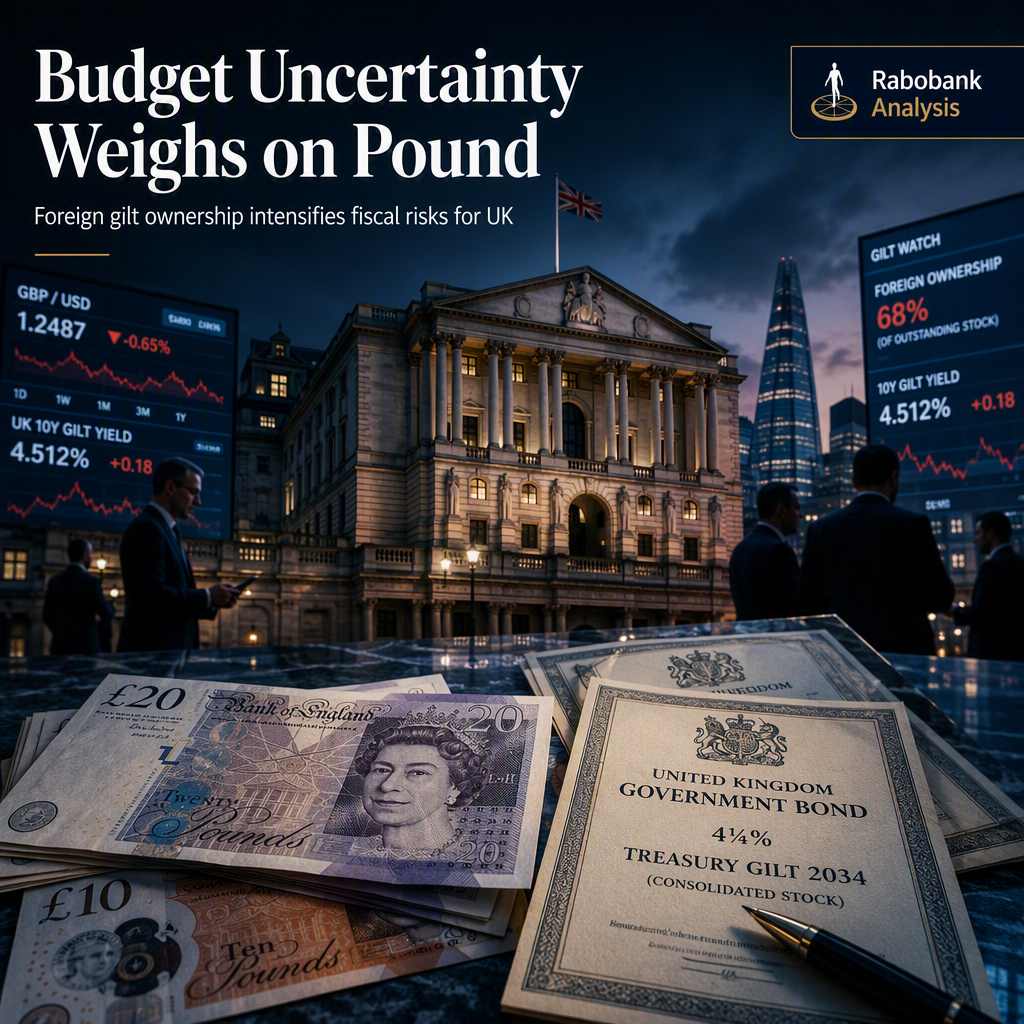
Rabobank’s Senior FX Strategist Jane Foley has highlighted growing vulnerability for the British Pound (GBP) as global bond market pressures intensify, particularly for high-debt countries facing elections or budget negotiations. Foley points out that the United Kingdom (UK) stands out due to its relatively high share of government debt—around 30% of UK gilts—held by foreign investors, according to the Office for Budget Responsibility (OBR) [1]. Since 2022, the Bank of England (BoE) has been reducing its holdings of gilts, further exposing the market to foreign sentiment [1].
Foley notes that foreign investors are typically more reactive to negative domestic developments, which increases the risk of bond market volatility spilling over into the exchange rate. This dynamic is particularly relevant for the UK, as the proportion of government debt owned by foreign investors is higher than in other G10 countries, making the pound more susceptible to budget-related concerns [1].
With the UK budget scheduled for October 28, Foley expects GBP markets to remain focused on fiscal risks in the coming weeks. She anticipates ongoing discomfort for the pound, projecting that EUR/GBP will be biased higher, potentially reaching 0.87 on a three-month horizon [1].
Overall, Rabobank’s analysis suggests that the British Pound may be more sensitive to budget uncertainties than many of its G10 peers, with market participants likely to remain cautious as the budget date approaches [1].
CONCLUSION
Rabobank’s analysis underscores heightened vulnerability for the British Pound due to significant foreign ownership of UK gilts and looming budget uncertainties. Market participants are expected to remain cautious, with potential for further GBP weakness and a higher EUR/GBP in the coming months.