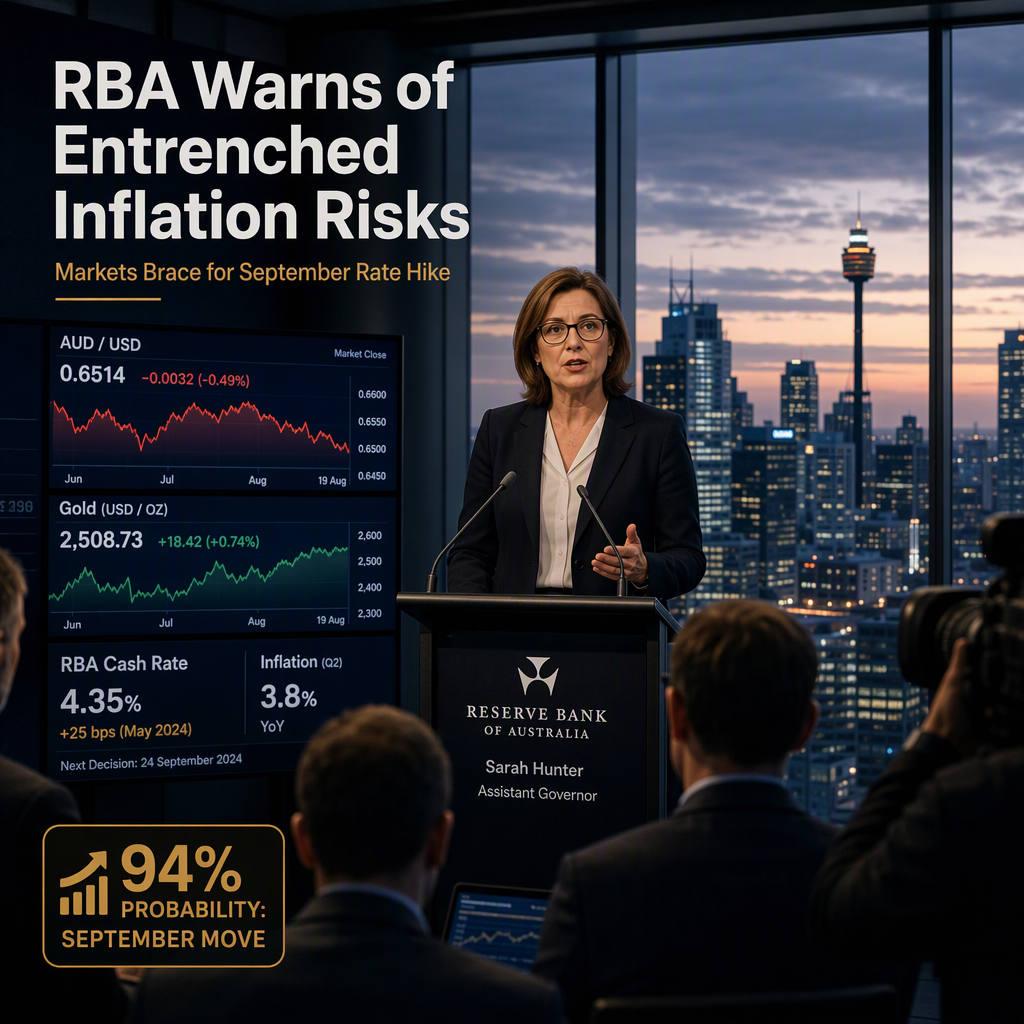
The Reserve Bank of Australia (RBA) Assistant Governor Sarah Hunter has confirmed the need for additional rate hikes this year to address persistent inflation risks, raising the likelihood of a rate increase at the September 29 meeting [1][2]. Hunter emphasized the board's concern that inflation has remained elevated for too long and warned of increasing risks that it could become entrenched, stating, 'We can see lots of reasons why inflation might be a bit higher than what we currently think' [1][2]. Money markets are forecasting a 94% probability that the RBA will raise rates by 25 basis points at the upcoming meeting, according to Prime Terminal [1][2]. The RBA has already raised rates three times by a total of 75 basis points this year, bringing the cash rate to 4.35%, which is back to post-pandemic levels [1].
In parallel, the Australian Dollar (AUD) has held firm against the US Dollar, trading near 0.7119, as risk appetite remains positive despite renewed hawkish signals from US Federal Reserve officials [2]. Technical analysis suggests a constructive near-term bias for AUD/USD, with key resistance at 0.7198 and support at 0.7088, though momentum has cooled, leaving the pair vulnerable to deeper pullbacks if buyers fail to press higher [2].
Globally, the Federal Reserve raised interest rates last week to a range of 3.75%-4%, with officials signaling the possibility of further hikes to combat inflation [2][3]. St. Louis Fed President Alberto Musalem stated that additional rate increases may be needed to achieve the central bank’s inflation goal, warning that inflation could remain above 2% in 18 months without more policy restraint [2][3]. This hawkish stance has pushed US Treasury yields higher and weighed on gold prices, which declined to near $4,365 as traders priced in a 90.3% chance of a US rate hike in December, according to the CME FedWatch Tool [3].
Analysts at ING noted that gold edged lower as investors assessed the implications of the Fed's first rate hike since 2023 and the prospect of further tightening, reinforcing expectations that rates will stay higher for longer [3]. However, supportive underlying flows, such as ETF holdings at a six-month high and continued central bank buying, are expected to help limit downside for gold [3].
CONCLUSION
The RBA's clear signal for further rate hikes has heightened market expectations for a September increase, with traders pricing in a 94% probability. The Australian Dollar remains resilient amid global tightening trends, while gold faces headwinds from higher interest rates. Overall, central banks' hawkish stances are shaping a high-impact environment for currency and commodity markets.