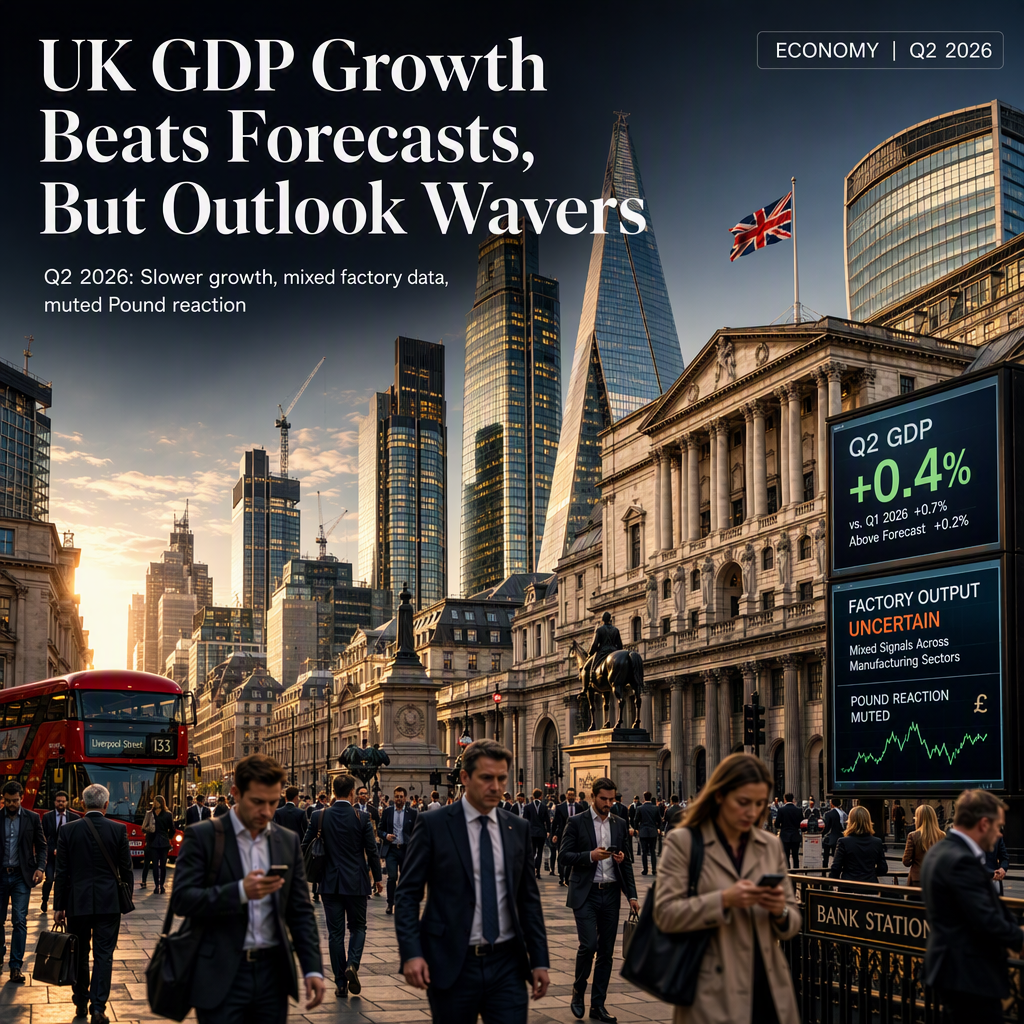
The United Kingdom's economy grew by 0.4% quarter-on-quarter in the second quarter of 2026, according to data released by the Office for National Statistics, matching market expectations but marking a slowdown from the 0.6% growth recorded in the first quarter [1][2][3]. On an annual basis, GDP expanded by 1.2% in Q2, surpassing both the previous reading of 0.9% and the 1.1% consensus estimate [1][3]. Monthly GDP for June rose by 0.3%, outperforming the market consensus of 0% and improving from May's revised figure of 0% [1][2][3].
However, there are discrepancies in the reporting of industrial and manufacturing production data. According to [2], Industrial Production contracted by 0.2% in June, missing expectations of 0.1% growth, and May's figure was revised down to a 0.7% fall. Manufacturing Production also shrank by 0.5% in June, worse than the anticipated 0.2% drop. In contrast, [3] reports that Manufacturing Production rose by 0.5% and Industrial Production grew by 0.2% in June, both beating expectations. This contradiction highlights uncertainty in the underlying strength of the UK's industrial sector.
Market reaction to the GDP data was muted, with the British Pound holding steady against the Euro near 0.8540 and trading flat against the US Dollar just below 1.3500 [1][2]. Against the Japanese Yen, the Pound attracted slight bids following the GDP release [3]. Strategists at Scotiabank noted that GBP moves remain sentiment-driven and expect the currency to trade in a near-term range between 1.3450 and 1.3550 as markets await further UK economic releases [2].
Looking ahead, economists at Deutsche Bank caution that the recent strength in the UK economy may not be sustained through the rest of the year, citing rising energy costs as a potential headwind for households and businesses in the third quarter [1]. The outlook for the Pound will also be influenced by expectations for the Bank of England's monetary policy [3].
CONCLUSION
UK GDP growth in Q2 2026 met expectations but slowed from the previous quarter, with annual growth outpacing forecasts. Conflicting reports on industrial and manufacturing output add uncertainty to the economic outlook. While the Pound's immediate reaction was limited, analysts warn that rising energy costs could weigh on growth in the coming months.