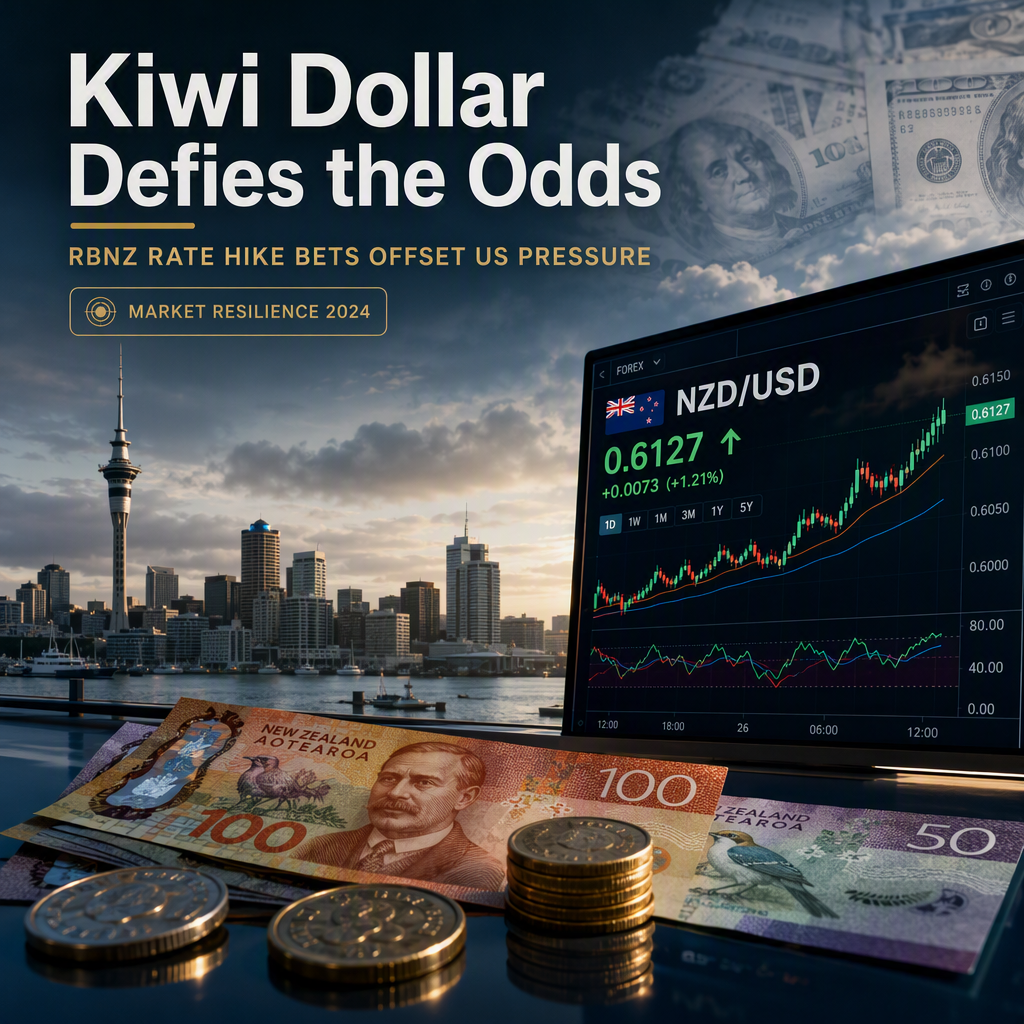
The New Zealand Dollar (NZD) edged slightly higher against the US Dollar (USD) on Tuesday, with NZD/USD trading around 0.5965, up 0.08% on the day, despite a generally stronger US Dollar driven by increased safe-haven demand amid ongoing geopolitical tensions between the United States and Iran [1]. The US has intensified economic pressure on Iran, with Treasury Secretary Scott Bessent outlining a strategy to further isolate Tehran through sanctions targeting countries and entities that continue to trade with Iran. President Donald Trump has warned that foreign entities must end commercial ties with Tehran or face US financial sanctions, contributing to market uncertainty regarding the resolution of the conflict and the reopening of the Strait of Hormuz [1].
While the safe-haven demand has supported the US Dollar, its advance has been limited by the US Treasury's decision to expand buyback operations for longer-dated bonds. Scott Bessent may deploy up to $1 trillion from the Treasury General Account to finance these operations, which could impact US market liquidity and bond yields [1]. On the economic front, US private employment data showed modest improvement, with the four-week average ADP Employment Change rising to 11.75K jobs per week for the period ending August 8, up from 9.5K previously. However, this acceleration in hiring did not trigger a significant move in the US Dollar [1].
The New Zealand Dollar remains supported by expectations that the Reserve Bank of New Zealand (RBNZ) could raise interest rates again in September, as persistently elevated inflation reinforces this possibility. This monetary policy outlook has helped limit downside pressure on the Kiwi, even as the broader geopolitical environment remains unfavorable for risk-sensitive assets [1].
Looking ahead, investors are focused on several upcoming US events, including consumer confidence data on Tuesday, the Personal Consumption Expenditures (PCE) Price Index on Wednesday, and a speech by Federal Reserve Chair Kevin Warsh at the Jackson Hole symposium on Friday, which could provide further insights into the path of US monetary policy [1].
From a technical perspective, NZD/USD is trading with a mild bullish bias, consolidating above the 100-period simple moving average (SMA) at 0.5956 and the 200-period SMA at 0.5918. The pair has also broken above a downward trend-line around 0.5959, which now acts as support, while the Relative Strength Index (RSI) is around 55, indicating moderate upward momentum [1].
CONCLUSION
The New Zealand Dollar has shown resilience against a stronger US Dollar, supported by expectations of a potential RBNZ rate hike in September. While geopolitical tensions and US policy actions continue to drive market uncertainty, upcoming US economic data and Fed commentary are likely to influence near-term currency movements.