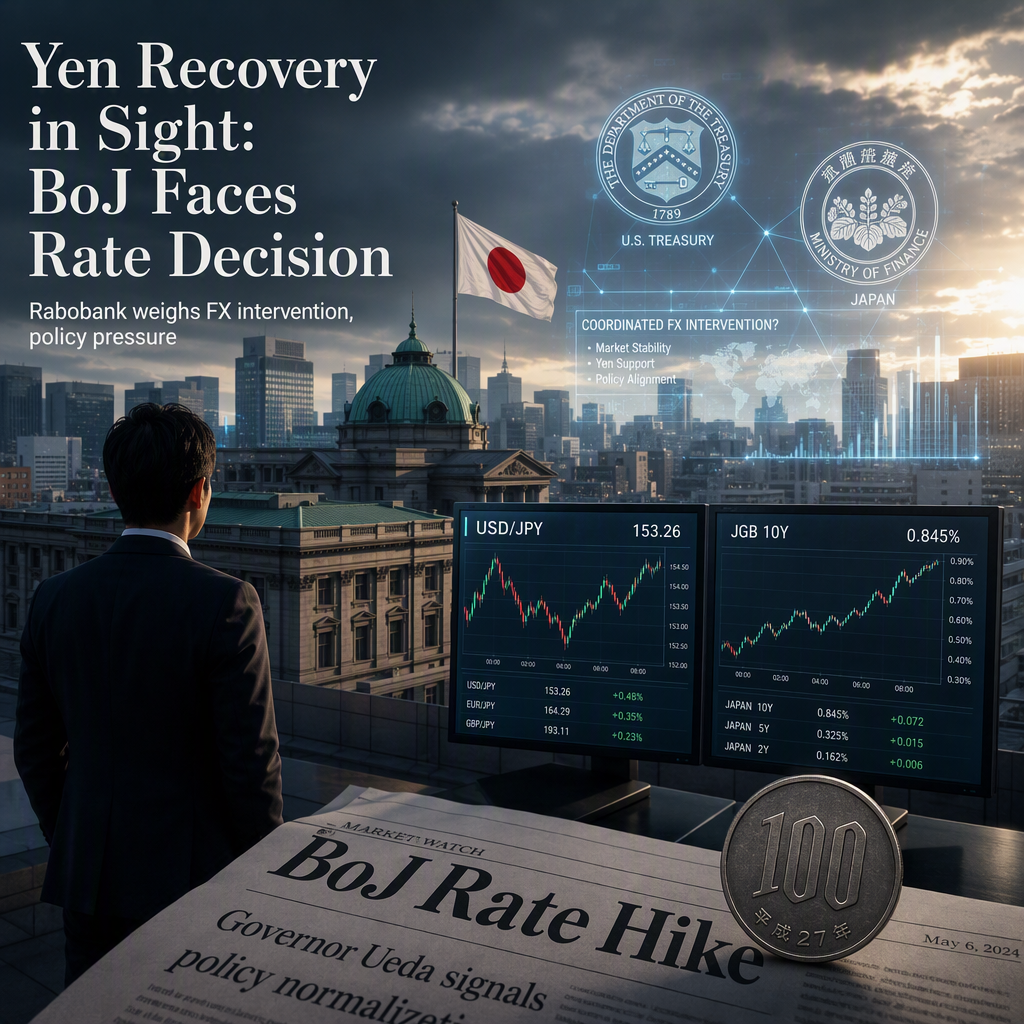
Rabobank’s Jane Foley analyzes the recent weakness in the Japanese Yen (JPY), attributing it to Prime Minister Sanae Takaichi’s preference for low interest rates and her reputation as a fiscal dove, which has led to speculation that the government is pressuring the Bank of Japan (BoJ) to avoid raising rates [1]. Foley notes that the US Treasury joined Japan’s Ministry of Finance in late July for a coordinated foreign exchange intervention to support the JPY [1].
Foley highlights that both US Treasury yields and Japanese Government Bond (JGB) yields have been rising, driven by supply and inflation concerns [1]. She points out that tight labor market conditions, a resilient Japanese economy, elevated oil prices, and a weak JPY are increasing the risk of second-order price effects, providing strong reasons for the BoJ to consider another rate hike [1].
According to Foley, recent statements from the Prime Minister have increased pressure on the BoJ, with indications of a strong chance of a rate hike later this month [1]. Rabobank’s view is that the fear of further FX intervention and the prospect of a BoJ rate hike in September could see USD/JPY trading in the 157–158 range over the next three to six months [1].
CONCLUSION
Rabobank expects that ongoing policy pressure and the likelihood of a BoJ rate hike, combined with potential further FX intervention, could support the Japanese Yen in the coming months. Market participants should monitor BoJ policy signals and government intervention closely, as these factors are likely to influence USD/JPY trading in the near term.