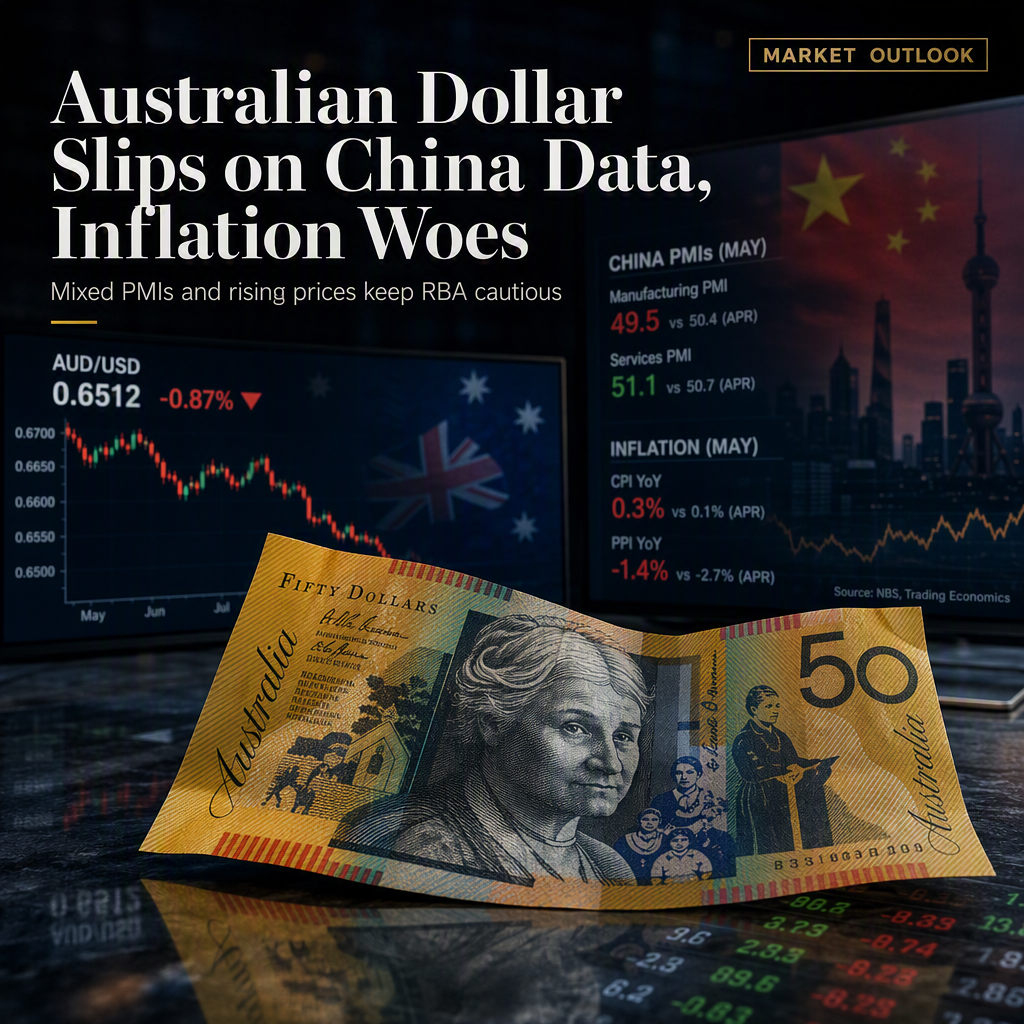
The Australian Dollar (AUD) edged lower against the US Dollar, with AUD/USD trading around 0.7160 on Monday, reflecting a modest decline of 0.08% on the day. This movement followed the release of mixed economic data from China, Australia's largest trading partner, and ongoing assessments of domestic inflation trends in Australia [1].
China’s National Bureau of Statistics reported that the Manufacturing Purchasing Managers Index (PMI) improved to 49.8 in August from 49.2 previously, slightly surpassing market expectations of 49.7. Despite this improvement, the index remained below the 50 threshold that separates expansion from contraction. Meanwhile, China’s Non-Manufacturing PMI was unchanged at 49 in August, also below the expansion threshold. Both figures signal ongoing fragility in Chinese economic activity, which limited any positive impact on the Australian Dollar [1].
Domestically, Australia’s TD-MI Inflation Gauge accelerated to 4.8% year-on-year in August from 4% in July, indicating persistent inflationary pressures. On a monthly basis, the indicator slowed to 0.5% after a 1% rise in the previous month. These inflation trends support the Reserve Bank of Australia’s (RBA) cautious policy stance. RBA Governor Michele Bullock emphasized that an interest-rate cut was not being considered and that further tightening remained possible if inflation did not slow as forecasted. This outlook provided some support to the AUD and helped limit its decline [1].
Looking ahead, investors are focused on the upcoming release of Australia’s second-quarter Gross Domestic Product (GDP) data on Wednesday, which could offer further insights into the economy’s strength and influence expectations for the RBA’s next policy move [1].
In the broader context, Rabobank analysts noted that US Federal Reserve Chair Kevin Warsh signaled openness to further rate hikes at the Jackson Hole Symposium, stating, “We must be convinced that underlying inflation is moving toward our target clearly and at a sufficient pace. Otherwise, we still have work to do.” This stance led markets to price in a greater probability of additional rate increases by the Fed [1].
CONCLUSION
The Australian Dollar’s modest decline reflects mixed signals from Chinese economic data and persistent domestic inflation, which support the RBA’s cautious stance. Market participants are now awaiting Australia’s Q2 GDP data for further direction, while global monetary policy remains in focus following hawkish signals from the US Federal Reserve.