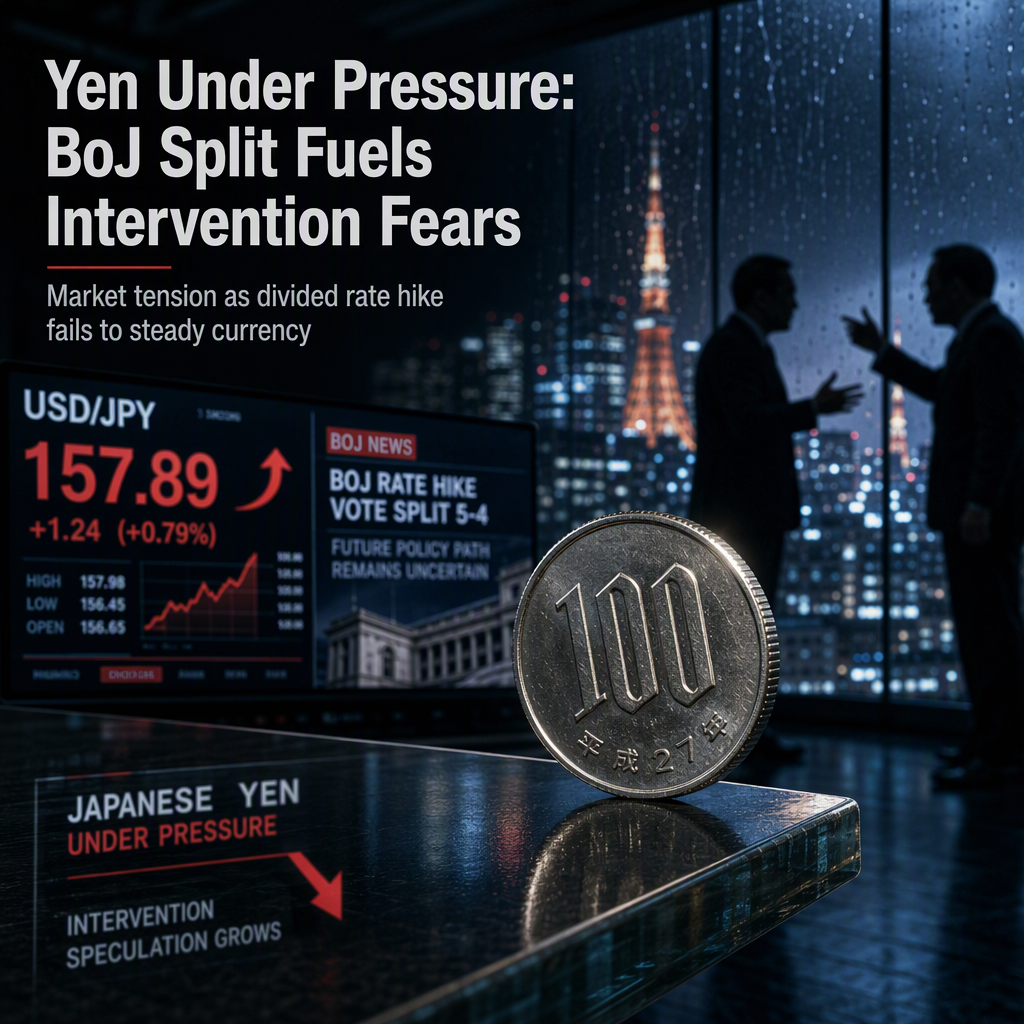
The Japanese Yen (JPY) continued to soften against the US Dollar, with the USD/JPY pair rising to around 157.60 during early Asian trading hours on Wednesday. This decline follows the Bank of Japan's (BoJ) recent decision to raise its policy rate by 25 basis points to 1.25%, marking the highest level since 1995. The rate hike was not unanimous, with a 7-2 vote split as board members Toichiro Asada and Ayano Sato dissented, which markets interpreted as a signal that further rate hikes may be difficult to implement, thereby weighing on the Yen [1].
BoJ Governor Kazuo Ueda stated that the central bank would not rule out any particular policy options in advance of board meetings when asked about the possibility of consecutive or larger rate hikes. However, Chidu Narayanan, chief APAC strategist at Wells Fargo, noted that while Ueda's press conference contained some hawkish elements, these were insufficient to meet the market's aggressively hawkish expectations [1].
Amid the Yen's weakness, traders are closely monitoring for potential currency intervention by Japanese authorities. The Nikkei newspaper reported that officials conducted rate checks last week, a move often seen as a precursor to intervention in the currency markets [1]. Strategists at OCBC highlighted that the BoJ's divided vote may act as a near-term headwind for the Yen, but emphasized that the central bank's apparent willingness to tighten policy more rapidly should help ease concerns about it lagging behind global peers. This evolving stance is expected to gradually support the Yen, even if short-term volatility persists [1].
On the US side, Fed's Collins delivered a notably hawkish message, supporting last week's rate hike and warning of persistent inflation risks above the 2% target. Collins' remarks, reflected in a high FXS Speechtracker score of 8.1/10, signaled a bias toward maintaining a 'somewhat more restrictive' federal funds rate for longer, a stance typically supportive of the Dollar and negative for risk-sensitive assets. The FXS Fed Sentiment Index also rose by 0.53 points, reinforcing the hawkish outlook [1].
CONCLUSION
The Japanese Yen remains under pressure due to the BoJ's lack of clear hawkish guidance and a divided policy board, prompting speculation about possible intervention. While the BoJ signals a gradual shift toward tighter policy, immediate market support for the Yen appears limited, especially as the US Fed maintains a hawkish stance. Market participants are likely to remain cautious, watching for further policy signals and potential intervention.