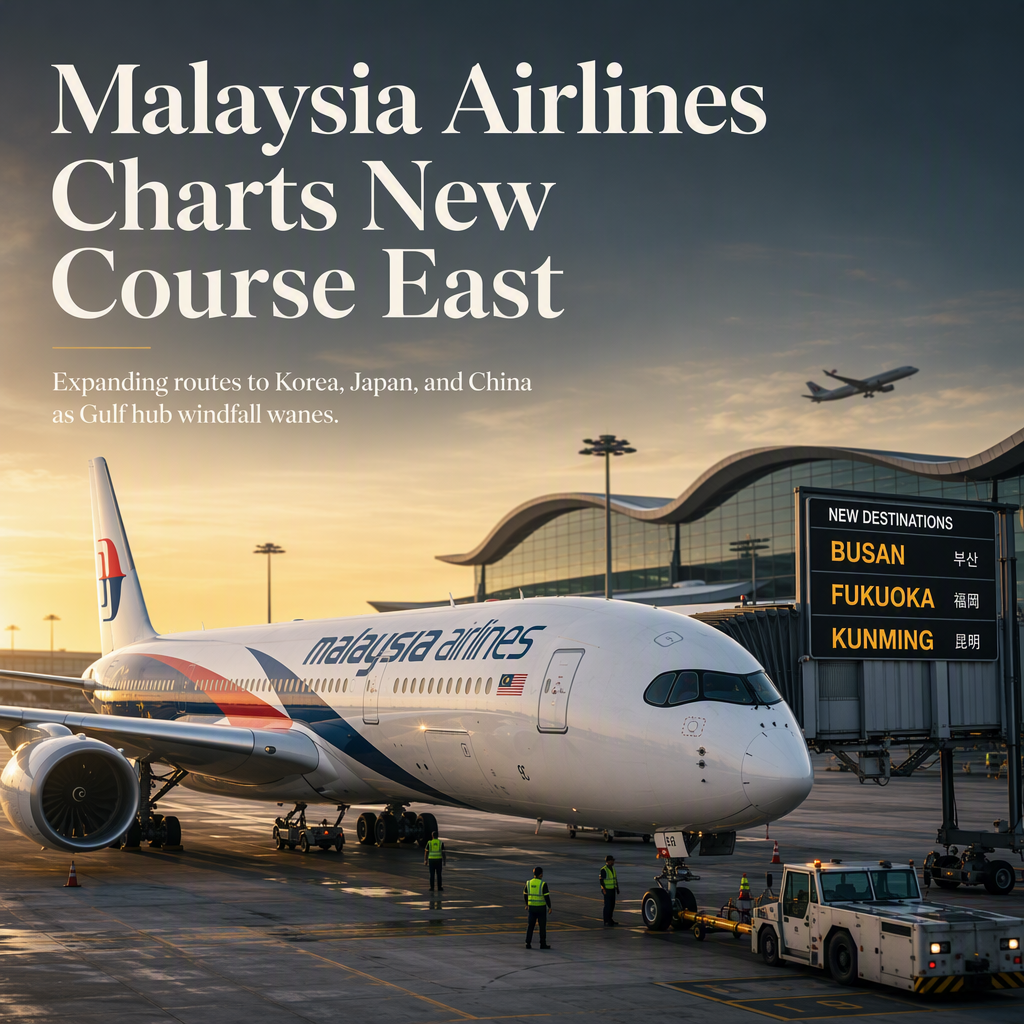
Malaysia Aviation Group (MAG), the state-owned parent company of Malaysia Airlines, is redirecting its strategic focus toward expanding routes in East Asia following a decline in the surge of demand that was previously driven by disruptions at major Gulf aviation hubs earlier this year [1]. The airline is increasing its service to several East Asian destinations, specifically adding new routes to Busan in South Korea, Fukuoka in Japan, and Kunming in China [1]. This move is part of Malaysia Airlines' efforts to capture new growth opportunities as the temporary windfall from Gulf unrest and operational disruptions has faded [1].
The expansion strategy is visually underscored by Malaysia Airlines planes stationed at Kuala Lumpur International Airport, signaling the carrier's commitment to this new direction [1]. While the article does not provide specific figures regarding passenger numbers, revenue impact, or market share, it highlights the airline's proactive approach in response to shifting market dynamics [1].
No forward-looking statements from analysts or market reactions are mentioned in the source. The article does not specify any financial projections, competitive responses, or detailed operational changes beyond the new route additions [1].
CONCLUSION
Malaysia Airlines is pivoting its growth strategy toward East Asia as the benefits from earlier Gulf hub disruptions subside. The airline's expansion into new cities in South Korea, Japan, and China reflects its efforts to adapt to changing market conditions and sustain growth momentum.