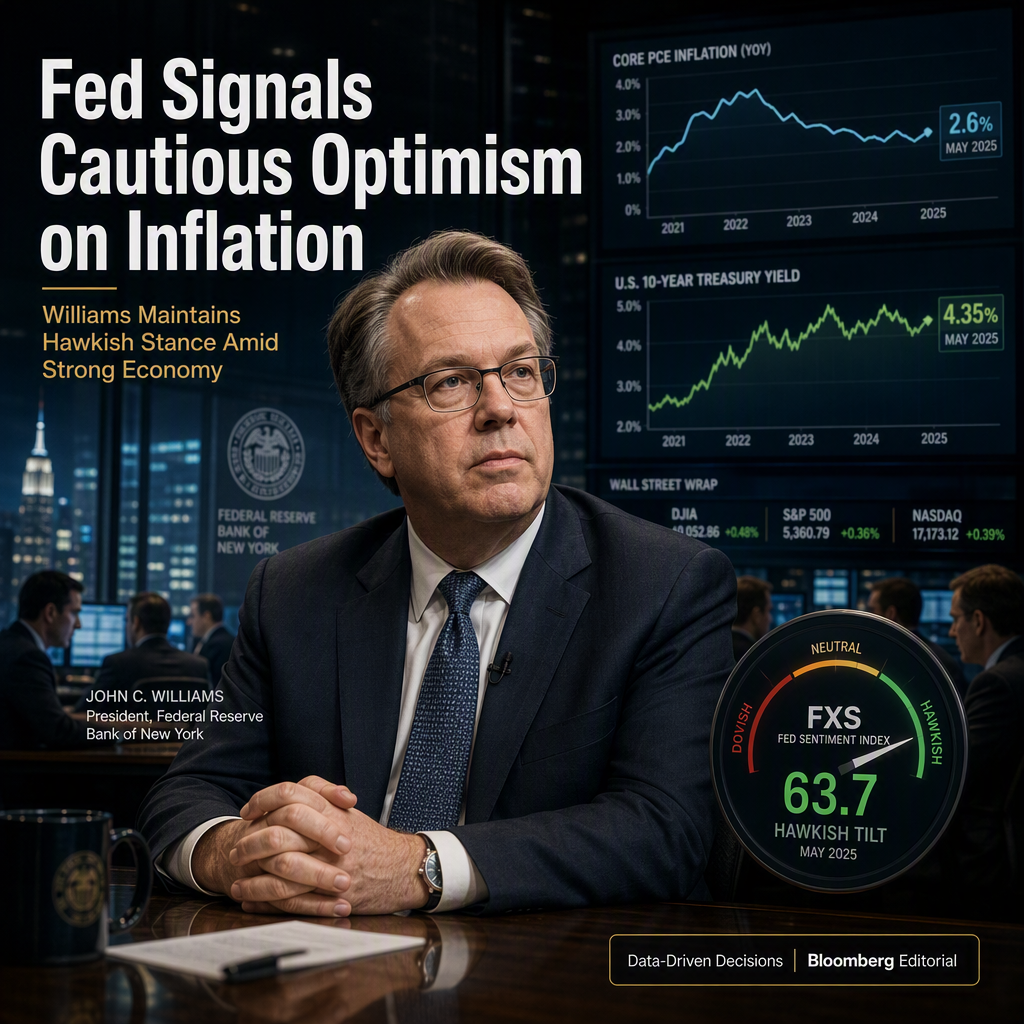
New York Federal Reserve Bank President John Williams stated in a CNBC interview that recent data on inflation have been encouraging, while emphasizing that the Federal Reserve remains focused on achieving its 2% inflation target as its primary objective [1]. Williams attributed current inflationary pressures to factors such as tariffs and the Middle East conflict, but noted that these have not led to unanchored inflation expectations or second-round inflation impacts from tariffs [1].
Williams described the current rise in bond yields as a reflection of a strong economy and robust investment demand, rather than concerns about the inflation outlook. He highlighted that the labor market remains 'stable and solid,' and that the Fed is taking a data-dependent approach, considering the totality of economic data when setting monetary policy [1].
The FXS Fed Sentiment Index declined by 1.42 points to 127.44, indicating a modest pullback in perceived hawkishness, though the overall level remains well above the neutral mark of 100. This suggests that, despite a slightly softer tone compared to recent communications, the Fed is still viewed as operating in hawkish territory, consistent with a strong economy narrative and a cautious approach to policy easing [1].
Williams expressed optimism about the long-term economic impact of artificial intelligence and supported the outcome of the July FOMC meeting, while stressing the need to collect more data ahead of the next meeting. He reiterated that things are working well with the current implementation of monetary policy [1].
CONCLUSION
Fed's Williams signaled cautious optimism on inflation, highlighting encouraging data and a stable labor market while maintaining a hawkish stance. The Fed remains committed to its 2% inflation goal and is unlikely to rush into policy easing, with future decisions dependent on incoming data. Market sentiment reflects a strong economy and a measured approach to monetary adjustments.