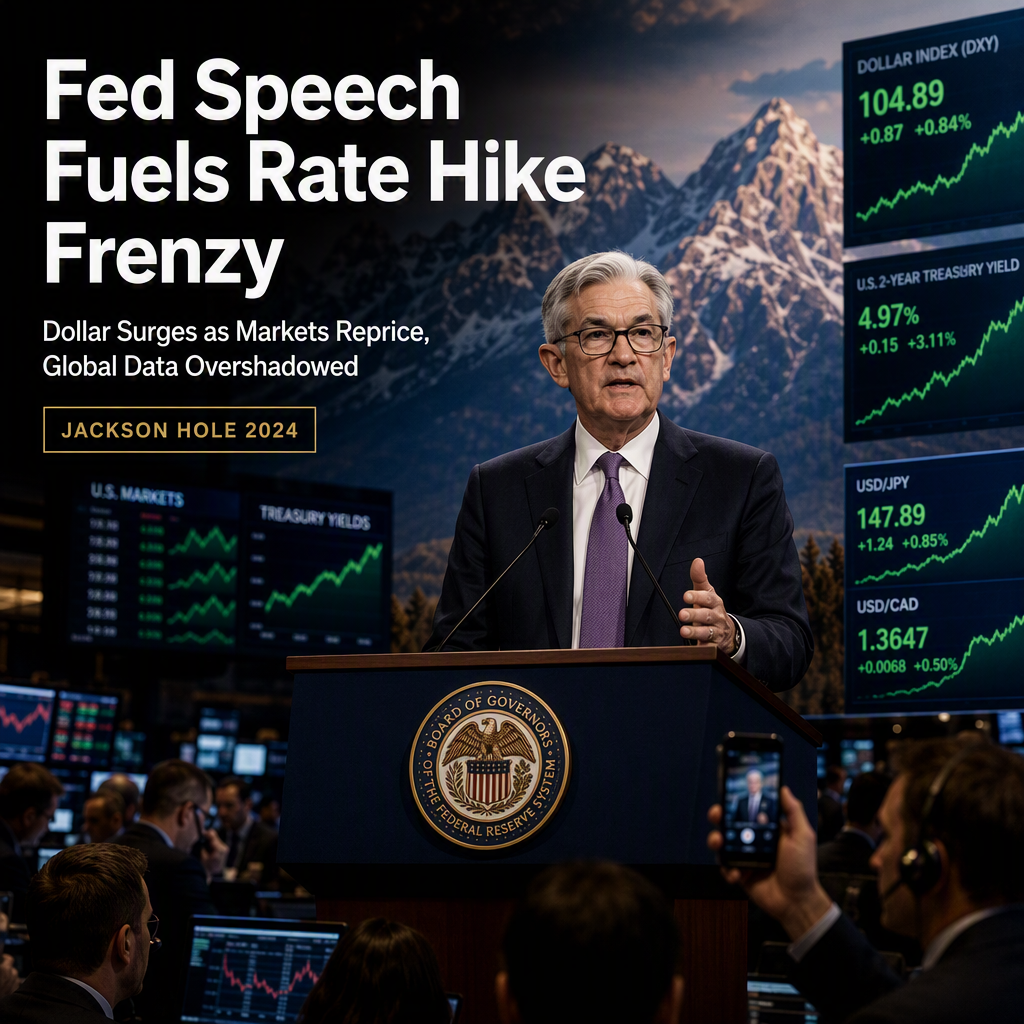
Federal Reserve Chair delivered a keynote speech at Jackson Hole that notably withheld forward guidance, reaction functions, or specific numerical thresholds for future policy moves, instead committing to a disciplined, rules-based approach without defining the rules themselves [1]. Despite the lack of explicit direction, the speech prompted a significant repricing in futures markets: the probability of a quarter-point rate hike at the September 16 FOMC meeting jumped above 55% from 35.4% the previous day, marking the first outright majority for a hike this cycle [1][2][3]. Odds for at least one increase by October 28 are near 85%, and a second hike by December 9 is priced at roughly 38% [2][3].
The market reaction was immediate and pronounced. The Dow Jones Industrial Average initially dipped to its daily low during the speech but rebounded to its first look above 53,800 since mid-month within ninety minutes [1]. Two-year Treasury yields, which are sensitive to Fed policy, rose more than six basis points to their highest in a month, while longer-term yields remained flat, resulting in a flatter yield curve [1]. The USD/JPY surged, taking the 160.00 handle and adding roughly 65 pips since the speech, while USD/CAD climbed about 50 pips in half an hour after the remarks [2][3].
The speech's omission of any reference to the Treasury operation that will double the ceiling on longer-dated buybacks from September 9 was noted as significant, as this operation provides duration support not directly voted on by the FOMC [1]. The chair also acknowledged the challenges of forecasting in a rapidly changing environment, citing geopolitics, supply chains, and technology as complicating factors [1].
Globally, the Fed's hawkish tone overshadowed strong domestic data in other countries. In Japan, Tokyo CPI inflation excluding food and energy reached 2% in August, and unemployment fell to 2.4%, the lowest in a year, fueling speculation about a Bank of Japan rate hike on September 18 [2]. However, the persistent interest rate gap with the U.S. (projected to remain around 250 basis points even if both central banks tighten) kept the yen under pressure, with the only scenario favoring the yen being a Japanese hike against a Fed hold—a scenario futures put at just 44% [2]. In Canada, GDP grew at an annualized 3.3% in Q2, the fastest since early 2023 and above the Bank of Canada's forecast, yet the Canadian dollar weakened as the expected policy rate spread with the U.S. widened following the Fed chair's remarks [3].
Analyst and market commentary across the sources highlight that the Fed's ambiguous but disciplined stance has left markets to interpret tone rather than explicit guidance, resulting in heightened volatility and a repricing of rate expectations [1][2][3]. The immediate market impact has been a stronger U.S. dollar and higher short-term yields, with global currencies and equities reacting more to U.S. policy signals than to their own domestic data.
CONCLUSION
The Federal Reserve chair's Jackson Hole speech, despite offering no explicit forward guidance, triggered a sharp repricing of U.S. rate hike expectations and drove significant moves in global currency and bond markets. Strong economic data from Japan and Canada was overshadowed by the Fed's perceived hawkishness, reinforcing the U.S. dollar's dominance and highlighting the market's sensitivity to U.S. monetary policy signals.