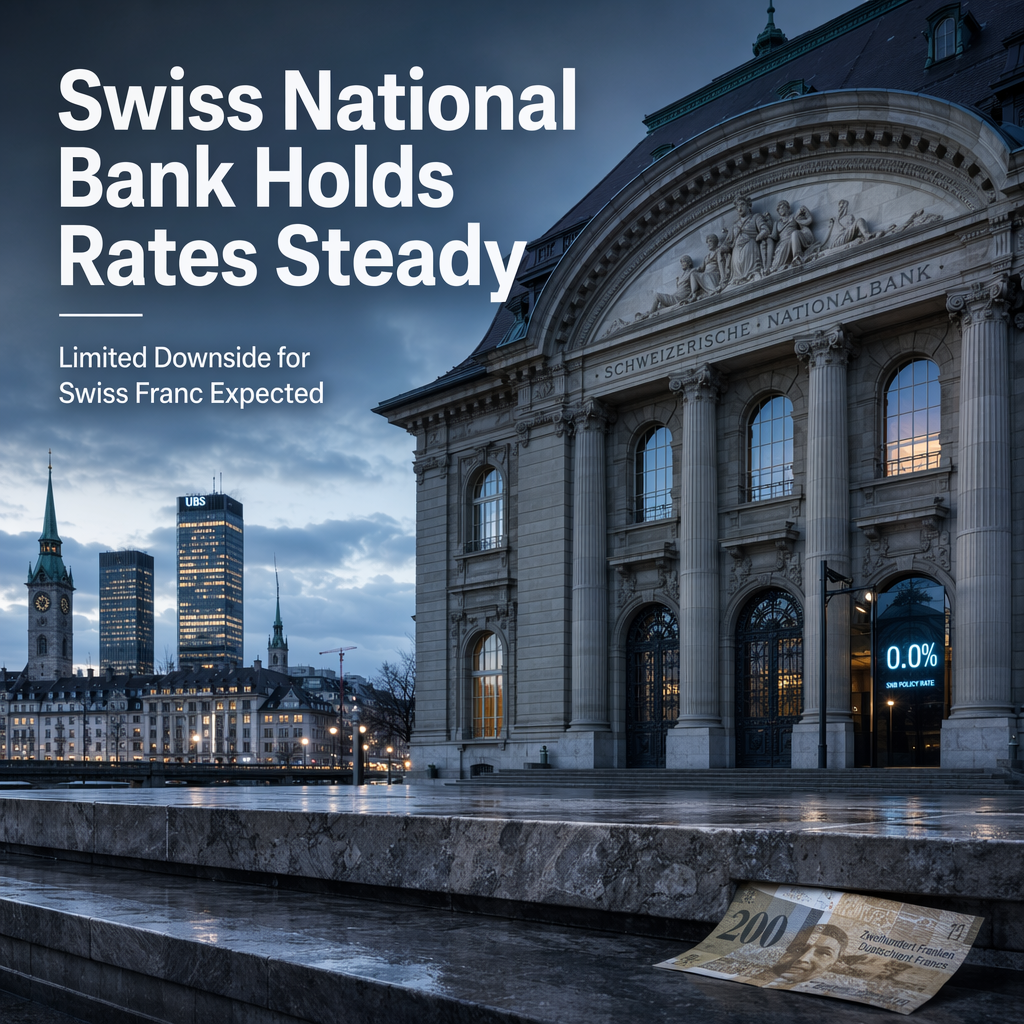
The Swiss National Bank (SNB) maintained its key policy rate at 0.0% during its recent meeting, a move that was widely anticipated by market participants [1][2]. According to MUFG’s Derek Halpenny, the Swiss Franc underperformed against most G10 currencies following the decision, ranking as the third worst performer, with only the Norwegian Krone (NOK) and Swedish Krona (SEK) faring worse [1]. The SNB made only minor revisions to its inflation forecasts, reinforcing expectations for persistently low inflation in Switzerland [1]. The central bank reiterated its readiness to intervene in the foreign exchange market if necessary to prevent excessive currency strength that could undermine its price stability objective. President Schlegel emphasized that the phrase 'if necessary' does not signal a reduced willingness to act [1].
MUFG notes that the limited adjustments to inflation projections slightly reduce the likelihood of the SNB reverting to negative rates if required [1]. The global rise in yields since the onset of recent geopolitical conflicts has contributed to the weakening of the Swiss Franc, making it the second worst performing G10 currency since the start of the conflict. However, some of this movement is attributed to easing geopolitical risks and a smaller-than-feared inflation shock from the Middle East conflict [1]. Looking ahead, MUFG expects limited further upside for global yields and forecasts that the Federal Reserve, European Central Bank (ECB), and Bank of England (BoE) will cut rates next year, which should constrain further weakness in the Swiss Franc [1].
ING’s FX team also commented on the SNB’s decision, noting that Switzerland, along with Norway, held rates steady in their latest meetings [2]. ING expects the SNB to keep rates at 0.0% for at least another two years [2]. While ING’s primary focus is on the EUR/USD outlook, they highlight the SNB’s steady policy as part of the broader European rate environment [2].
Both sources indicate that the SNB’s cautious stance and commitment to low rates are likely to limit downside risks for the Swiss Franc, with market participants not expecting significant policy shifts in the near term [1][2].
CONCLUSION
The SNB’s decision to keep rates unchanged at 0.0% and its cautious communication have contributed to the Swiss Franc’s recent underperformance, but both MUFG and ING see limited downside ahead. With persistently low inflation and expectations for stable SNB policy, the Franc is likely to remain supported, especially as major central banks are forecast to cut rates next year. Market impact is moderate, with no immediate policy changes anticipated.