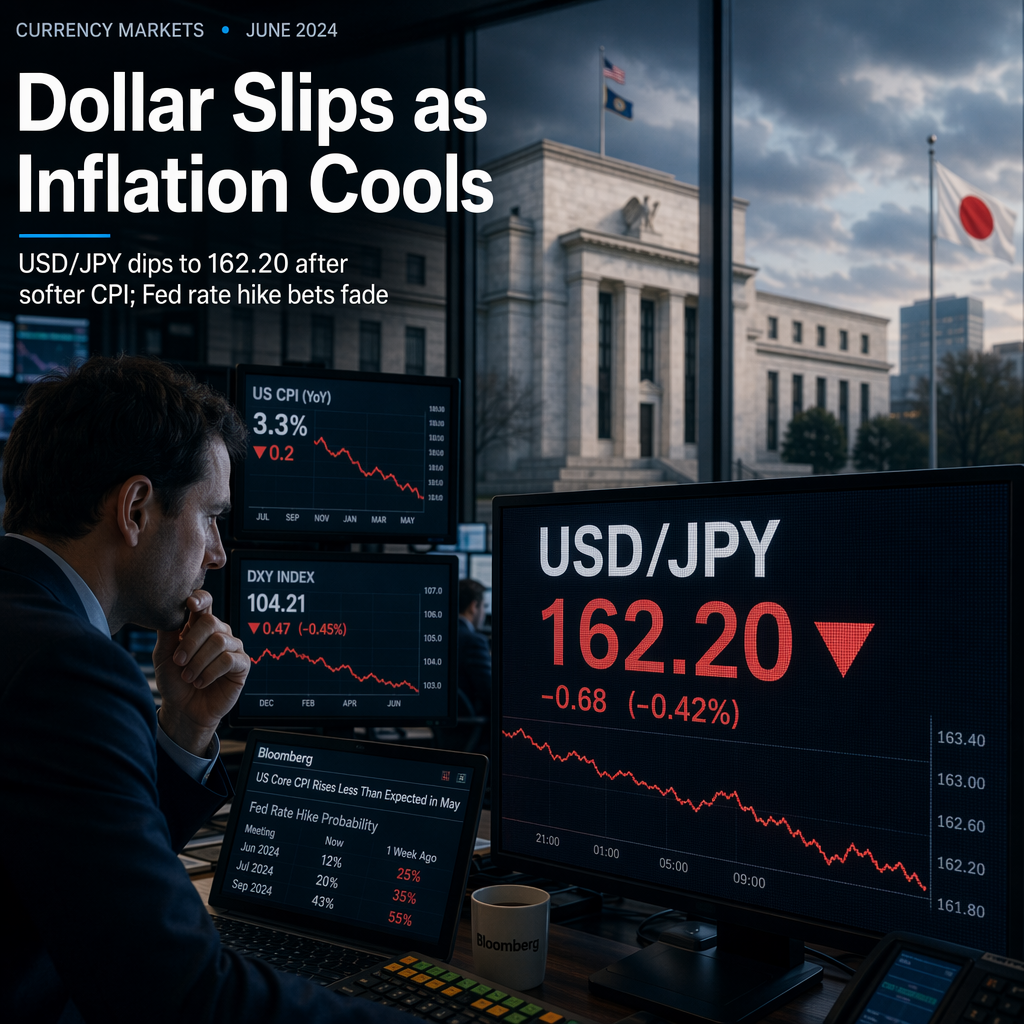
The USD/JPY currency pair traded slightly lower at around 162.20 during the European session on Wednesday, reflecting a modest decline as the US Dollar underperformed against major currencies. This weakness in the Greenback was attributed to easing fears of further interest rate hikes by the Federal Reserve, following the release of a softer US Consumer Price Index (CPI) report for June. The report indicated that headline inflation decelerated to 3.5% year-on-year, while core inflation slowed to 2.6% year-on-year, prompting traders to trim hawkish bets on the Fed's policy trajectory [1].
At the same time, the US Dollar Index (DXY), which measures the currency against a basket of six major peers, was down 0.16% to near 100.78 at press time. The US Dollar was the weakest against the Euro, declining by 0.18%, and also posted losses against the British Pound (-0.13%) and Japanese Yen (-0.05%) [1].
Fed Chairman Kevin Warsh, in his testimony on Tuesday, emphasized the central bank's commitment to price stability, stating, “The Fed has no tolerance for persistently elevated inflation. If we get policy right - and we will - the inflation surge of the last five years will be a thing of the past” [1]. Despite this, the market's focus remains on the softer inflation data and the reduced likelihood of imminent rate hikes.
On the technical front, USD/JPY is trading near the 20-period exponential moving average at 162.10, indicating a sideways trend. The formation of an Ascending Triangle chart pattern suggests a sharp contraction in volatility, while the Relative Strength Index (RSI) at 51.51 signals steady but not overstretched buying pressure. Immediate resistance is noted at the descending trend line around 162.7 [1].
In Japan, investors are awaiting further cues on whether the Bank of Japan will raise interest rates again this year, though no definitive signals have emerged [1].
CONCLUSION
The USD/JPY pair is experiencing modest downward pressure as softer US inflation data and a less hawkish Fed outlook weigh on the US Dollar. Technical indicators point to a period of consolidation, while market participants await further guidance from both the Federal Reserve and the Bank of Japan. The overall market sentiment is slightly negative for the US Dollar in the near term.