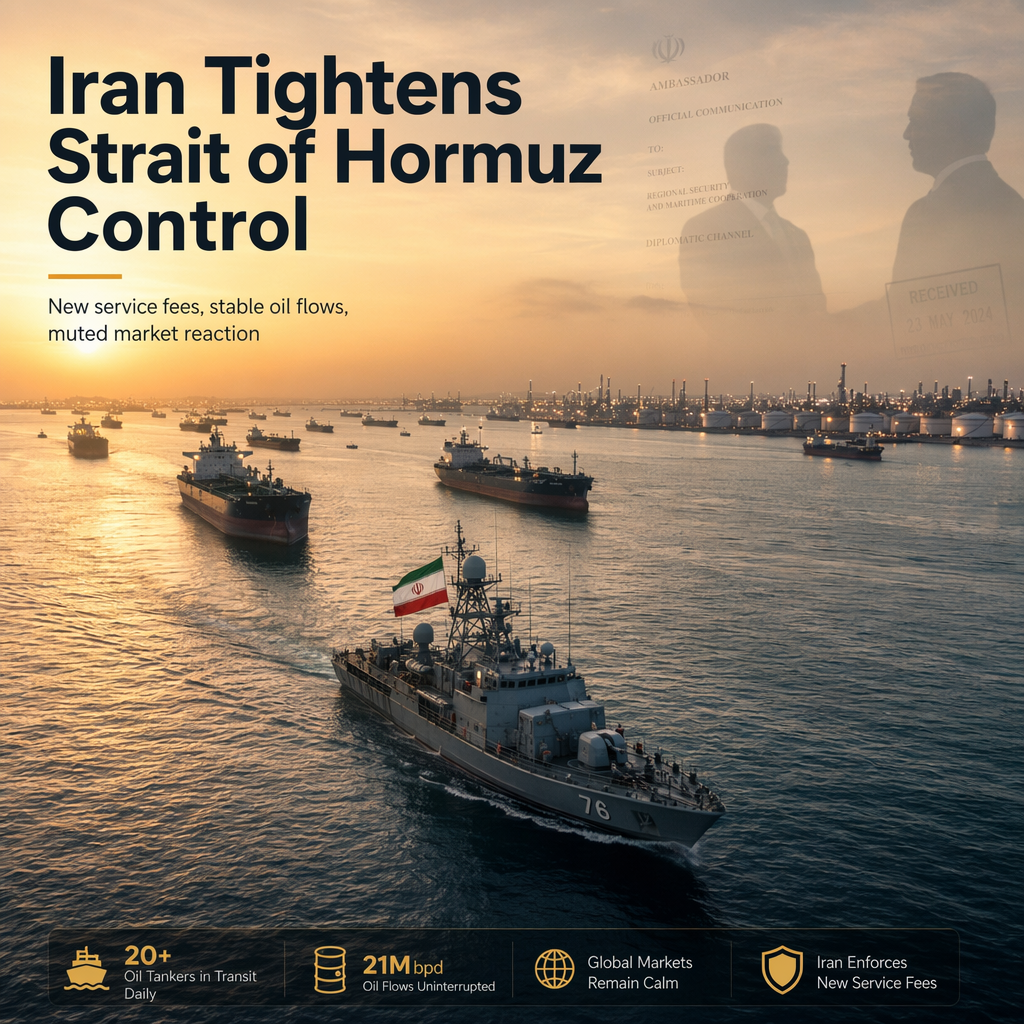
Iran has confirmed plans to introduce new service fees for ships passing through the Strait of Hormuz, a critical global oil transit chokepoint, according to statements by Iran’s ambassador to China, Abdolreza Rahmani Fazli, at the World Peace Forum in Beijing. Fazli emphasized that these charges should not be considered a 'toll' and noted that countries which supported Iran during the recent conflict would receive 'special' treatment regarding these fees [1].
Iran’s Foreign Ministry clarified that mine clearance operations in the Strait are governed by an existing memorandum of understanding (MoU), and Tehran sees no need for third-party intervention in these activities [1]. In parallel, US Vice President JD Vance stated that oil traffic through the Strait of Hormuz has returned to pre-war levels, indicating a normalization of shipping flows despite the new fee announcement [1].
On the diplomatic front, Iran’s Parliament Speaker Mohammad Bagher Ghalibaf asserted that Tehran will not engage in final agreement talks with the US until all clauses of the MoU are implemented, including an end to hostilities in Lebanon and the release of frozen Iranian funds [1].
Despite these developments, the market reaction has been muted, with WTI—the US oil benchmark—remaining weak near $69 at the start of the week, suggesting that traders are not currently pricing in significant supply disruptions or risk premiums related to the Strait of Hormuz situation [1].
CONCLUSION
Iran’s confirmation of new service fees for ships transiting the Strait of Hormuz and its rejection of third-party intervention have not led to immediate market volatility, as oil flows remain stable and WTI prices are subdued. The market appears to be taking a wait-and-see approach, with no significant risk premium reflected in oil prices at this time.