
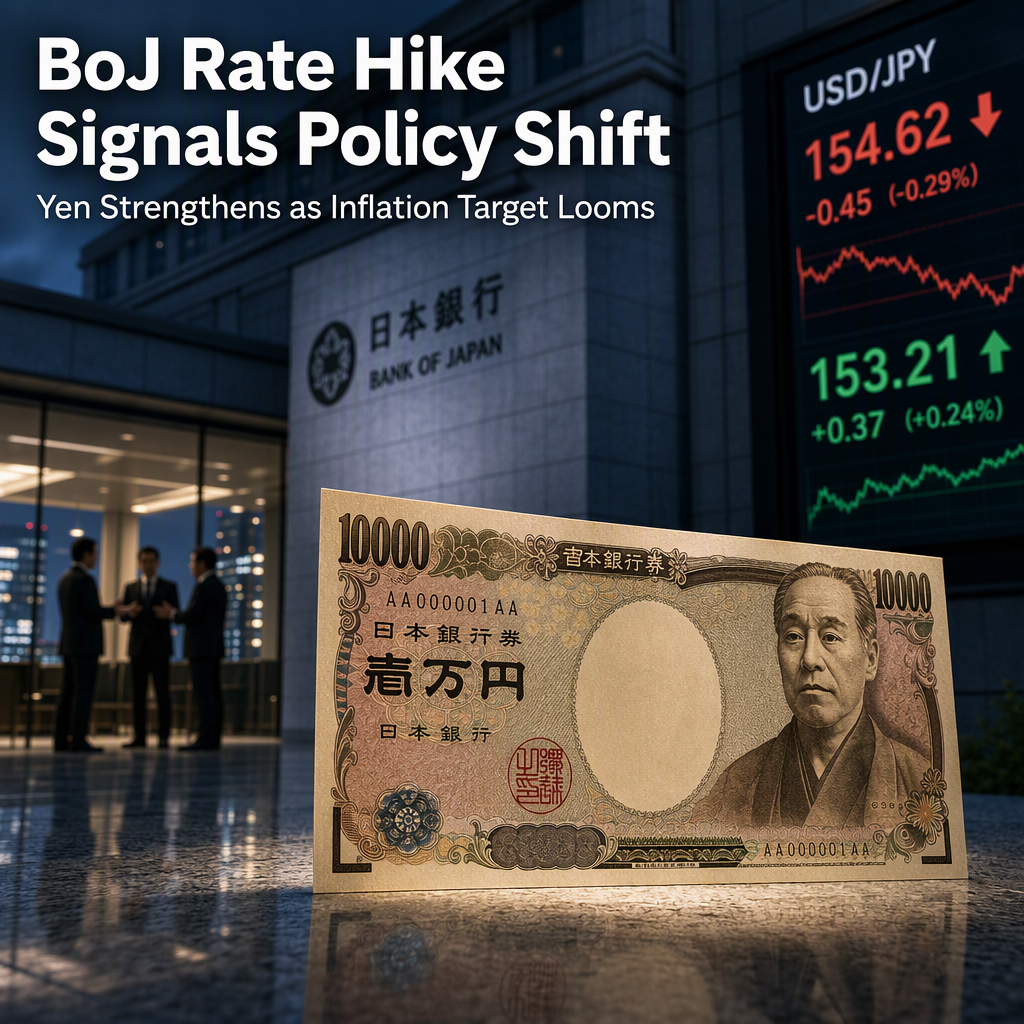
Japanese Finance Minister Satsuki Katayama stated that the Bank of Japan's (BoJ) most recent rate hike was implemented to achieve its inflation target, emphasizing the central bank's commitment to conducting appropriate monetary policy in coordination with the government [1]. Katayama clarified that specific monetary policy tools are determined by the BoJ, and refrained from commenting on particular foreign exchange levels or rate checks [1]. She also noted that former US President Trump expressed concerns about the weak yen during a summit, and that Japan will closely coordinate with the US on forex matters. Prime Minister Takaichi has similarly voiced concerns regarding yen weakness [1].
At the time of reporting, the USD/JPY currency pair was down 0.24% on the day, trading at 158.48, indicating a modest strengthening of the yen following the BoJ's policy move [1]. The BoJ's mandate is to ensure price stability, targeting an inflation rate of around 2%. Historically, the BoJ pursued an ultra-loose monetary policy since 2013, including Quantitative and Qualitative Easing (QQE), negative interest rates, and yield curve control. However, in March 2024, the BoJ lifted interest rates, signaling a retreat from its ultra-loose stance [1].
The BoJ's previous stimulus measures led to significant yen depreciation against major currencies, especially as other central banks raised rates to combat inflation. This widened the policy differential and further weakened the yen. The shift in 2024, with the BoJ abandoning its ultra-loose policy, was prompted by rising inflation—driven by a weaker yen, higher global energy prices, and the prospect of increasing salaries in Japan, which pushed inflation above the BoJ's 2% target [1].
While no forward-looking analyst opinions are provided, Katayama's remarks suggest ongoing government and central bank coordination, as well as continued attention to currency stability and inflation management [1].
CONCLUSION
The Bank of Japan's latest rate hike marks a strategic shift aimed at achieving its inflation target and addressing yen weakness. The immediate market reaction saw the yen strengthen modestly against the US dollar. Ongoing coordination between the Japanese government and BoJ, as well as international dialogue, signals continued focus on monetary stability and inflation control.