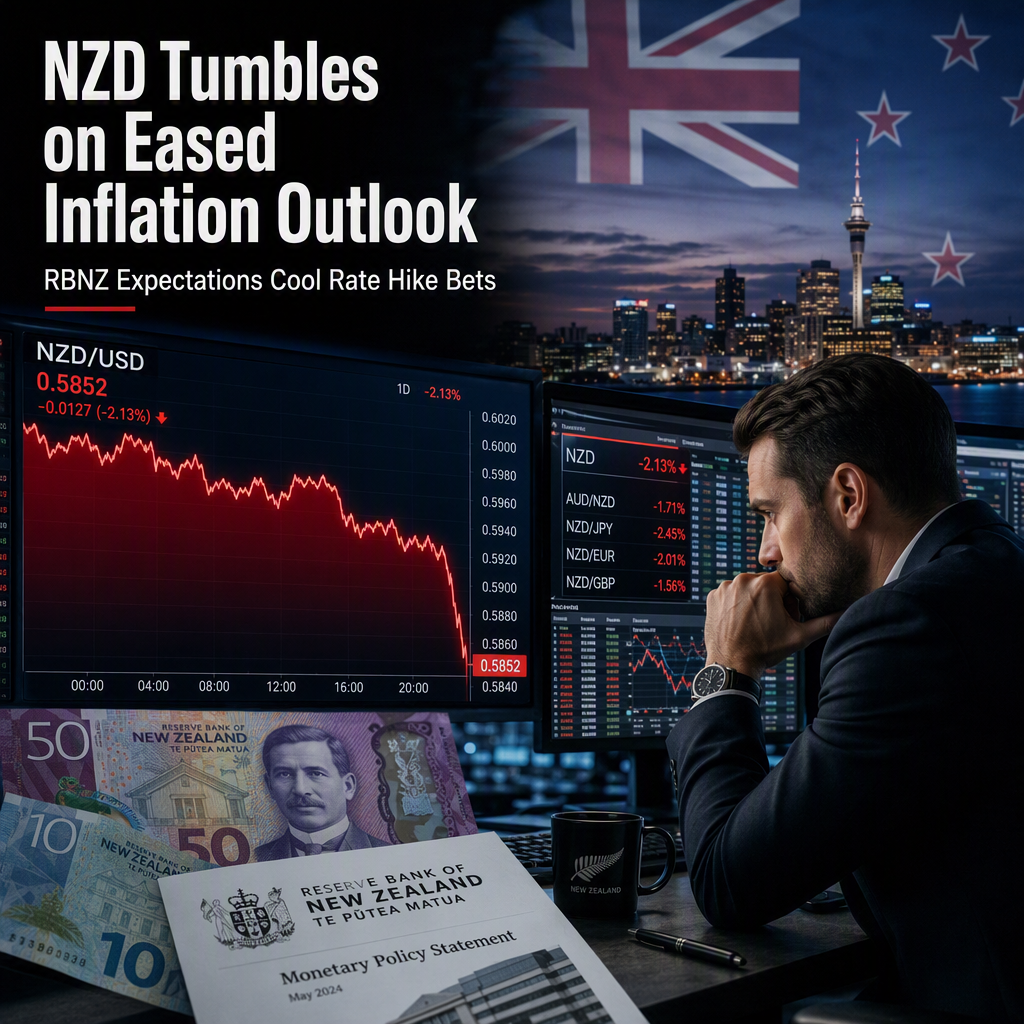
The New Zealand Dollar (NZD) declined sharply against the US Dollar (USD), trading 0.45% lower at approximately 0.5830 during the European session on Thursday, as revised Reserve Bank of New Zealand (RBNZ) two-year inflation expectations for Q3 came in lower at 2.34% year-on-year, down from 2.53% in the previous quarter [1]. This cooling in inflation expectations has led to increased skepticism regarding the likelihood of an RBNZ interest rate hike at the upcoming September policy meeting, despite earlier market confidence in a rate increase [1].
TD Securities commented that, despite mixed labor market data, the RBNZ is likely to maintain its hawkish bias, suggesting the central bank could still hike rates by 25 basis points in September if economic activity continues to recover in Q3. The bank believes policymakers can look past short-term labor market fluctuations as long as the broader economic recovery remains intact [1].
Meanwhile, the US Dollar has retained its strength, supported by ongoing Middle East tensions and a cooling US Consumer Price Index (CPI) in July, which could potentially limit further USD gains [1]. Technical analysis indicates that NZD/USD is extending its correction, with immediate resistance at 0.5870 and key support at 0.5827. A break below this support could lead to further declines toward 0.5800 and the July 29 low at 0.5761 [1].
CONCLUSION
The NZD/USD pair is under pressure following a downward revision in New Zealand's inflation expectations, which has reduced market confidence in a near-term RBNZ rate hike. While some analysts still see room for tightening, the currency remains vulnerable to further declines if support levels are breached.