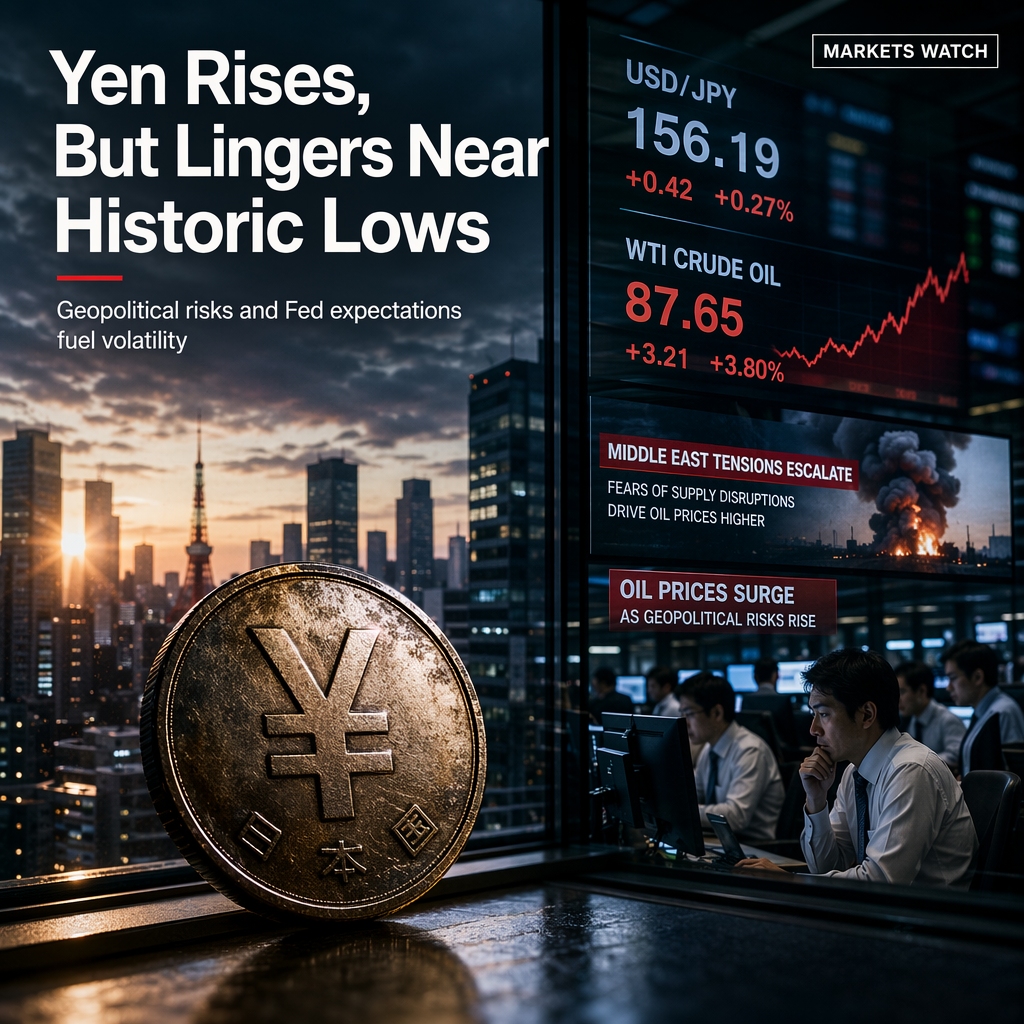
The Japanese Yen (JPY) gained modestly on Thursday, with the USD/JPY pair trading slightly lower around 162.45. Despite this uptick, the Yen remains near its lowest levels in four decades, reflecting persistent structural challenges such as Japan's low interest rates and a deteriorating fiscal outlook [1]. Traders remain vigilant for potential intervention by Japanese authorities, though previous suspected interventions have had only short-lived effects [1].
Japan's Chief Cabinet Secretary Minoru Kihara emphasized the government's commitment to 'secure market trust by stably lowering the government debt-to-GDP ratio' and noted that officials are monitoring markets with a 'very high sense of urgency' [1]. A key near-term risk for the Yen is the renewed fighting between the United States and Iran, which has driven up oil prices and heightened concerns about disruptions to crude flows through the Strait of Hormuz [1]. Higher oil prices are particularly negative for the Yen, given Japan's heavy reliance on imported energy from the Middle East [1].
The rebound in oil prices has also brought inflation back into focus, increasing pressure on central banks to maintain restrictive monetary policies. Markets are currently pricing in a 63% probability of a Federal Reserve interest rate hike at the September meeting [1]. Hawkish Fed expectations, combined with escalating geopolitical tensions, have kept the US Dollar's downside limited. The US Dollar Index (DXY) is trading around 101.00 after hitting an intraday low of 100.79 [1].
While the Bank of Japan continues its gradual policy normalization, its pace of tightening lags behind other major central banks, maintaining a wide interest rate differential between Japan and the United States that supports USD/JPY [1]. According to the latest data, the US Dollar was 0.10% weaker against the Yen today, but remains the strongest against the British Pound [1].
CONCLUSION
The Japanese Yen's modest gains have done little to lift it from multi-decade lows, as structural and geopolitical headwinds persist. Market participants remain alert for possible intervention, but the wide interest rate gap and rising oil prices continue to weigh on the Yen. Hawkish Fed expectations and ongoing tensions in the Middle East suggest continued volatility for USD/JPY.