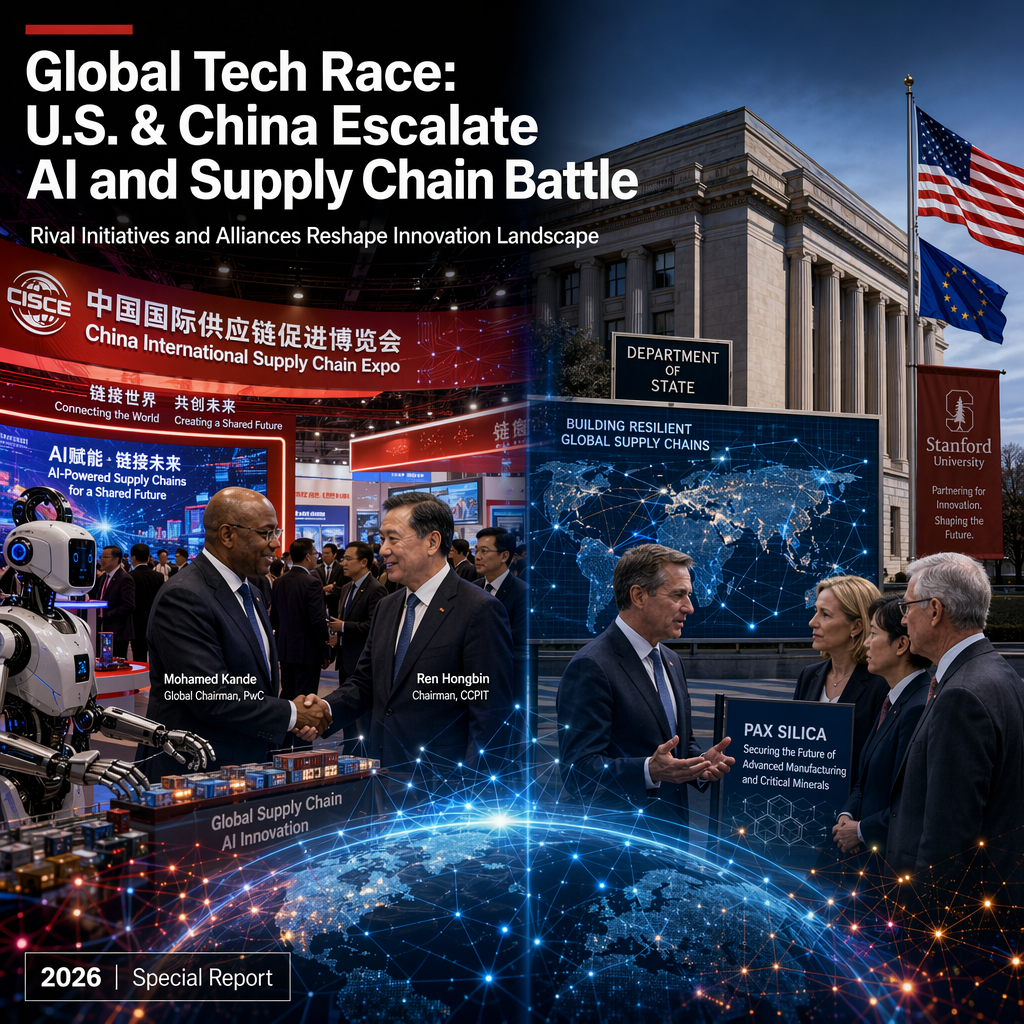
The U.S.-China technology rivalry is escalating, with both countries making strategic moves to secure global market share, particularly in artificial intelligence and supply chain innovation. Market strategist Peter Boockvar emphasized that U.S. tech investors should closely monitor the growing competition from Chinese tech firms, which often prioritize market share over profit margins [1]. Recent events highlight this intensifying competition, as Chinese companies rapidly expand their presence in global markets, launching low-cost AI models with capabilities comparable to American offerings and moving toward industrial integration [1].
At the China International Supply Chain Expo in Beijing on June 24, 2026, PwC Global Chair Mohamed Kande showcased the company's booth to Ren Hongbin, Chairman of the China Council for the Promotion of International Trade (CCPIT). Kande stated that AI-driven manufacturing will generate new jobs and opportunities not only in China but also internationally, as companies worldwide leverage Chinese technology [1]. The expo, which began in 2023 following President Xi Jinping's call to enhance industrial security, underscores China's ambition to play a larger role in global innovation and industrial chains [1].
Chinese Premier Li Qiang, speaking at the World Economic Forum's "Summer Davos" in Dalian, referenced the expo to highlight how innovation can counteract global economic challenges. He cited 10 billion downloads of China's open-source AI models worldwide and pledged that China would integrate more proactively into global innovation and industrial chains [1]. According to a PwC report released at the expo, Chinese companies are leading in cross-industry AI collaboration compared to their U.S. counterparts [1].
Meanwhile, the U.S. is advancing its own initiatives. The State Department recently enlisted new European participants for its "Pax Silica" initiative, aimed at securing global tech supply chains and encouraging countries to support U.S. technology over competing systems [1]. Following the two-day Pax Silica summit in Washington, D.C., the U.S. launched an advanced manufacturing program in partnership with Stanford University [1].
These developments signal a new phase in the U.S.-China tech rivalry, with both nations leveraging policy, partnerships, and technological advancements to strengthen their positions in the global market.
CONCLUSION
The U.S.-China tech rivalry is entering a critical stage as both countries intensify efforts to expand their global influence in AI and supply chain technology. With significant initiatives and partnerships announced on both sides, market participants should expect heightened competition and rapid innovation in the sector.