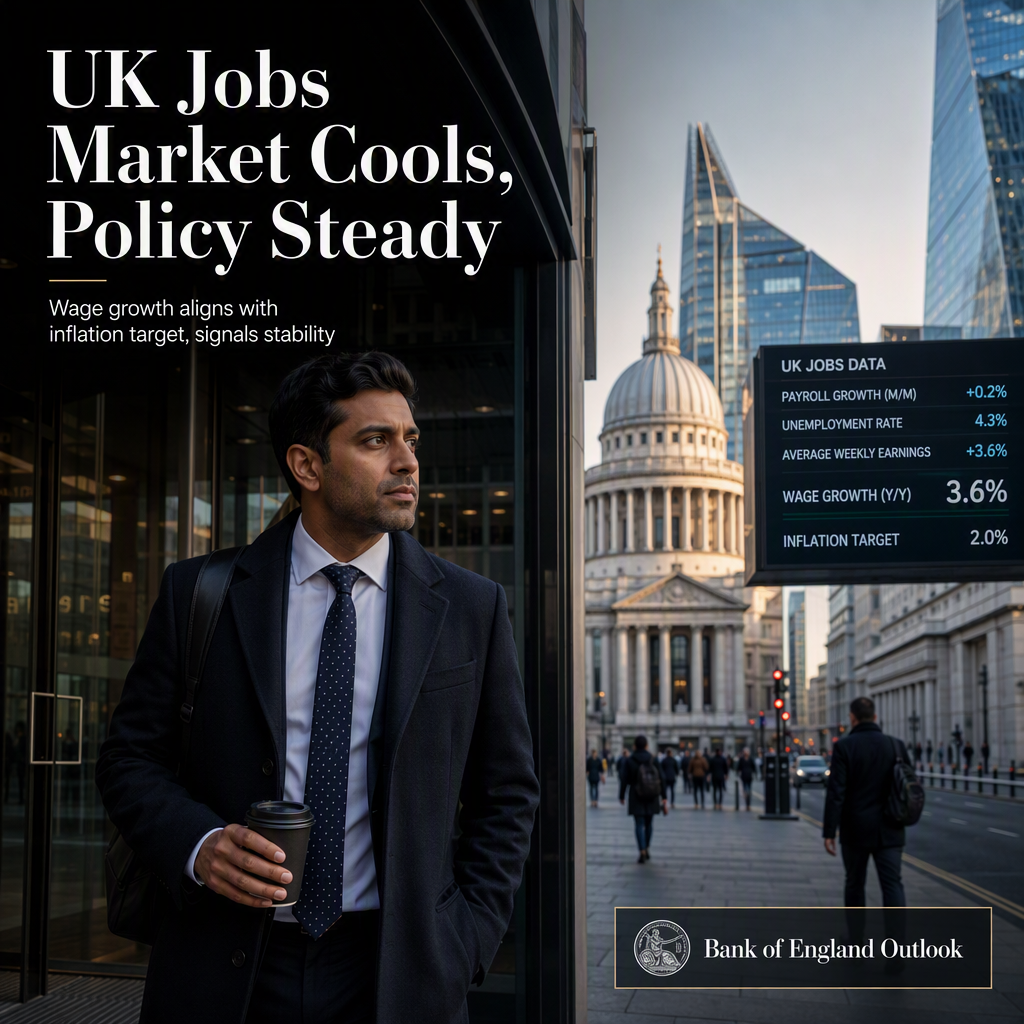
Recent United Kingdom jobs data indicate a cooling labour market and weaker wage growth, according to ING economist James Smith. Smith highlights that private sector wage growth has stabilized at 2.9%, or approximately 3.3% when adjusted for compositional effects, which aligns with the Bank of England’s 2% medium-term inflation target based on the central bank’s own analysis earlier this year [1].
Smith notes that the UK jobs market is significantly cooler compared to the period following the Ukraine shock four years ago, reducing the likelihood of severe second-round inflation effects from higher energy prices. He states, 'All of this goes hand in hand with the weak wage growth we’re seeing,' and emphasizes that the current wage dynamics support the case for steady monetary policy [1].
ING’s base case is for the Bank of England to keep interest rates on hold into next year, despite the risk of higher energy prices. Smith expects another 6-3 vote to maintain rates at the upcoming meeting and does not anticipate a major hawkish shift among policymakers at this time. However, he acknowledges that a rate hike later in the year cannot be entirely ruled out if energy prices remain elevated [1].
Overall, the latest jobs report reinforces the view that the UK economy is less vulnerable to another prolonged inflation wave, supporting the Bank of England’s cautious approach to monetary policy [1].
CONCLUSION
The latest UK jobs data suggest a cooler labour market and wage growth consistent with the Bank of England’s inflation target, reducing the risk of renewed inflation pressures. ING expects the central bank to keep rates steady into next year, with only a limited chance of a rate hike if energy prices remain high. Market participants are likely to interpret this as a signal of policy stability in the near term.