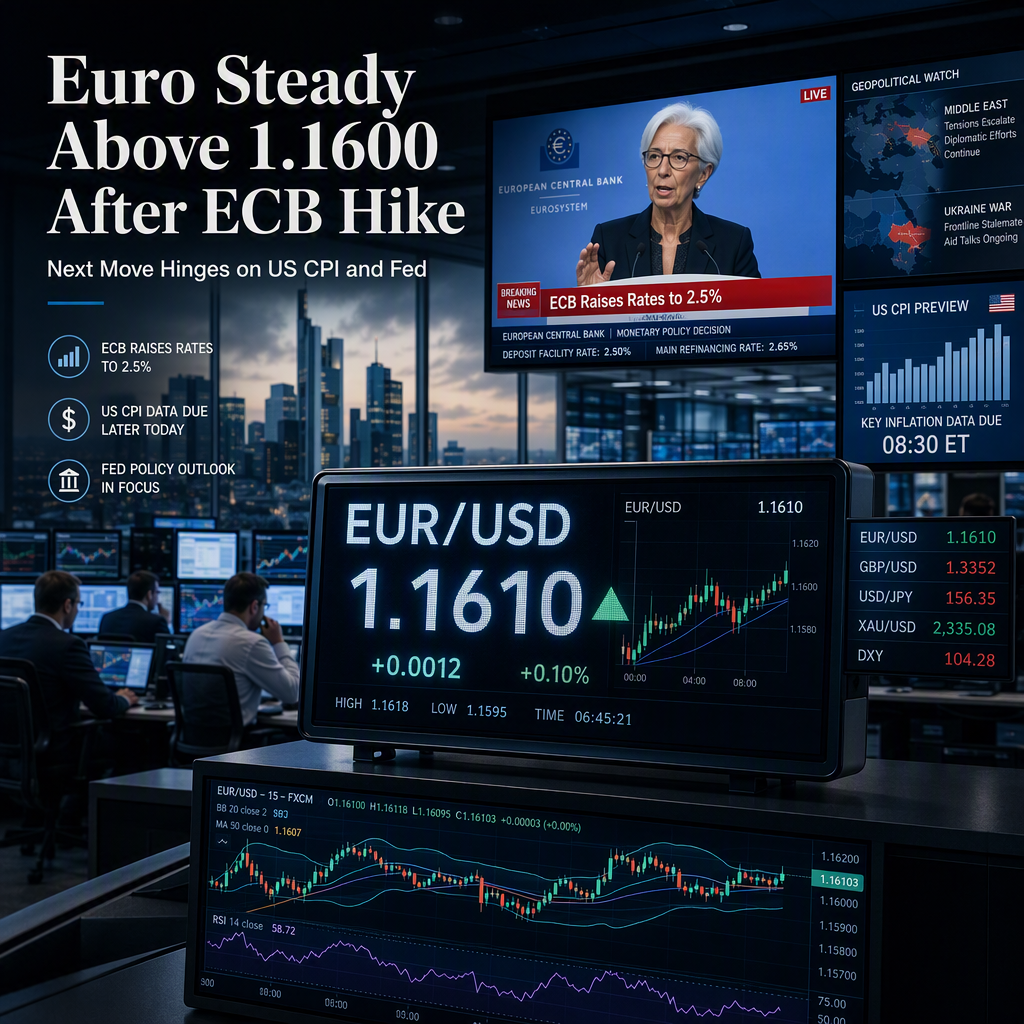
The EUR/USD pair remained stable around 1.1610 during the early Asian session on Friday, following the European Central Bank's (ECB) decision to raise the interest rate on the deposit facility to 2.50% at its September policy meeting on Thursday, marking the second hike this year after a previous increase in June [1]. ECB President Christine Lagarde cautioned that ongoing geopolitical tensions, including the conflict in the Middle East and developments in Russia’s war on Ukraine, are expected to keep headline inflation 'well above target'—the bank’s 2% target—for an extended period [1].
Analysts interpreted Lagarde’s comments as hawkish, with FX strategist Roman Ziruk noting that the ECB’s communications had a hawkish tilt, potentially supporting the euro in the near term [1]. Scotiabank analysts anticipate the ECB will maintain a firm stance at upcoming meetings, expecting a 'forceful endorsement in favor of further near-term tightening' due to rising oil prices and persistent inflation risks [1].
On the technical front, EUR/USD maintains a modest bullish bias, trading above the 100-day simple moving average (SMA) and supported by the lower Bollinger Band near 1.1561. The Relative Strength Index (RSI) at 53.9 suggests a slightly positive outlook, with immediate resistance at the 20-day SMA around 1.1628 and further resistance at the upper Bollinger Band near 1.1695. Initial support is seen at the 100-day SMA and lower Bollinger Band in the 1.1560 area [1].
Meanwhile, hotter-than-expected US Producer Price Index (PPI) inflation data has increased market expectations for a US Federal Reserve rate hike next week, with the CME FedWatch Tool indicating nearly 70% odds of an increase, up from 62% prior to the data release [1]. Market participants are now cautious ahead of the key US Consumer Price Index (CPI) inflation data, which could provide further direction for the US interest rate outlook [1].
CONCLUSION
The ECB’s hawkish rate hike and forward guidance have kept the euro steady above 1.1600, with analysts expecting further tightening if inflation risks persist. However, market sentiment remains cautious as traders await US CPI data and monitor the possibility of a US Fed rate hike next week. The euro’s near-term direction will likely depend on upcoming inflation data and central bank communications.