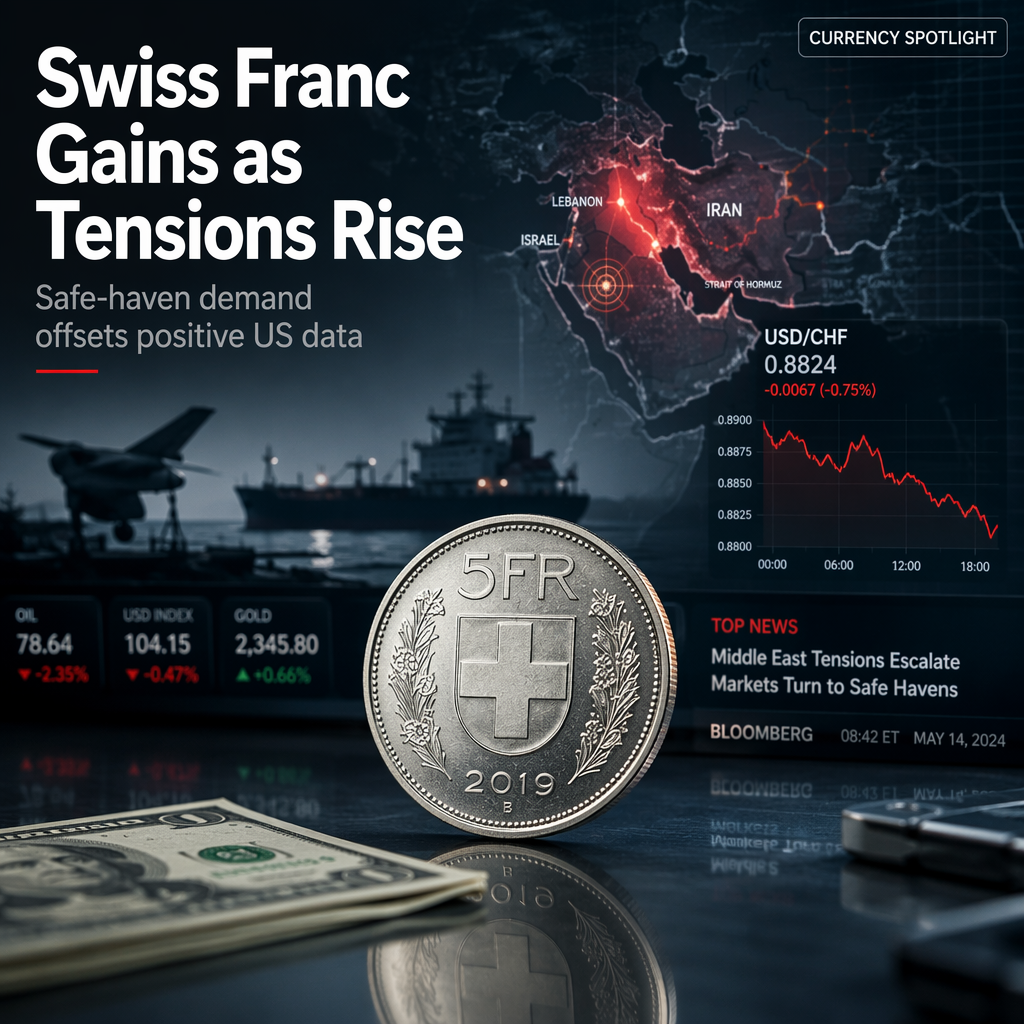
The Swiss Franc (CHF) maintained its gains against the US Dollar (USD) on Friday, with the USD/CHF pair trading around 0.8070, down 0.22% for the day. This movement was driven by increased safe-haven demand for the Swiss Franc amid escalating geopolitical tensions in the Middle East, which outweighed the impact of stronger-than-expected US consumer sentiment data [1].
The preliminary University of Michigan Consumer Sentiment Index for July rose to 54.4 from 49.5 in June, surpassing market expectations. The Current Conditions Index increased to 54.9 from 47.7, and the Expectations Index improved to 54 from 50.7, indicating growing confidence among US households. Inflation expectations were mixed, with the one-year outlook easing to 4.2% from 4.6%, while the five-year forecast remained steady at 3.3%. Despite these positive data points, the US Dollar Index (DXY) was only modestly supported, trading around 100.80 after a previous rebound [1].
The US Dollar continued to face pressure following softer-than-expected US Consumer Price Index (CPI) data and an unexpected decline in the Producer Price Index (PPI) earlier in the week. These developments led markets to rule out a near-term interest rate hike by the Federal Reserve, though opinions remain divided regarding a potential move in September [1].
Geopolitical risks intensified after reports that Iran instructed Yemen's Houthi rebels to prepare to close the Red Sea oil route if the US attacks Iranian infrastructure. Additional explosions were reported in Bandar Abbas, Qeshm, Ahvaz, Kuwait, and Basra. Iran's Islamic Revolutionary Guard Corps also warned of further retaliation against the US and countries hosting US military bases, sustaining demand for safe-haven assets like the Swiss Franc [1].
The Swiss National Bank (SNB) kept its policy rate unchanged at 0% during its June meeting, acknowledging increased near-term inflation risks due to geopolitical tensions. However, OCBC analysts noted that the SNB's willingness to intervene in the foreign exchange market and Switzerland's low interest rate environment could limit the Swiss Franc's upside, even as geopolitical risks persist [1].
On the day, the Swiss Franc was the strongest against the Australian Dollar among major currencies [1].
CONCLUSION
The Swiss Franc's gains against the US Dollar reflect heightened safe-haven demand amid escalating Middle East tensions, despite positive US economic data. While geopolitical risks support the CHF, analysts caution that the SNB's intervention policy and low rates may cap further appreciation. Market participants remain attentive to both geopolitical developments and central bank actions.