
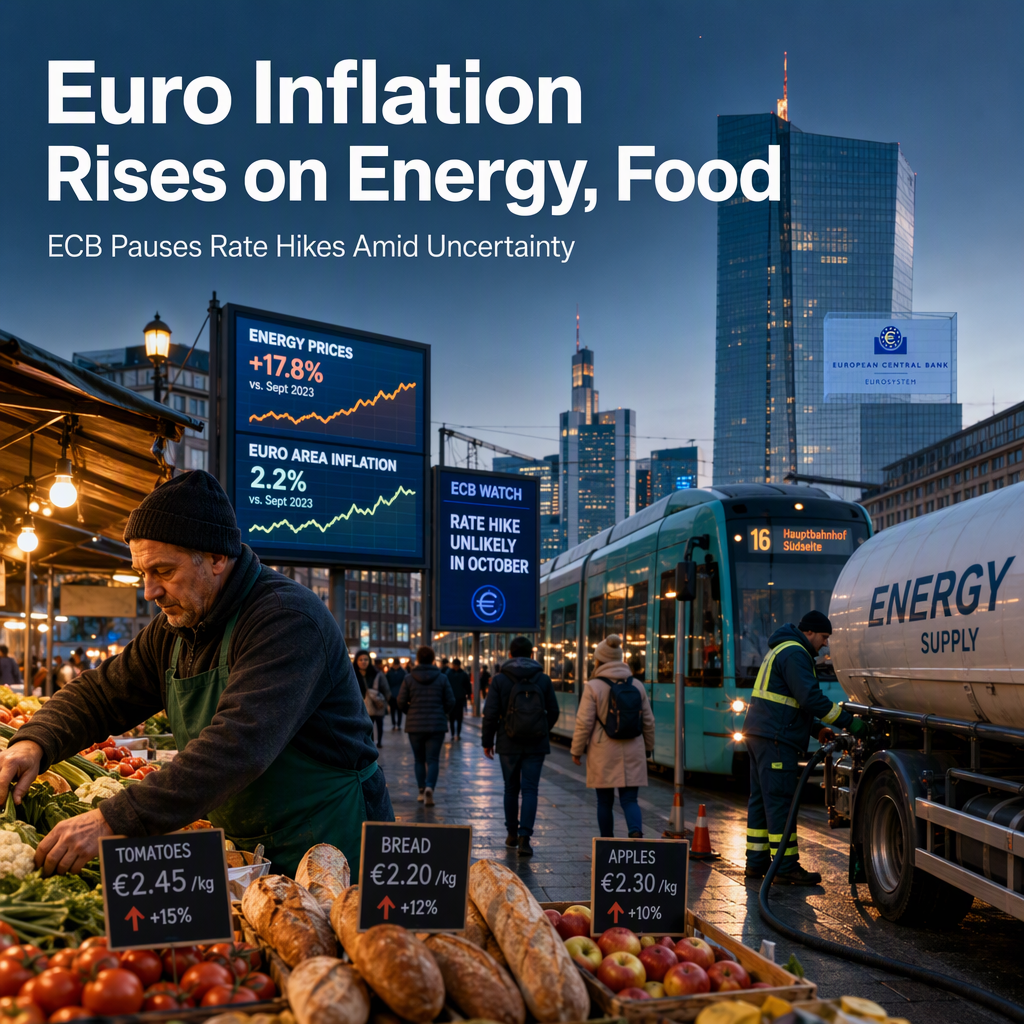
According to Nordea’s Global Macro team, Euro-area inflation accelerated in September, primarily driven by increases in energy and food prices [1]. Despite this uptick in headline inflation, core inflation remains relatively stable and broader price pressures are described as moderate [1]. The analysts highlight that predicting future energy price pressures is currently challenging due to significant uncertainty in the oil market. They cite ongoing geopolitical tensions in the Middle East as a source of risk, but also note that recent estimates of global oil production and improved traffic conditions in the Red Sea could lead to positive surprises in energy prices [1].
Nordea’s team does not expect the European Central Bank (ECB) to raise interest rates at the upcoming October policy meeting [1]. They maintain their forecast for potential rate hikes in December and March, but explicitly state that another hike in October is unlikely at this point [1].
No specific market reactions or analyst opinions beyond Nordea’s outlook are mentioned in the article. The report focuses on the drivers of inflation and the ECB’s likely cautious approach in the near term [1].
CONCLUSION
Euro-area inflation rose in September due to higher energy and food prices, but core inflation remains stable. Nordea does not anticipate an ECB rate hike in October, maintaining expectations for possible hikes in December and March. The outlook for energy prices remains highly uncertain, influencing the ECB’s cautious stance.