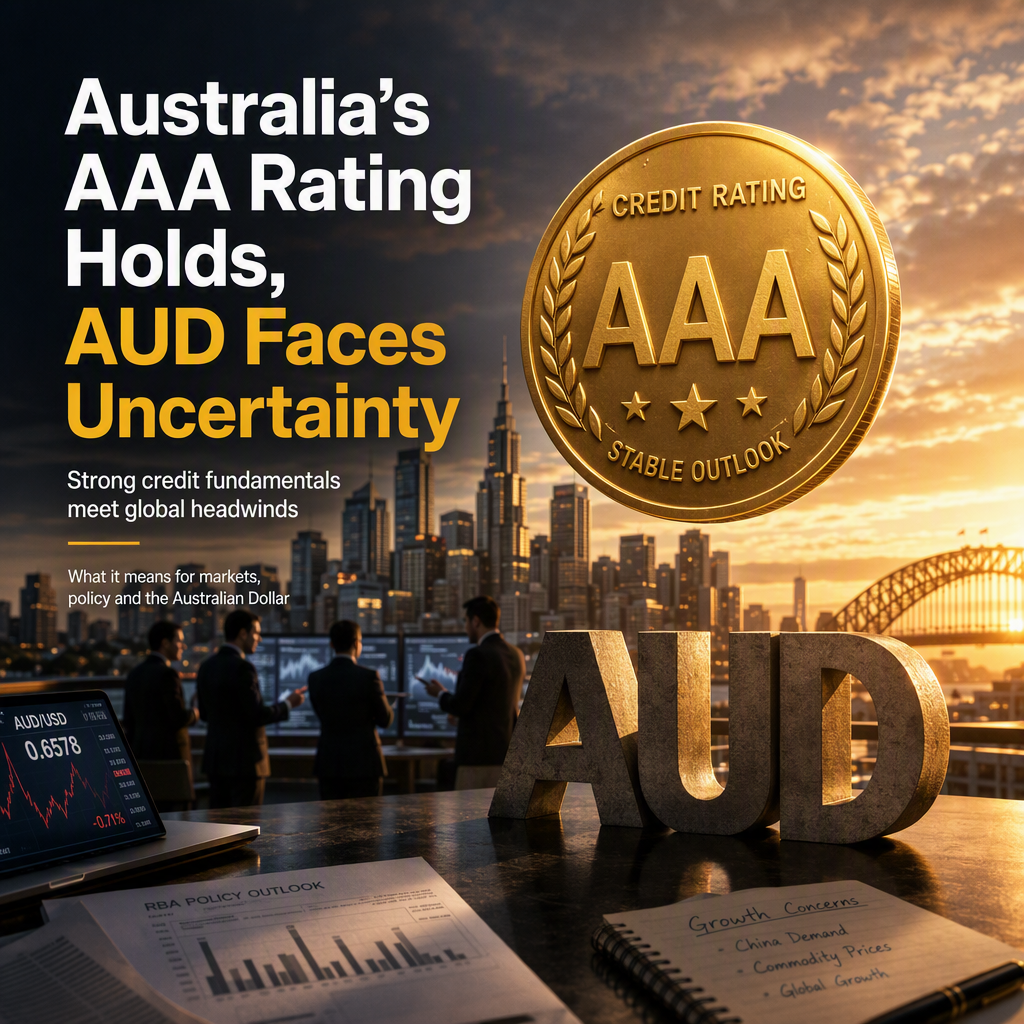
S&P has reaffirmed Australia's AAA credit rating with a stable outlook, citing the country's low public debt, robust institutions, and credible monetary policy as key strengths supporting its fiscal fundamentals [1]. The rating is underpinned by a projected general government deficit of 1.6% of GDP over the next two years and net debt expected to stabilize near 28% of GDP by fiscal 2029 [1]. Despite this positive credit assessment, the Australian Dollar (AUD) faces significant near-term headwinds. Economic growth is projected to slow to 1.5% in fiscal 2027, with weak productivity and persistent above-target inflation presenting ongoing risks for the domestic economy [1]. Notably, per capita GDP has declined in ten of the past fifteen quarters, highlighting underlying economic friction [1].
Market analysts from BNY and Rabobank offer differing perspectives on the AUD's trajectory. BNY emphasizes the structural support provided by the AAA rating but warns that higher interest rates are weighing on domestic demand and limiting the currency's appreciation potential [1]. Rabobank, meanwhile, points to the Reserve Bank of Australia's (RBA) upcoming August 11 meeting as a potential catalyst, suggesting that strong labor data could leave room for one final rate hike in November [1].
In terms of market implications, Rabobank has upgraded its 3-month AUD/USD forecast to 0.71 (from 0.70), maintaining a modest upside bias over the next 12 months, primarily driven by broader US Dollar weakness [1]. Jane Foley at Rabobank notes that AUD/USD has maintained a gentle upward trend since July, placing the currency in the middle of the G10 performance pack [1].
Overall, while the AAA rating provides a structural backstop for the AUD, ongoing domestic economic challenges and shifting central bank expectations continue to shape the currency's outlook [1].
CONCLUSION
Australia's AAA credit rating offers long-term support for the AUD, but persistent growth and inflation challenges temper the outlook. Market analysts see potential for modest appreciation, especially if the RBA pursues further tightening and the US Dollar remains soft. However, economic headwinds are likely to remain a drag in the near term.