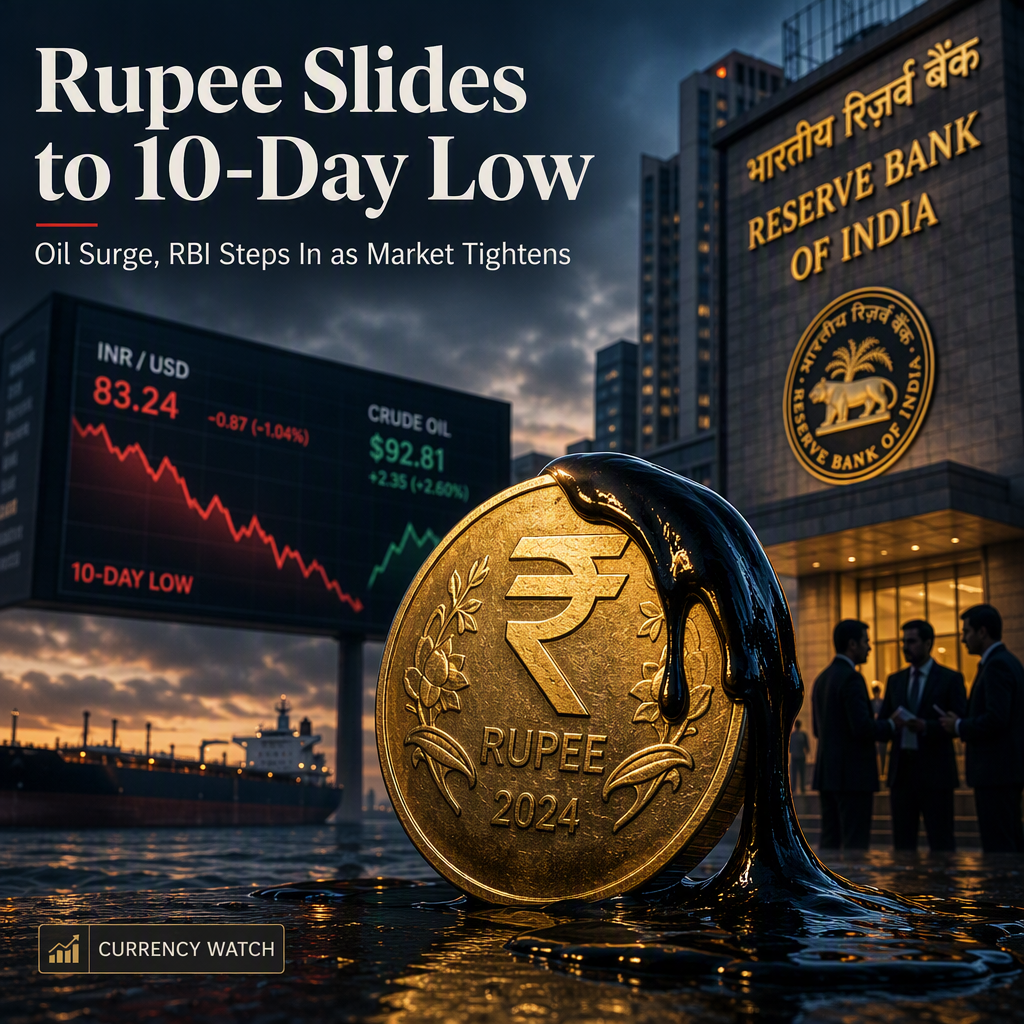
The Indian Rupee (INR) has extended its losing streak against the US Dollar (USD) for the third consecutive trading day, with the USD/INR pair reaching a fresh 10-day high at 95.31. This decline is attributed to a continued rally in oil prices, which are trading 0.5% higher in the opening session, nearing a three-month high of Rs. 9,189 for the MCX Crude Oil contract expiring September 21. Economies like India, which rely heavily on oil imports, are particularly vulnerable to currency depreciation in a high-oil-price environment [1].
TD Securities notes that crude prices are rallying due to persistent conflict risks, with no end in sight and a preference for limited attacks and economic squeeze over deal-making. The energy market remains tight, even as the market deficit in crude has eased somewhat, and the path of least resistance for crude oil prices remains upward, potentially reaching triple digits again [1].
To counter excessive volatility in the INR, the Reserve Bank of India (RBI) has been actively intervening in both spot and Non-Deliverable Forward (NDF) markets. Despite a forceful presence, RBI's support has only provided limited relief so far. However, strong foreign flows through the Foreign Currency Non-Resident (FCNR) (B) window have significantly bolstered the RBI's liquidity. Societe Generale’s EM strategists highlight that the RBI raised $136.38 billion through FX mobilisation schemes, including the FCNR(B) window launched in early June, materially strengthening its external buffers and intervention capacity. This sizeable build-up in reserves enhances the RBI’s ability to manage currency volatility and underpins a more constructive stance on the Rupee [1].
Looking ahead, global markets are awaiting the US Consumer Price Index (CPI) for August, set to be released on Friday. TD Securities expects underlying inflation to remain contained, with core CPI likely rising 0.19% month-on-month (2.3% year-on-year), driven mainly by the services segment [1].
CONCLUSION
The Indian Rupee continues to face downward pressure amid rising oil prices and persistent global conflict risks, despite active intervention and strengthened reserves by the RBI. Market sentiment remains negative, with high impact expected as traders await US inflation data for further direction. The RBI's enhanced intervention capacity may help stabilize the currency, but immediate relief has been limited.