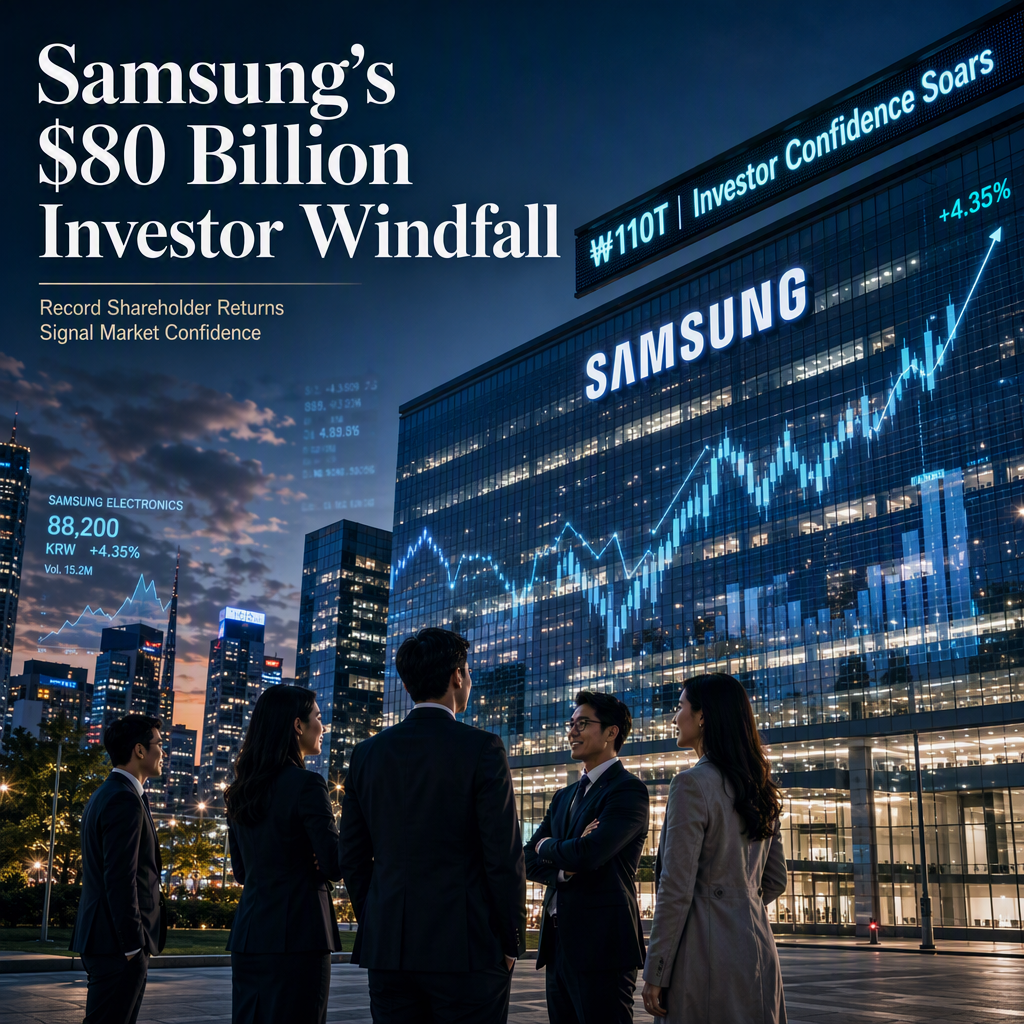
Samsung Electronics announced on Friday that it expects to allocate between 90 trillion won and 110 trillion won ($65.1 billion to $79.52 billion) for shareholder returns in 2026, which the company described as 'the largest ever by a Korean company' [1]. This announcement comes shortly after SK Hynix revealed a 40 trillion won share buyback plan, highlighting a significant week for shareholder returns among South Korea's leading semiconductor firms [1].
Samsung's shareholder return package includes a plan to pay approximately 30 trillion won in cash dividends in the third quarter of 2026, which encompasses its regular quarterly dividend. The specifics of this payout will be finalized at a board meeting scheduled for late October 2026 [1]. The company also stated that the size and details of the remaining shareholder returns will be determined at a board meeting in late January 2027, with options including a mix of cash dividends, share buybacks, and cancellations [1].
This initiative is part of Samsung's 2024-2026 shareholder return program, under which the company committed to returning 50% of free cash flow generated during this period while maintaining annual regular dividends of 9.8 trillion won [1]. In a corporate value enhancement plan released in March, Samsung reported paying 20.9 trillion won in cash dividends in 2024 and 2025 and spending 8.4 trillion won on share repurchases for cancellation [1].
The announcement comes as Samsung seeks to close the gap with domestic rival SK Hynix in the high-bandwidth memory chip market, which is crucial for AI systems. Samsung's stock has surged approximately 135% year-to-date, reflecting strong investor confidence and positive market sentiment following these shareholder-focused initiatives [1].
CONCLUSION
Samsung's record-breaking shareholder return plan signals a robust commitment to rewarding investors and maintaining competitiveness in the AI chip sector. The announcement, coupled with a significant stock rally, underscores strong market confidence in Samsung's strategic direction. Investors are likely to view these developments as highly positive for the company's future value.