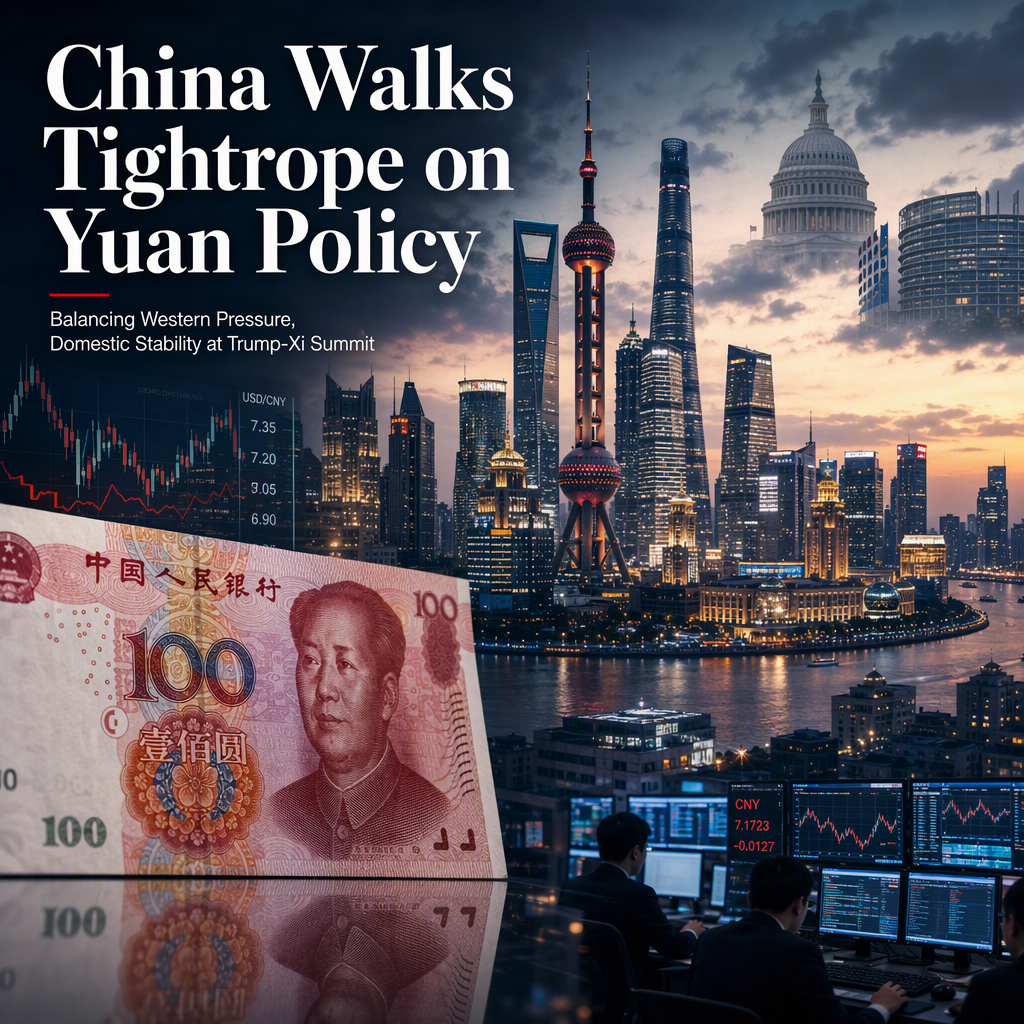
China is taking a cautious approach to yuan appreciation as US and European leaders demand a rebalancing of global trade during the Trump-Xi summit this week [1]. The Chinese currency is considered by some analysts to be undervalued by up to 30%, with Western policymakers arguing that a stronger yuan could help reduce China's significant trade surpluses with the US and Europe [1]. However, Chinese officials and financial experts warn that rapid appreciation could severely impact already thin factory profit margins and worsen unemployment in the manufacturing sector, especially as the economy faces deflationary pressures [1].
A Shanghai-based analyst noted that quickly boosting the yuan's value may not resolve deeper structural issues in production and consumption, and could actually exacerbate unemployment and put more pressure on exporters [1]. Technical analysis indicates the yuan is trading within a tight band, with resistance at 7.3 per dollar and support at 7.0. A breakout above resistance could trigger significant volatility, but most economists expect China to continue its gradual, 'slow-walk' approach to appreciation, balancing international demands with domestic economic stability [1].
The yuan's role in international finance is under increasing scrutiny as global bond yields diverge between China and the US. Recent developments include the debut of offshore government bond futures and rising yuan payments as a currency of last resort for countries such as Iran and Russia, highlighting China's efforts to promote the yuan internationally without risking domestic disruption [1].
Market sentiment remains mixed, with traders closely monitoring the Trump-Xi meeting for any signals of future currency policy. Technical indicators suggest continued range-bound trading for the yuan, with attention focused on macroeconomic signals and geopolitical developments. Traders are advised to watch for announcements following the summit, as any hint of policy shift could impact yuan trading levels and broader Asian market sentiment [1].
CONCLUSION
China is expected to maintain its gradual approach to yuan appreciation, balancing external demands with domestic economic concerns. Market participants are watching the Trump-Xi talks for any policy signals, but technical analysis points to continued range-bound trading. The yuan's international role is growing, yet significant volatility is unlikely unless a major policy shift occurs.