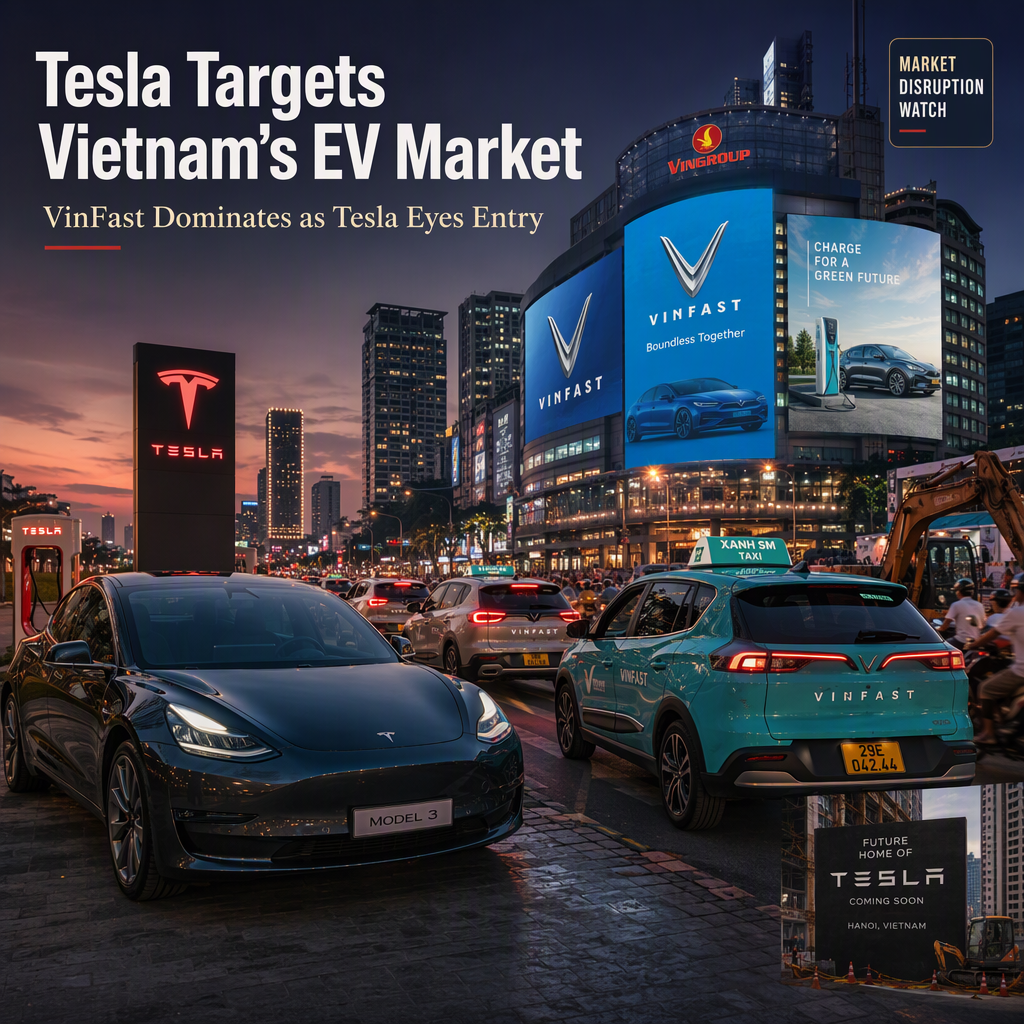
Tesla has registered a local entity, Tesla Motors Vietnam, signaling its intention to enter Vietnam's rapidly expanding electric vehicle (EV) market [1]. Vietnam became Southeast Asia's largest electric car market in 2025, with EVs accounting for nearly 40% of new car sales, according to International Energy Agency data released in May [1]. The market is currently dominated by VinFast, which holds a commanding 92% share of domestic EV sales, as reported by HSC research [1]. VinFast's dominance is supported by its parent company, Vingroup, one of Vietnam's largest private conglomerates founded by billionaire Pham Nhat Vuong. Vingroup reported revenue of 221.97 trillion dong ($8.52 billion) in the first half of 2026, according to reviewed financial statements [1].
VinFast's competitive advantages include strong local brand recognition, an extensive consumer ecosystem, and visibility through an affiliated electric taxi network. Its proprietary charging infrastructure, with over 150,000 charging ports restricted to VinFast vehicles, further strengthens its market position and has posed challenges for other entrants like BYD [1]. According to Koketso Tsoai, senior automobiles analyst at BMI (Fitch Solutions), VinFast's widespread charging and after-sales network reduces perceived ownership risk and makes it difficult for Tesla to compete [1].
Tesla faces significant hurdles in Vietnam, including the need to build distribution and service coverage and establish charging confidence among buyers who are highly sensitive to price and practicality. No details have been released regarding the timing of Tesla's market entry [1]. Analyst Supparoek Sawangwong of Mobility Global notes that Vietnam's EV infrastructure landscape is uniquely challenging compared to other Southeast Asian markets, such as Thailand and Indonesia, due to VinFast's entrenched position and the country's fast-expanding mobility ecosystem [1].
Despite these challenges, Vietnam's high EV awareness and adoption rates present a potentially attractive opportunity for Tesla. However, the presence of a 'national champion' in VinFast and its robust ecosystem means Tesla will need to overcome significant barriers to gain market share [1].
CONCLUSION
Tesla's registration of a local entity marks a strategic step toward entering Vietnam's booming EV market, but it faces formidable competition from VinFast, which dominates both sales and infrastructure. Market implications are medium, as Tesla's entry could disrupt the landscape, but its success will depend on overcoming VinFast's entrenched advantages and addressing local consumer needs.