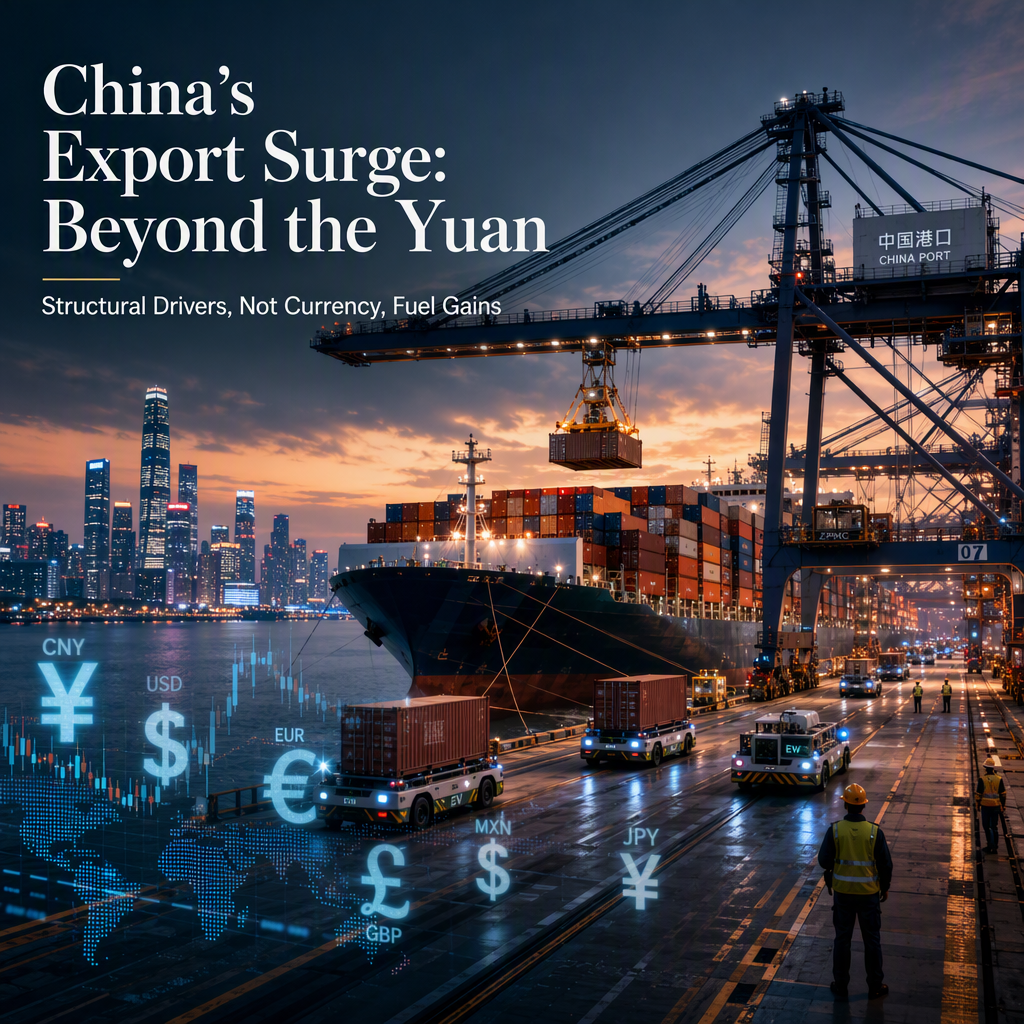
Commerzbank’s Michael Pfister has conducted an analysis to determine whether the depreciation of the Chinese yuan (CNY) is responsible for China's increasing export market share. The study, which examined bilateral real exchange rates across major trading partners, found no systematic link between movements in the CNY and gains in market share, including in advanced sectors such as electric cars [1].
Between 2019 and 2025, the CNY depreciated in real terms against several major currencies: by 33% against the Mexican peso, 30% against the British pound, 24% against the US dollar, and 22% against the euro. Conversely, the CNY appreciated by almost 20% against the Japanese yen during the same period [1]. Despite these significant currency movements, the analysis revealed that, on average across HS6 product categories, a stronger CNY was very slightly associated with an increase in market share, though this result was statistically insignificant. This suggests that the CNY’s value does not play a decisive role in explaining China’s export performance [1].
The report emphasizes that structural factors, rather than currency movements, are the dominant drivers behind China’s export strength. It cautions European policymakers that focusing solely on CNY appreciation is unlikely to reverse the Euro-area’s loss of export market share to China [1]. The analysis does not rule out the possibility that the CNY is undervalued, but concludes that changes in the real exchange rate do not account for recent shifts in market share [1].
CONCLUSION
Commerzbank’s analysis indicates that structural factors, not CNY depreciation, are primarily responsible for China’s export gains. Policymakers should look beyond currency movements when addressing market share losses, as CNY appreciation alone is unlikely to alter current trends.