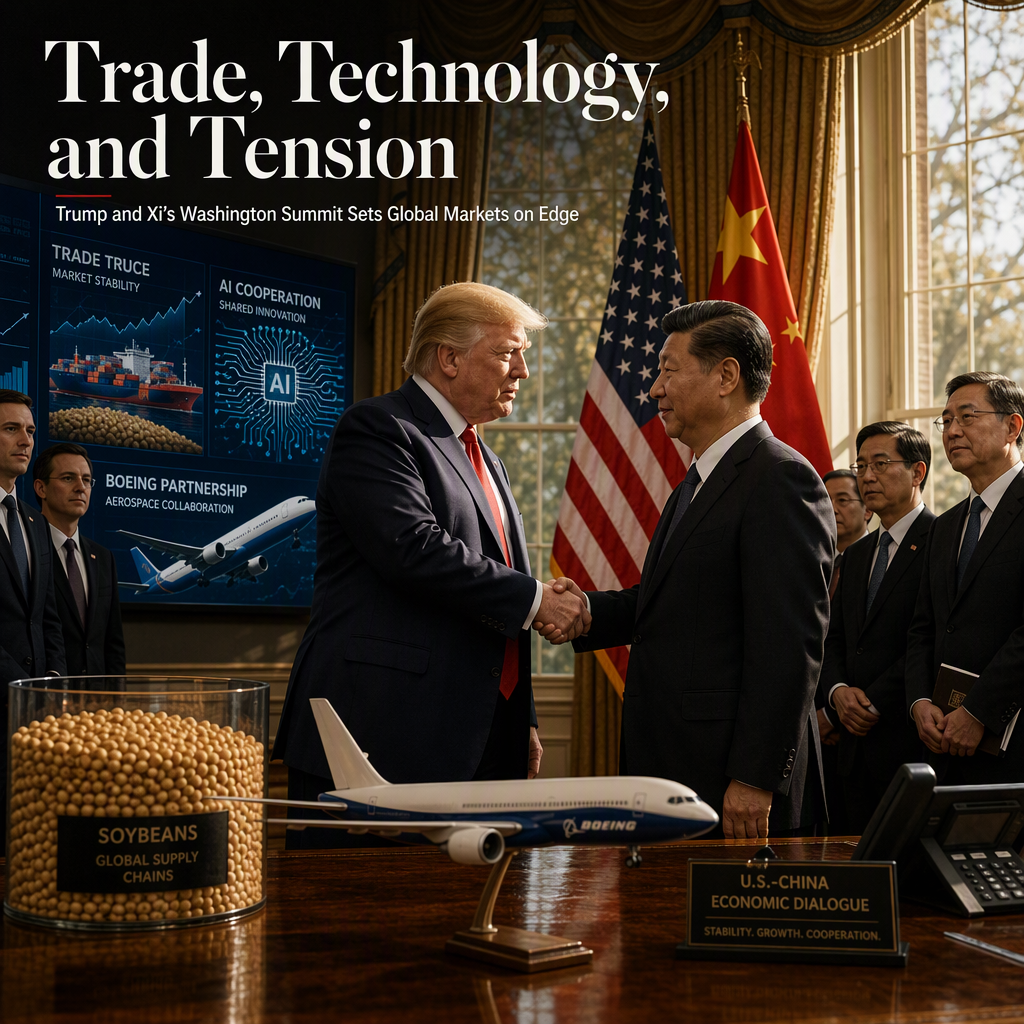
U.S. President Donald Trump is set to welcome Chinese President Xi Jinping in Washington this week for their second meeting of the year, marking Xi's first state visit to the U.S. since the Obama administration and his first during Trump's second term [1][2][3][4]. The summit is highly anticipated by both governments and markets, with key topics including the extension of the current U.S.-China trade truce, artificial intelligence (AI) safety, and bilateral economic cooperation [1][2][3][4].
The trade truce, which suspended rare earth export controls and retaliatory tariffs for a year, is scheduled to expire on November 10 [2][3][4]. Both sides are expected to discuss extending this agreement, though the duration remains uncertain [2][4]. At their previous summit in May, China agreed to increase purchases of U.S. agricultural products and Boeing jets, while both countries planned new trade and investment cooperation mechanisms [2]. Recent data shows China has completed nearly half of its annual commitment to purchase 25 million tons of American soybeans [2]. However, Boeing CEO Kelly Ortberg has tempered expectations for a large, single order from China, suggesting instead that incremental orders by individual carriers are more likely [2]. The U.S. is also seeking to narrow the trade deficit, which stood at approximately $91 billion through July [4].
On the technology front, AI safety is expected to be a central issue. Treasury Secretary Scott Bessent described his pre-summit meeting with Chinese Vice Premier He Lifeng as 'successful,' noting that both sides discussed establishing a 'U.S.-China AI Dialogue' and a notification mechanism for AI incidents that rise to a national security level [3]. Bessent emphasized the importance of transparency between the world's two leading AI powers [3]. The Trump administration has favored voluntary, national-security-focused safeguards for AI, while top AI executives have recently warned about the risks of unregulated AI development [3].
Market participants are closely watching the summit for any signs of a shift in diplomatic posture or new trade concessions, particularly regarding the extension of the tariff truce and potential aircraft purchases from Boeing (BA) [4]. The summit is seen as a pivotal moment for U.S.-China relations, with the potential to influence global markets depending on the outcomes related to trade, technology, and economic cooperation [2][3][4].
According to Zhou Bo, a senior fellow at Tsinghua University, the May summit marked 'a U-turn in China-U.S. relations,' recognizing Beijing as a peer power and establishing a foundation for 'constructive strategic stability' [2]. However, while optimism is higher in China, U.S. analysts remain cautious, with some suggesting that maintaining the status quo may be the best possible outcome for the U.S. [2].
CONCLUSION
The Trump-Xi summit in Washington is a critical event for global markets, with high expectations for progress on trade truce extension and AI cooperation. While both sides have made commitments in agriculture and technology, the ultimate impact will depend on the concrete outcomes of the summit. Investors are watching closely, as any developments could significantly affect trade relations and market sentiment.